Smart textiles bra to help detect cancer for women with intellectual disabilities
By Chris Birkle | Published on 13 November 2025
Categories: Press office; Research; School of Art & Design;
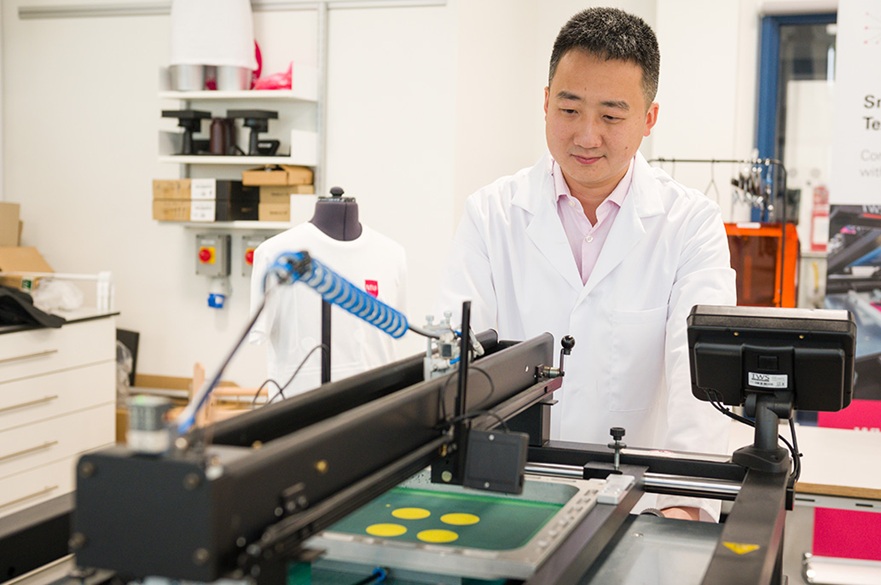
Smart textiles bra to help detect cancer for women with intellectual disabilities
Women with intellectual disabilities could receive added monitoring for breast cancer with the development of a smart textiles bra by researchers at Nottingham Trent University (NTU) and the University of Glasgow (UofG).
Funded by Cancer Research UK, a team of scientists and designers are developing an electronic textile which would fit inside a bra and monitor whether a tumour is growing in real time, before alerting clinicians to potential risks.
Although women with intellectual disabilities have a lower incidence of breast cancer, they face significantly higher mortality rates due to barriers in accessing current screening methods.
The research is being developed at NTU’s Medical Technologies Innovation Facility (MTIF) and the Scottish Learning Disabilities Observatory (SLDO) at UofG, with an investment of around £100,000 from Cancer Research UK.
The technology uses a form of electrical current that can scan to spot subtle differences in body tissues. Because tumours tend to be denser and hold less water than healthy areas, the device can help differentiate them.
The technology has the potential to detect growths as little as 5mm – enabling earlier detection and triggering other scans to be taken, such as MRI.
The device would record data and provide feedback via smartphone to the wearer, carers and clinicians so that assessments can be made.
It will be co-designed with input from women with intellectual disabilities, carers, and healthcare professionals to ensure usability and effectiveness.
The research team says there’s potential for the technology to be developed as part of a new bra altogether, as well as an insert.
Cancer Research UK figures show, there are 56,900 new cases of breast cancer in the UK every year, with around 11,200 breast cancer deaths.
The research is led by Professor Yang Wei of the Nottingham School of Art & Design (NSA&D) and Professor Deborah Cairns, Director of SLDO (UofG). The team includes co-investigators Professor Katherine Townsend, of the NSA&D and Professor John Hunt of MTIF; Researchers Shadrack Aboagye of the NSA&D; and Dr Lauren Fulton (SLDO).
Professor Wei said: “Breast cancer can develop over time, and while some types grow quickly, others may progress slowly, making early detection critical for improving survival outcomes.
“This technology has the potential to save women’s lives by detecting tumours early, while being used as an added measure alongside all other normal checks and scans.
“As MRI scans can be months apart, patients could be given better peace of mind by knowing that any growth between monitoring appointments would be picked up.
“We hope in the future that this technology could reduce the need for many other checks, such as MRI, ultrasound and mammograms, and in doing so create efficiencies for health services.”
Research Information Manager at Cancer Research UK, Dr Dani Skirrow, said: “Over the past 50 years, our work has helped to nearly double breast cancer survival in the UK. We’re committed to making sure everyone shares in this progress equally, regardless of who they are, where they’re from or what type of cancer they have.
“The ‘Smart Bra’ has the potential to make breast cancer screening more accessible so that more people can benefit from it. This would help us to detect more breast cancers at the earliest stage, when treatments are most likely to work.
“We’re supporting our scientists to develop innovative technologies like the ‘Smart Bra’ to make sure the benefits of research are shared by everyone.”
Notes for Editors
Press enquiries please contact Chris Birkle, Public Relations Manager, on telephone +44 (0)115 848 2310, or via email.
Nottingham Trent University (NTU) has been named UK ‘University of the Year’ five times in six years, (Times Higher Education Awards 2017, The Guardian University Awards 2019, The Times and Sunday Times 2018 and 2023, Whatuni Student Choice Awards 2023) and is consistently one of the top performing modern universities in the UK.
It is the 3rd best modern university in the UK (The Times and Sunday Times Good University Guide 2023). Students have voted NTU 1st in the UK for student employability (Uni Compare 2025).
NTU is the 5th largest UK institution by student numbers, with over 40,000 students and more than 4,400 staff located across six campuses. It has an international student population of almost 7,000 and an NTU community representing over 160 countries.
NTU owns two Queen’s Anniversary Prizes for outstanding achievements in research (2015, 2021). The first recognises NTU’s research on the safety and security of global citizens. The second was awarded for research in science, engineering, arts and humanities to investigate and restore cultural objects, buildings and heritage. The Research Excellence Framework (2021) classed 83% of NTU’s research activity as either world-leading or internationally excellent.
NTU was awarded GOLD in the national 2023 Teaching Excellence Framework (TEF) assessment, as it was in 2019. NTU is a top 10 for sport (British Universities and Colleges Sport league table 2023). NTU is the most environmentally sustainable university in the UK and second in the world (UI Green Metric University World Rankings, 2023).