Ultra-fast light-shaping technology could be ‘game-changer’ for future imaging
Scientists have developed a new type of ‘virtual’ metasurface – capable of controlling light in ways traditional lenses and optics can’t – which they say is superior to the current approach which relies on ultra-thin engineered materials.
By Dave Rogers | Published on 25 June 2026
Categories: Press office; Research; School of Science and Technology;

The Nottingham Trent University team says the work will help to fully optimise metasurface potential for a range of real-world applications and paves the way to a move from physical to virtual platforms in nanotechnology.
Metasurfaces are many times thinner than a human hair and can bend and focus light, change its colour and steer it in different directions, meaning they can replace bulky optical elements in small devices such as lenses, mirrors and filters.
While they are powerful however, the materials and dimensions of physical metasurfaces are fixed — once built, they can’t change their shape, which can limit how useful they are in real‑world technologies.
Now a team at Nottingham Trent University has led a study – published in the journal Advanced Photonics Nexus– demonstrating the potential for virtual metasurfaces, which use emulated two-dimensional optical patterns on a flat surface rather than tiny physical particles.
The process uses a device called a spatial light modulator, which can control light pixel by pixel to change its shape and function faster than the blink of an eye.
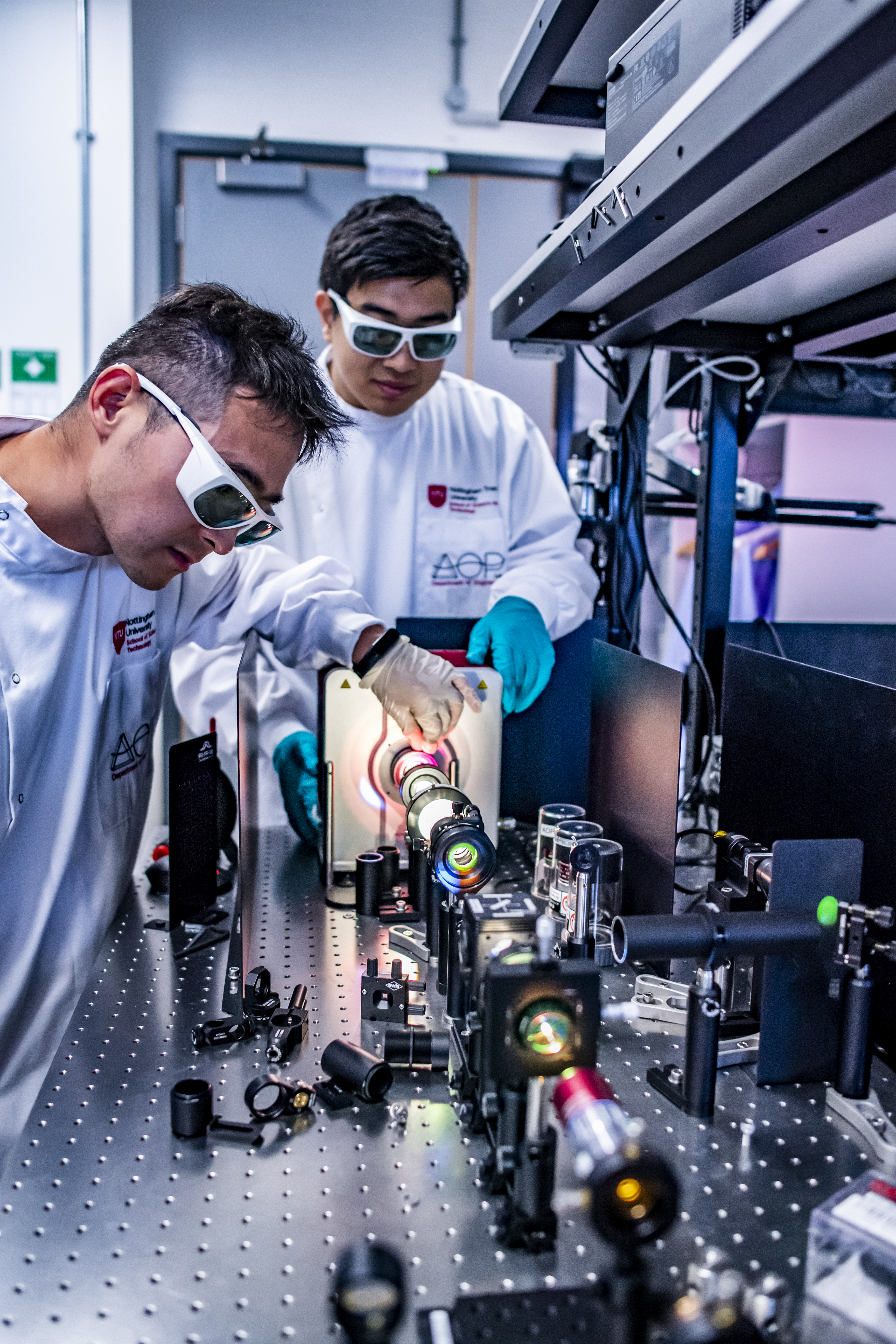
Associate Professor Lei Xu (L) and Research Fellow Dr Ze Zheng (R)
Because the patterns are programmable and can change instantly, the metasurface can perform many different functions within the same device. This could include mixing colours, turning invisible infrared images into visible, or acting like a lens to adjust focus.
The researchers argue that making the material ‘tuneable’ by using such synthesised metasurfaces is what is required to move metasurfaces out of laboratories and onto production lines into new technologies.
While the approach requires additional research and development, the team says that the approach could benefit a range of technologies, spanning imaging and microscopy, quantum photonics, sensing, beam steering, semiconductor manufacturing, telecommunications and holography.
In the new study, the researchers demonstrate the technology’s potential by using the approach to turn invisible infrared signals into visible pictures and adjusting the images’ focal lengths on demand. Conventional lenses and mirrors are unable to perform these two functions concurrently.
Working with researchers at the University of Brescia in Italy and Nankai University in China they were also able to generate the image at arbitrary focal lengths.
Traditional infrared cameras rely on expensive semiconductor sensors and separate optics but a programmable light pattern meant it was possible to convert infrared light into visible wavelengths that a standard camera could capture.
“Over the last decade or so, metasurfaces have been introduced as an alternative to larger optical elements and have been the backbone of the photonics revolution of the 21st Century,” said Mohsen Rahmani, Professor in Nanotechnology, Optics and Photonics in Nottingham Trent University’s School of Science and Technology.
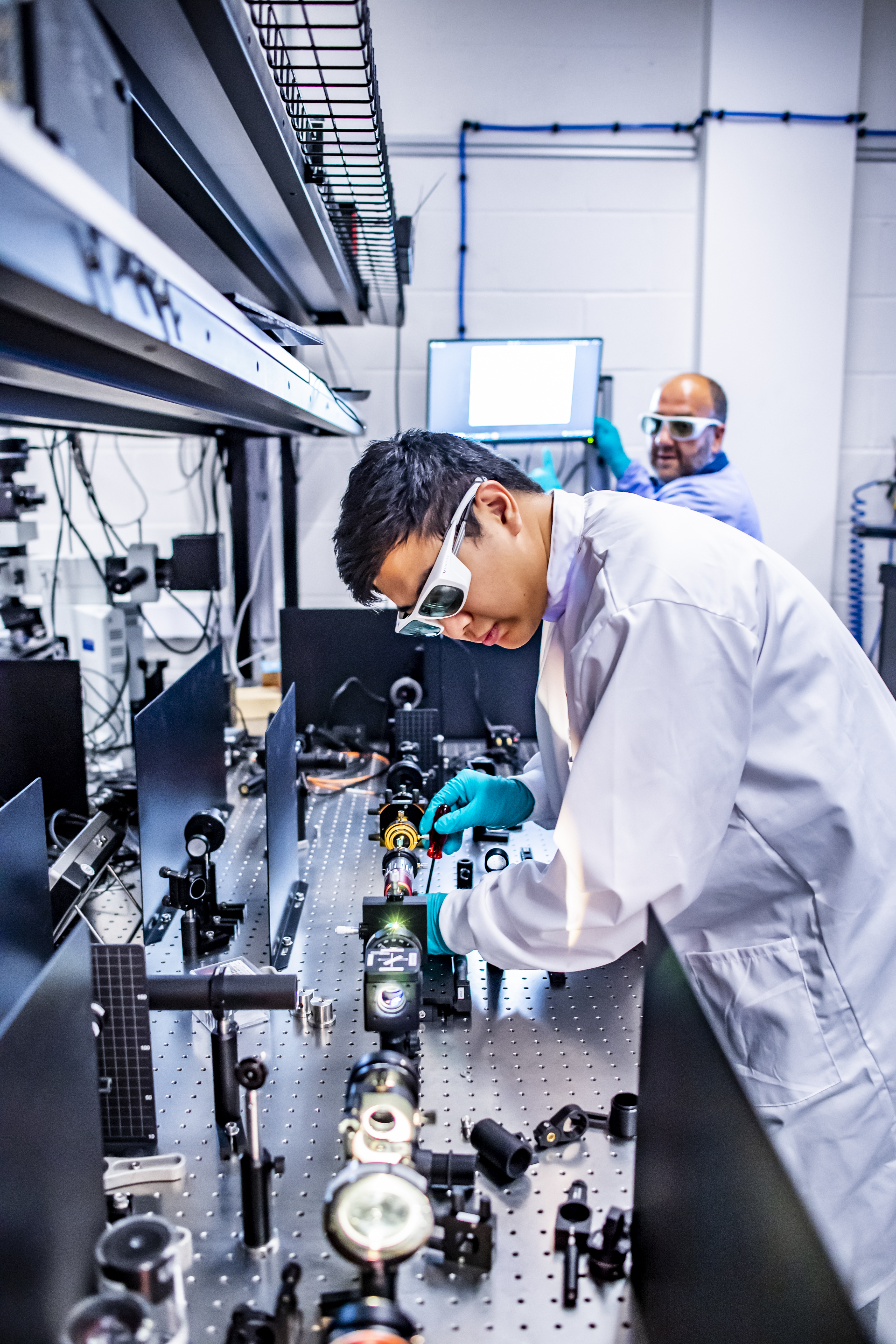
Research Fellow Dr Ze Zheng and Mohsen Rahmani, Professor in Nanotechnology, Optics and Photonics
He said: “Despite this, their tunability has been significantly limited, creating a bottleneck in laboratories and restricting their full potential. This new category of emulated, virtual metasurfaces can be the game-changer. Perhaps the best analogy is the transition from universe to metaverse – the 3D digital world where lifelike spaces exist but are not real.
“Our virtual metasurfaces can be dynamically reshaped in every 20 milliseconds, offering a completely distinct function, each time, within small gadgets and devices.”
Nottingham Trent University Associate Professor Lei Xu said: “Our virtual metasurfaces act like an imaginary toolbox containing every optical component. Employing AI to program virtual metasurfaces enables us to offer multimodal functions and enormous potential for real-life applications.”
Nottingham Trent University Research Fellow Dr Ze Zheng, the first author of this study, added: “Replacing physical metasurfaces with virtual metasurfaces can be viewed as a transition from analogue optical components towards more flexible digital platforms. This approach enables compact optical systems with enhanced programmability, multifunctionality, and reduced fabrication constraints, offering a promising route towards next-generation microscopes, cameras and imaging devices.”
The team, based in NTU's Advanced Optics and Photonics (AOP) Laboratories, were supported by the UK Research and Innovation Future Leaders Fellowship and the European Research Council Consolidator Grant.
Notes for Editors
Press enquiries please contact Dave Rogers, Public Relations Manager, on telephone +44 (0)115 848 8782, or via email.
About Nottingham Trent University
Nottingham Trent University (NTU) has been named UK ‘University of the Year’ five times in six years, (Times Higher Education Awards 2017, The Guardian University Awards 2019, The Times and Sunday Times 2018 and 2023, Whatuni Student Choice Awards 2023) and is consistently one of the top performing modern universities in the UK.
Students have voted us first in the UK for course quality, top five in the UK for employability and third best University in the UK (Uni Compare 2027). We are ranked in the top 25 universities in the country (The Guardian University Guide 2026).
We have over 35,000 students and more than 4,000 staff located across five campuses. It has an international student population of over 5,000 and an NTU community representing over 160 countries.
NTU owns two Queen’s Anniversary Prizes for outstanding achievements in research (2015, 2021). The Research Excellence Framework (2021) classed 83% of NTU’s research activity as either world-leading or internationally excellent.
NTU was awarded GOLD in the national 2023 Teaching Excellence Framework (TEF) assessment.
NTU is a top 10 for sport (British Universities and Colleges Sport league table 2025) and was named as Sports University of the Year (Daily Mail University Guide 2025).
NTU is a holder of the University Mental Health Charter, recognising the commitment an institution has shown towards continuous improvement in the area of mental health and wellbeing.
NTU is the most environmentally sustainable university in the UK and third in the world (UI Green Metric University World Rankings, 2025).