Glowing liquids could offer new way to protect products from counterfeiters
Scientists have developed a new type of glowing liquid that could help create harder-to-copy security markings for products, documents and other valuable items.
By Dave Rogers | Published on 16 October 2026
Categories: Press office; Research; School of Science and Technology;
Researchers at Nottingham Trent University developed room-temperature liquids containing chemical elements that produce distinctive patterns of light.
They say the materials could provide a flexible new approach to optical tagging and anti-counterfeiting, while being compatible with existing processing and printing technologies.
The materials are a type of ionic liquid – salts that remain liquid at relatively low temperatures – combined with ‘lanthanide’ elements.
Lanthanides are a group of 15 metallic elements and several of which have distinctive light-emitting properties. When exposed to ultraviolet light, each produces its own characteristic pattern of wavelengths, giving the material a unique optical fingerprint.
The team developed four different glowing liquids – which can be easily mixed together – each containing one of the lanthanide elements.
Rather than having to develop and manufacture a completely new material for every security code, it would be possible to combine the different glowing liquids in different proportions.
As part of the study, the researchers demonstrated mixtures containing two different lanthanides, as well as more complex combinations containing three or four.
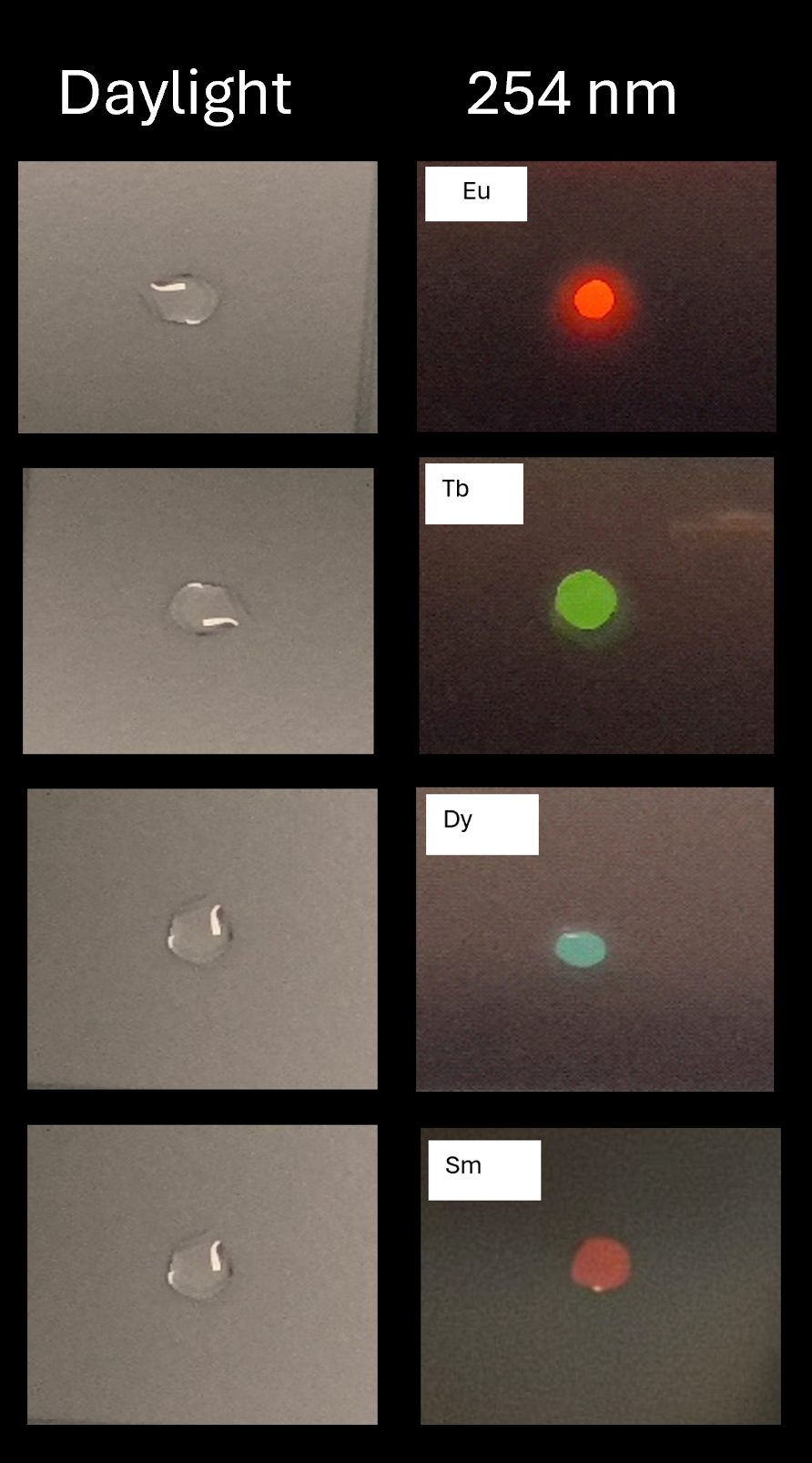
The liquids as seen under daylight and UV illumination (Image: Annie Prasad)
The mixtures produced increasingly complex light signatures, while retaining the characteristic emissions of the individual components.
This means that a relatively small number of basic materials can be combined to create a much larger range of optical signatures without requiring additional chemical synthesis.
Many security systems today rely on features that can be difficult to reproduce, such as specialised inks, holograms or other optical effects.
The researchers wanted to explore whether materials with complex light signatures could provide an additional layer of security.
A security marking made with one of the liquids could look ordinary under normal conditions but reveal a distinctive pattern when examined under ultraviolet light.
The team demonstrated the materials on paper, showing that different lanthanide liquids and mixtures produced different optical responses under ultraviolet light at different wavelengths.
The initial work has demonstrated the potential of the materials, although further research would be required to fully establish how they might perform in real-world applications.
“This could have potential applications in optical tagging and secure identification, including anti-counterfeiting technologies,” said senior author Dr Anthony Fitzpatrick, a researcher in Nottingham Trent University’s School of Science and Technology.
He said: “The materials could potentially be incorporated into printed security features or other systems where a distinctive optical response is used to verify that an item is genuine.
“Creating a more complex security signature does not require creating more complicated materials. Instead, different luminescent liquids can be combined to produce new signatures.
“That could make the approach easier to adapt for different applications, potentially allowing manufacturers to create tailored optical tags or identification systems without having to synthesise a new material for every application.”
Nottingham Trent University PhD student Annie Prasad added: “A key feature is that the new materials remain liquid at room temperature, making them easier to mix and formulate than materials that need to be processed as solid compounds. In addition to this, their properties could make them suitable for processing and printing technologies already used to produce security markings.”
The study, which also involved the University of Liverpool and the University of Manchester, is published in the Royal Society of Chemistry journal RSC Advances.
Notes for Editors
Press enquiries please contact Dave Rogers, Public Relations Manager, on telephone +44 (0)115 848 8782, or via email.
About Nottingham Trent University
Nottingham Trent University (NTU) has been named UK ‘University of the Year’ five times in six years, (Times Higher Education Awards 2017, The Guardian University Awards 2019, The Times and Sunday Times 2018 and 2023, Whatuni Student Choice Awards 2023) and is consistently one of the top performing modern universities in the UK.
Students have voted us first in the UK for course quality, top five in the UK for employability and third best University in the UK (Uni Compare 2027). We are ranked in the top 25 universities in the country (The Guardian University Guide 2026).
We have over 35,000 students and more than 4,000 staff located across five campuses. It has an international student population of over 5,000 and an NTU community representing over 160 countries.
NTU owns two Queen’s Anniversary Prizes for outstanding achievements in research (2015, 2021). The Research Excellence Framework (2021) classed 83% of NTU’s research activity as either world-leading or internationally excellent.
NTU was awarded GOLD in the national 2023 Teaching Excellence Framework (TEF) assessment.
NTU is a top 10 for sport (British Universities and Colleges Sport league table 2025) and was named as Sports University of the Year (Daily Mail University Guide 2025).
NTU is a holder of the University Mental Health Charter, recognising the commitment an institution has shown towards continuous improvement in the area of mental health and wellbeing.
NTU is the most environmentally sustainable university in the UK and third in the world (UI Green Metric University World Rankings, 2025).