Nottingham and Lace – a journey through changing technologies
By Professor Amanda Briggs-Goode and Dr Gail Baxter | Published on 12 October 2026
Categories: Press office; Research; School of Art & Design;
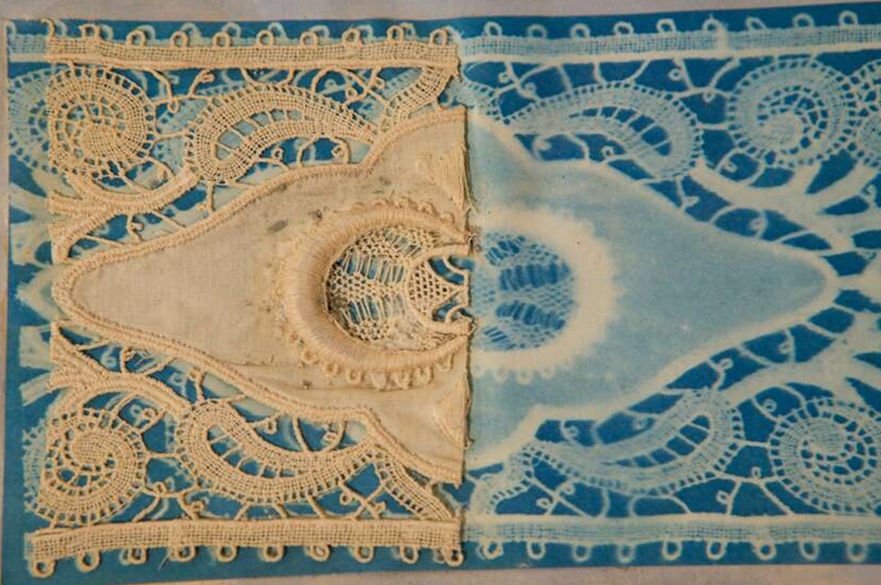
Hand-made bobbin lace was a cottage industry. Highly skilled, but badly paid, predominantly female workers, manipulated threads to create the lace that was a status symbol worn by the rich and nobility. The primary UK centres of manufacture were Buckinghamshire and surrounding counties (the old East Midlands), and the Honiton region of South Devon.
The Nottingham area was famous as the home of the Stocking Frame knitting machine, one of the earliest iterations of the Industrial Revolution, being invented in the 16th century in a village on the outskirts of Nottingham by the Rev William Lee[1]. It was the stocking frame which became the focus of the Luddites in the early 19th century as the technology matured, demand for men’s hosiery reduced, wages dropped. Some knitting machines were adapted to make hexagonal net in imitation of the nets of hand-made lace, particularly the fashionable Buckinghamshire Point and Mechlin laces. These nets were hand embroidered to turn them into lace that looked like hand-made lace but was quicker and cheaper to produce. The NTU Lace Archive holds hundreds of examples of hand embroidery on machine knitted silk net made in the late 1700s. Unfortunately, the net was not very stable and was liable to unravel if snagged.
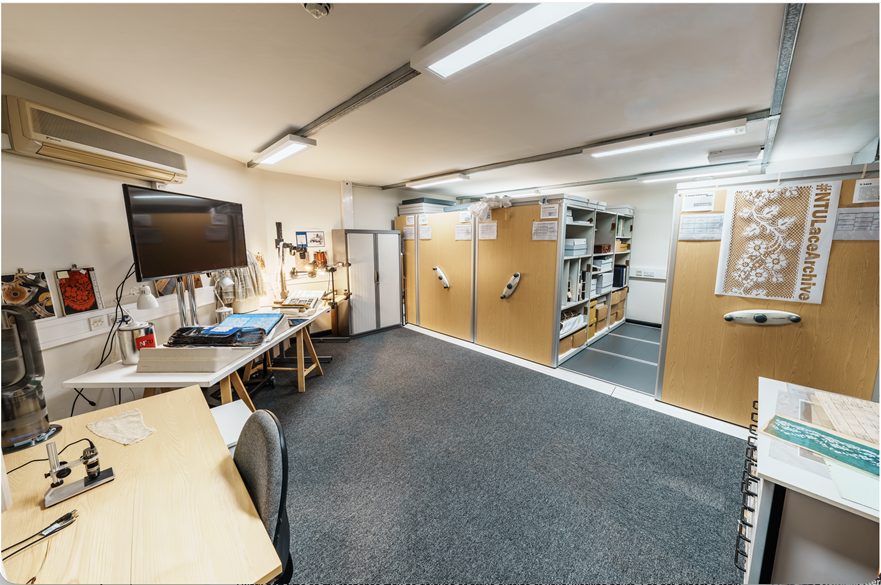
Inside the Lace Archive at NTU
The Loughborough mechanic and inventor, John Heathcoat, had watched his sister-in-law, originally from the lacemaking area of Northamptonshire, making bobbin lace[2]. He learned from her how the hexagonal net was made by crossing and twisting threads around one another, which didn’t unravel if snagged. In 1808 Heathcoat patented a Twist-net (also known as the Bobbin-net) machine and Nottingham Lace was born. Initially the net was embroidered by hand to make it into lace. However, new, improved, versions of the machine soon followed, most notably in 1816 the Leavers machine, and in 1837 the Jacquard mechanism was added, enabling the pattern to be made by the machine[3]. The machines grew larger, and more sophisticated, as they progressed from hand powered to steam driven, and later being electrified. Eventually even the punch-cards of the Jacquard mechanism were replaced with computer-controlled systems.
The Victorians loved machine made lace, seeing it as an exciting new product of the Industrial Revolution. It also brough a once exclusive fabric within the economic reach of the masses. As hand-made lacemakers tried to compete with the machines there was a catastrophic decline in the quality of their product which resulted in an almost complete loss of market.
Although it was made in a wide area around the county (including Derbyshire and Leicestershire) the machine-made lace was called Nottingham lace because that was where the main wholesale trade was based. Nottingham lace machines and the lace that they made were exported around the world. A large Leavers dress-lace machine can be 11 meters long, weighing 17 tons and making a web of lace over 4 meters wide. Plain net and curtain machines are larger still.
The industry was so successful that by the 20th century most people couldn’t tell the difference between hand and machine-made lace. At its height, in the early 20th century, the Nottingham lace industry employed around 60,000 people[4]. Beyond those employed directly in lace factory manufacturing there were many ancillary trades; designing, drafting, Jacquard card punching. Finishing trades included; bleaching, dyeing, scalloping and Jennying.
An example from the Lace Archive
The industry went into a slow decline after WWI due to a combination of factors including the changing role of women, changes in fashion and compulsory education for young people. During WWII it was badly hit by shortages of labour and thread, which accelerated the rate of factory closures.
New, faster, quieter, cleaner machines began to replace the traditional Nottingham machines. These used the warp-knitting process rather than the twisting of Nottingham machines. They soon proved to be more capable of working with modern threads such as synthetics, stretch, Lurex varieties. These machines were widely taken up in newly developing manufacturing countries and their production soon outstripped that of Europe.
The Nottingham industry contracted gradually, few noticed the loss of a manufacturer here or a dye-house there, until they were almost all gone. The industry is now a shadow of its former self with only three Nottingham Lace manufacturers remaining. Heathcoat’s, who still make plain net Tiverton Devon, and where John Heathcoat established his second factory after his first, in Loughborough, was attacked by Luddites, Cluny Lace who make dress laces in Ilkeston Derbyshire and Morton, Young and Borland (MYB) make curtain laces in Newmilns, Scotland.
The Nottingham Government School of Art and Design, the forerunner of Nottingham Trent University, was established in 1843 primarily to serve the local industry. Sadly, lace design is no longer taught at NTU. However, the Lace Archive is a major resource for inspiring students across a wide range of courses and frequently supports external researchers. The archive contains thousands of samples of lace, both hand and machine made, design books, period journals and photographs of historic examples of handmade lace. The Unarchived[5] cabinet, in Bonington Foyer, showcases changing displays of material from the Lace Archive and, another of the schools archives, FashionMap.
[1] Lowe, D. and Richards, J. 1989. William Lee and Lace. Nottingham: Nottingham Lace Centre.
[2] Sutton, J. F. 1852. The Date-Book of Remarkable and Memorable Events connected with Nottingham and its neighbourhood 1750-1850. London: Simpkin & Marshall.
[3] Earnshaw, P. 1986. Lace Machines and Machine Laces. London: B. T. Batsford Ltd.
[4] Mason, S. 2013. The Machine Made Lace Industry of Nottingham. In A. Briggs-Goode & D. Dean (Eds.) Lace:Here:Now. Black Dog Publishing.
[5] https://www.ntu.ac.uk/about-us/ntu-arts/unarchived