Space junk: what is it, why is it dangerous and can we clean it up?
Millions of pieces of space debris are orbiting Earth at enormous speeds, threatening satellites and future space missions. Space physics expert Dr Ian Whittaker explains how the problem has grown, the dangers it poses and whether we can find ways to clean up our increasingly crowded orbit.
By Dr Ian Whittaker | Published on 22 October 2026
Categories: Press office; Research; School of Science and Technology;
What you need to know
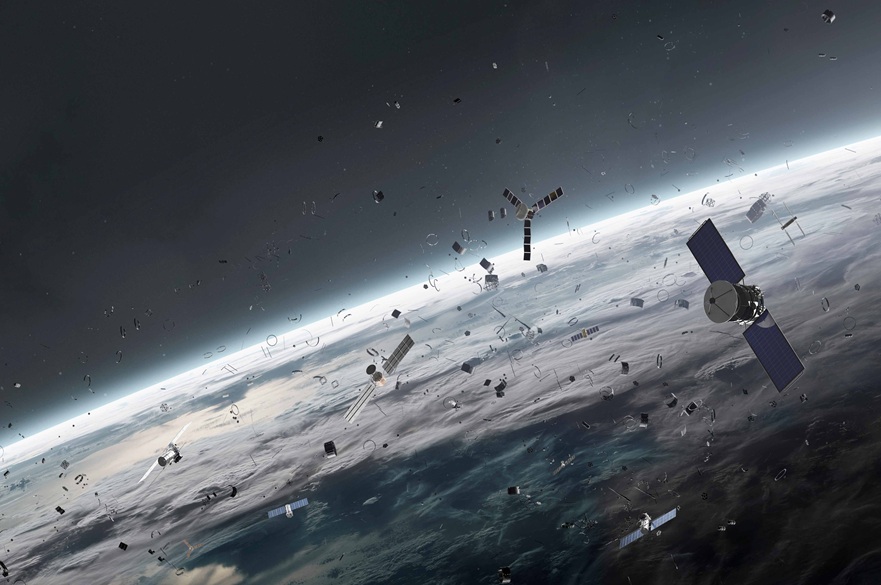
Space debris includes old satellites, discarded rocket parts and fragments from collisions that remain in orbit around Earth.
Millions of pieces of debris are orbiting Earth, travelling at speeds that can cause serious damage to satellites.
Debris can take decades or even hundreds of years to return to Earth, depending on its altitude.
Collisions create more debris, increasing the risk of further impacts – a chain reaction known as the Kessler syndrome.
Scientists are exploring ways to remove debris, including lasers, nets and robotic arms, as well as recycling old materials to make new satellite parts.
Humans have been sending objects into orbit around Earth for almost 70 years. But many of these objects are still up there long after they have stopped working.
As the number of satellites grows, so does the amount of debris in space – and the risk of collisions.
What is space debris?
Since the launch of Sputnik in 1957, humans have been sending rockets, satellites and other objects into orbit around Earth.
According to the European Space Agency’s Space Environment Report, more than 300 launches delivered 4,000 payloads into orbit during 2025. That is almost one rocket launch a day.
The problem is that getting objects into space is much easier than bringing them back down.
Once an object reaches orbit, there is very little to slow it down. Earth’s gravity pulls it inwards, but its forward movement keeps it travelling around the planet rather than falling straight back to the ground.
To bring an object back to Earth, its orbital movement needs to slow down. This happens through atmospheric drag – the resistance created as an object moves through the atmosphere.
The higher an object travels, the thinner the atmosphere becomes and the weaker this drag is. At altitudes of 200–300km, an object may take a few years to return to Earth. At 500–700km, where many satellites and the International Space Station operate, this can take around 20 years depending on solar conditions. At higher altitudes, objects can remain in orbit for hundreds of years.
This means that old satellites and other discarded objects can remain in space long after their useful lives have ended.
Is space debris just made up of old satellites?
Old satellites are only part of the problem. Two other factors make space debris a growing concern.
The first is the increasing use of smaller satellites. Rather than launching one large satellite, private companies are increasingly choosing to send many smaller ones into orbit. These small satellites, including CubeSats, can be deployed in groups of hundreds, adding to the number of objects sharing space around Earth.
The second problem is that satellites can break apart.
Damage from tiny space particles, collisions and the effects of the solar wind can cause pieces to break off a satellite. Even something as small as a loose screw can become a piece of space debris.
Imagine a minor car accident in which a car clips a traffic bollard. The car remains largely intact, but the collision may leave paint chips and broken glass scattered around the scene.
Now imagine that those pieces did not fall to the ground but continued travelling at the same speed as the car. That is closer to the problem we face in space.
Even tiny fragments can remain in orbit, travelling at enormous speeds and potentially damaging other satellites.
How much space debris is there?
As of October 2026, approximately 28,000 satellites have been launched into orbit since 1957, with around 69% still in space.
The estimated number of objects and fragments orbiting Earth gives a sense of the scale of the problem:
- Around 68,500 objects larger than 10cm (four inches).
- Around 1.5 million pieces measuring between 1cm and 10cm.
- Around 230 million pieces measuring between 1mm and 1cm.
Tracking smaller objects is particularly difficult, so the actual numbers are likely to be much higher.
As of October 2026, approximately 28,000 satellites have been launched into orbit since 1957
Why is space debris dangerous?
Space is enormous, so it might seem that there is plenty of room for satellites and other objects to avoid each other. The problem is how fast they are moving.
Objects close to Earth travel at around 7km per second (15,658mph), while objects much higher up, at around 20,000km, travel closer to 4km per second (8,948mph).
At these speeds, even a very small piece of debris can cause significant damage.
The danger depends partly on the direction in which objects are travelling. If two objects follow similar orbits, their relative speed may be relatively low. If they travel in opposite directions, their relative speed can be twice as high.
This makes planning a satellite’s journey into orbit increasingly complicated as the number of objects that could cause a collision grows.
There is another problem: collisions create more debris.
In 2009, the US communications satellite Iridium-33 collided with the Russian military satellite Kosmos-2251. Both satellites were destroyed, producing more than 2,300 pieces of debris.
These fragments can go on to collide with other objects, creating still more debris.
What is the Kessler syndrome?
The Kessler syndrome describes a scenario in which collisions between objects in orbit create more and more debris, increasing the likelihood of further collisions.
This could create a chain reaction: one collision produces debris, that debris causes more collisions, and the amount of debris continues to grow.
In the most extreme scenario, the frequency of collisions could eventually make it impossible to send objects into orbit safely.
How did we get to this point?
Humans have a unique talent for polluting everywhere they go. In the early days of space exploration, the priority was getting into orbit before other nations. Recovering equipment and removing discarded objects were not major considerations.
The development of multi-stage rockets added to the problem. These rockets use separate stages that detach as the vehicle travels into space.
For example, rockets launched from Cape Canaveral in Florida may have a first stage that separates in the atmosphere and falls back into the Atlantic Ocean – where many are still sitting. The second stage then takes over and may be left in orbit after separation. Some rockets also use a detachable third stage, creating another object that can remain in space.
In recent years, space agencies have increasingly considered how satellites can be retrieved or brought out of orbit at the end of their useful lives. This includes calculating how long it will take for them to leave orbit.
However, putting such measures into practice presents challenges. There are no universally enforced rules that ensure every object is removed, and enforcing international agreements can be difficult.
The main United Nations treaty governing activities in space is the Outer Space Treaty of 1967 – a set of doctrine which is broken on an almost daily basis in the current era.
How do anti-satellite tests add to the problem?
Space debris is not always created accidentally. Anti-satellite tests have also added to the problem.
These tests involve using a missile to destroy a satellite in orbit, breaking it into pieces that may then remain in space rather than falling back towards Earth.
One of the most significant examples occurred in 2007, when China destroyed its Fengyun-1C weather satellite during an anti-satellite missile test.
Rather than sending the satellite’s remains towards Earth, the test created around 3,000 additional pieces of debris in orbit.
The incident drew political attention to the problem and helped bring space debris into sharper focus.
Are satellite constellations making the problem worse?
The growing number of satellites is another concern.
SpaceX’s Starlink network has already attracted scrutiny for the trails its satellites create in ground-based astronomical observations. The sheer number of satellites also adds to the challenge of managing objects in orbit.
There are approximately 11,000 Starlink satellites in orbit, and SpaceX wants to increase this number to around 40,000.
Can we remove space debris?
Active debris removal (ADR) is the idea of deliberately removing objects that are already in orbit, rather than relying on them to return to Earth naturally.
Several concepts have been developed, and some have been trialled.
Could lasers slow down space debris?
One proposed approach uses a low-power laser to change an object's movement by a very small amount.
The idea is similar to the principle behind solar sails: a small transfer of momentum can gradually change an object's motion.
By repeatedly applying this effect over many orbits, the object could be slowed enough to speed up its return towards Earth.
Could we catch debris with a net or harpoon?
Two other approaches include using a large net to capture debris or firing a harpoon to attach to it.
Although these ideas might sound like science fiction, they offer possible ways to remove large pieces of debris.
However, there could be disadvantages. Firing a harpoon creates recoil that can affect the launching satellite's orbit. Missing the target could also create additional debris, making the problem worse.
Could a satellite grab debris and bring it back to Earth?
Another approach involves sending a satellite equipped with a robotic grab claw to capture an old satellite and bring it back down.
The challenge is that the removal satellite must match the target's position and speed in orbit. This is exceptionally difficult, making successful removal far from guaranteed.
Nevertheless, plans such as this represent a step towards tackling the growing problem of space debris.
Could we recycle space debris instead?
At Nottingham Trent University, we are researching the possibility of recycling and manufacturing materials in orbit.
We want to investigate the potential for an orbital manufacturing plant. The idea is to collect space debris, melt it down and use the material to manufacture replacement parts for satellite repairs.
It is a futuristic concept, but it could offer two potential benefits: reducing the amount of debris in orbit and reducing the fuel costs associated with sending materials into space.
As the number of satellites continues to grow, finding ways to manage, remove and potentially reuse space debris will become increasingly important.
Dr Ian Whittaker is a Senior Lecturer in Physics in Nottingham Trent University’s School of Science and Technology, where he specialises in space science and astrophysics. He is passionate about communicating science to the public and has written widely on scientific topics for non-specialist audiences.