CIB European Affordable Housing Symposium 2026
School: School of Architecture, Design and the Built Environment
About the Symposium
The CIB European Affordable Housing Symposium took place at NTU London on 10 and 11 September 2026. Organised by Nottingham Trent University and CIB UK and Northern Europe, the event brought together researchers, housing providers, industry specialists and representatives of professional and public-sector organisations from the UK and overseas.
The symposium examined how affordable housing can be delivered more effectively and at greater scale. It connected emerging research on housing delivery within Thames Freeport with experience from the UK, Finland, the Netherlands, Sweden, Canada, Hong Kong and the wider European research and innovation community.
Across the two days, participants considered affordable housing as a delivery-system challenge. The discussions examined how client leadership, predictable demand, industrialised construction, production planning, digital information and international collaboration could contribute to better outcomes.
Day 1 summary
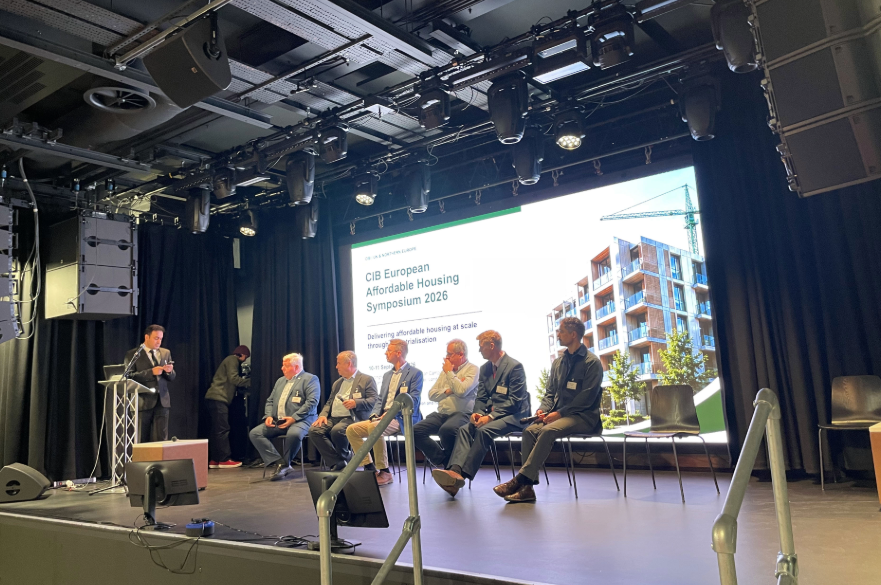
Delivery systems and international experience
Day 1 discussed the evidence on the barriers affecting housing delivery.
Emerging findings from the Thames Freeport research identified four interacting mechanisms affecting the pace and predictability of delivery:
- structural viability, investment risk and confidence in committing to individual sites;
- the sequencing of housing, infrastructure and placemaking;
- distributed decision-making across multiple organisations; and
- fragmented programmes and incentives that encourage projects to be procured and optimised individually.
The UK contributions examined these issues from the perspectives of a major housing provider, the Thames Freeport programme and industrialised construction. Discussions distinguished a headline housing pipeline from funded, timed and procurable demand. It also highlighted the importance of long-term client commitments, earlier integration of design and production, appropriate assurance and finance, and confidence in the capacity of suppliers.
International case studies then examined different approaches to affordable and industrialised housing delivery.
The Finnish contributions showed how long-term client leadership, collaborative procurement, Lean Construction and Takt production can help organisations move from isolated projects towards repeatable production systems. The Netherlands case demonstrated the value of coordinated innovation programmes connecting government, asset owners, industry and research. The Swedish presentations explored both the potential and the commercial risks of industrialised housebuilding, together with the role of Total BIM as an information infrastructure for production. The Canadian and Quebec examples showed how finance, standardised designs, public demand and municipal action can support industrialised construction, while also illustrating the importance of policy continuity and local context.
The Day 1 discussions highlighted several recurring messages:
- planning and approval processes need improvement, including further exploration of digital code checking;
- housing may need to be treated more explicitly as enabling infrastructure;
- standardisation should focus on systems, components and interfaces rather than producing identical design;
- digital tools and artificial intelligence may help identify sites, improve planning processes and aggregate demand; and
- innovations will struggle to move beyond pilots without an interconnected delivery ecosystem.
Day 2 summary
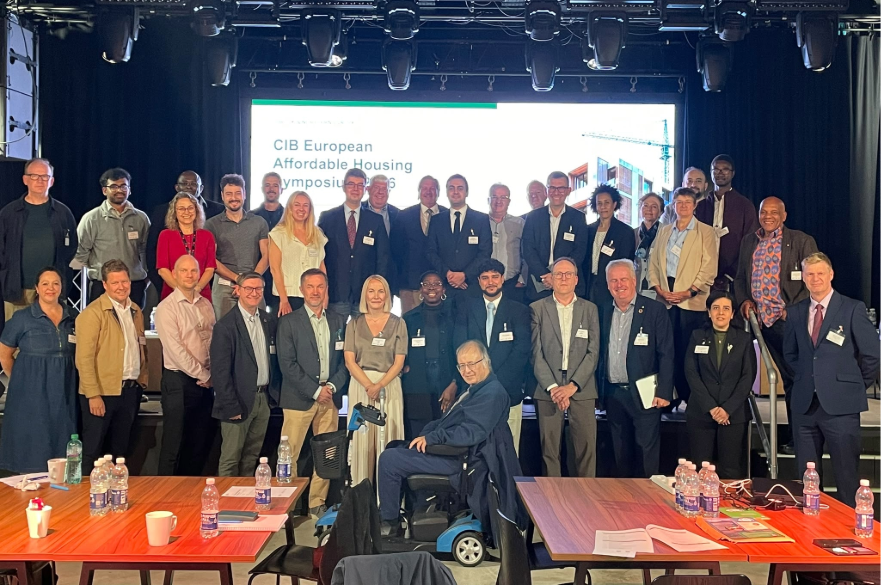
From evidence to collaborative research and CIB activity
Day 2 widened the discussion through a series of short interdisciplinary contributions and structured group activities.
A case study of public housing in Hong Kong examined the scale of housing demand, the constraints created by land and infrastructure, and the use of prefabrication, digital supply-chain management and construction automation.
The lightning presentations from academics participants then considered:
- What outcomes should affordable housing deliver for residents, communities and the environment?
- What performance should be designed into housing, including health, energy, resilience, adaptability and long-term affordability?
- How should the delivery system change to support industrialised construction and continuous learning?
- What digital infrastructure is needed to connect design, production, construction and building use?
The contributions emphasised that affordability cannot be understood only as initial construction cost or rent. Energy use, indoor environmental quality, health, durability, maintenance, climate resilience and the ability of homes to adapt to changing needs all affect long-term value.
Participants also considered the organisational capabilities required to sustain industrialised construction, the value of learning from project failures, and the relationship between platform approaches, Lean Construction and digital twins. Total BIM, interoperable product information and human interaction with data were discussed as components of a shared information infrastructure capable of supporting learning across projects.
A whole-room prioritisation exercise tested statements covering housing outcomes, measurable performance, client leadership, demand aggregation, integrated delivery systems, industrialisation, digital infrastructure, business models, skills and trust. Three main focus topics were priorities:
- Procurement, investments, regulations and business models need to align to long-term outcomes.
- Housing programmes require measurable performance/ indicators: housing quality, safety, energy, health and wellbeing, and whole life values.
- Industrialisation, standardisation, and platform-based approaches need viable models that work across contexts.
These were the basis for groups' discussion in the multidisciplinary research labs and initial ideas for collaborative research. It was highlighted the need for a more coordinated and evidence-based approach to industrialised construction. Key priorities included greater standardisation and platform-based solutions, clearer whole-life performance indicators and updated standards, and stronger links between research, industry and government. Participants also emphasised the need to address procurement barriers, fragmented markets and misaligned incentives through shared best practice, participatory approaches and greater aggregation of demand.
In the afternoon, participants considered how these ideas could be supported through CIB mechanisms such as:
- a European housing acceleration initiative;
- a UK and Northern Europe member forum;
- a housing, industrialisation and retrofit webinar series;
- industry and academic housing-delivery roundtables;
- an early career researcher network; and
- student exchange and research-collaboration activities.
The workshops provided a basis for continuing collaboration through CIB UK and Northern Europe.
Key messages from the symposium
Several messages connected the presentations and discussions across both days:
- Housing delivery depends on the performance of the whole system, not one organisation or technology.
- A large housing pipeline supports industrial investment only when it becomes predictable, funded and procurable demand.
- Industrialisation involves a repeatable production system, not only the use of offsite products.
- Clients can enable improvement by coordinating programmes, encouraging learning between projects and providing continuity.
- Standardisation can support variety when it focuses on platforms, shared components, interfaces, information and processes.
- Digital information, including AI, should support production, decision-making and learning throughout the housing lifecycle.
- Affordability needs to account for health, energy, maintenance, resilience and whole-life performance.
- International comparison is valuable, but solutions must reflect local institutions, markets and delivery conditions.
Programme and presentation resources
The materials below provide a record of the symposium and are shared with the permission of the contributors.
- View the presentation materials from Day 1.
- View the presentation materials from Day 2.
- Read more about the Thames Freeport housing research project.
- Read more about the BE SMART research group.
- Learn more about CIB UK and Northern Europe.
Please credit the relevant author or organisation when referring to material from an individual presentation.
Continuing the work
The symposium formed part of NTU’s wider research into housing delivery and the potential role of Modern Methods of Construction within Thames Freeport. The evidence, international comparisons and participant contributions will inform the next stages of the research.
The team will also use the ideas developed during Day 2 to identify opportunities for collaborative research, knowledge exchange and future CIB activity.
Contacts
Prof Patricia Tzortzopoulos – patricia.tzortzopoulos@ntu.ac.uk
PhD Researcher Simona Cosentino - simona.cosentino@ntu.ac.uk