Role
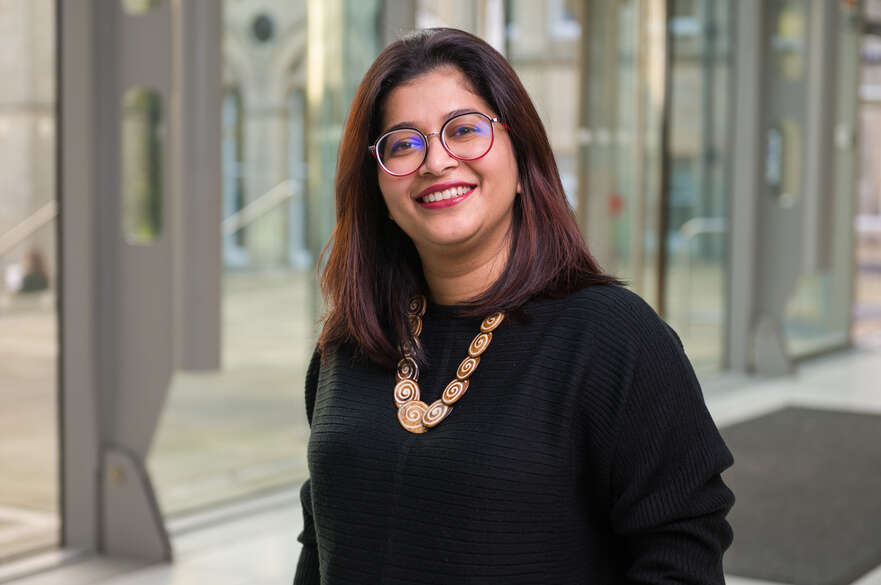
Dr. Raihana Ferdous is a Senior Lecturer in Geography at Nottingham Trent University. Her academic work combines active teaching responsibilities with ongoing research into energy, climate, and environmental justice. She has a strong interest in inclusive and decolonial pedagogies, alongside innovative, game based and field-based approaches to learning. She leads modules including Geographies of Global Change, Principles and Practices in Geography, International Development and Social Justice, Contemporary Topics in Geography, and Energy for a Low Carbon Future.
Raihana is the Deputy Chair of the ARES Research Ethics Committee and the International Students Experience Lead.
Career overview
Dr Raihana Ferdous obtained her PhD from the Geography Department at Durham University.
Her research interests orbit around interconnected topics such as emerging energy technology, ethical partnership, environmental sustainability, waste economy, ethical consumption and critical development.
Prior to moving to Nottingham Trent University to lecture in Geography, Raihana worked as a Lecturer at Oxford Brookes University and as a Postdoctoral Research Associate at the University of Glasgow and Durham University.
Raihana is a Fellow of the Higher Education Academy (HEA).
Research areas
Raihana has an extensive background in both Human Geography and Social Anthropology and has worked with various inter and multi-disciplinary teams.
Raihana is curious about different disciplinary approaches and always brings her multidisciplinary perspective to research that is empirically located in the Global South. Methodologically, Raihana values long-term ethnographic engagement and co-production of knowledge engaging with creative methods such as visual, storytelling, and following the networks and materials.
Research projects
Women’s Narratives of Heat and Climate Resilience in Informal Settlements (2026-28)
Extreme heat is an escalating climate risk with profound implications for health, livelihoods, and social wellbeing. Its effects are most acute in the Global South, where rapid urbanisation, poverty, and weak governance heighten vulnerability. Yet women’s experiences, particularly in informal settlements, remain marginal in both research and policy; despite their central role in sustaining households and disproportionate burdens under climate stress. This project examines how women in Chittagong, Bangladesh, and Hoima, Uganda experience and adapt to extreme heat. Guided by feminist political ecology and climate justice, this study employs participatory approaches and works with women as co-researchers, alongside geospatial science techniques. This project is funded by the British Academy International Interdisciplinary Research Projects Scheme 2026.
Kitchen Life Project
The Kitchen Life project is an interdisciplinary research pilot on sustainable cooking as it relates to energy, air pollution, and nutrition in two regions in Africa and Asia. Taking the ‘kitchen’ as the unit of analysis, three interlinked aspects will be investigated: everyday cooking practices, cooking economy and cooking materials. A cultural understanding of everyday kitchen life in Bangladesh and Malawi will contribute essential and often overlooked insights to the related fields of energy, sustainability, and health. This project is funded by SFC-GCRF.
Off the Grid: Notes from a forgotten Island (Research Documentary)
In collaboration with a filmmaker (Meghna Gupta), Raihana produces a research documentary Off the Grid: Notes from a Forgotten Island based on her PhD research. The film documents the arrival of solar energy to the community and the impact it has on everyday life. Off the Grid explores what the experience of a life without electricity means both emotionally and materially, as one goes from light to dark over the course of a day. The documentary has been screened at various academic and non-academic events and has won several awards.
Energy on the Move: longitudinal perspectives on energy transitions among marginal populations
Drawing on comparative lessons across four cities in two continents (Bangladesh, Nepal, Nigeria and South Sudan), this study examines the energy practices of poor women, men and young people living in informal settlements in peri-urban areas.
Research grants and awards
- 2026/28 PI for Women’s Narratives of Heat and Climate Resilience in Informal Settlements funded by the British Academy (£282,611.00)
- 2020/21 Co-I for Kitchen Life: Towards Clean Cooking Services in Bangladesh and Malawi funded by GCRF-SFC (£74,176)
- 2017/2018 Co-I for Energy on the Move: longitudinal perspectives on energy transitions among marginal populations (a comparative study) funded by DFID-ESRC (£206,316)
External activity
Research Group Memberships:
Sponsors and collaborators
- Durham University
- University of Glasgow
- Sustainable Futures Global Network
Publications
Press expertise
Raihana has press expertise related to critical development, environmental justice, climate resilience, sustainable energy development.
Course(s) I teach on
-
 Undergraduate | Full-time / Sandwich
COURSE
Geography - BSc (Hons)
https://www.ntu.ac.uk/course/animal-rural-and-environmental-sciences/ug/bsc-hons-geography
-
 Undergraduate | Full-time / Sandwich
https://www.ntu.ac.uk/course/animal-rural-and-environmental-sciences/ug/bsc-hons-environmental-science