Role
Dr. Hughes-Riley is an Associate Professor in Electronic Textiles at Nottingham Trent University where their research focusses on the design and development of novel electronic textile (E-textile) devices. Their research has a particular emphasis on sensor technologies and the creation of E-textiles for wellbeing, healthcare, and workwear applications.
Dr. Hughes-Riley has over 50 publications in top peer-reviewed journals including Chemical Society Reviews, Science Bulletin, Advanced Functional Materials, and npj Flexible Electronics.
As an investigator they have secured more than £2M in external research funding from funding agencies and industry.
Career overview
Dr. Hughes-Riley gained their BSc (Hons.) in Physics from Lancaster University in 2009. They went on to carry out PhD studies into the production and use of hyperpolarized gases for lung imaging at the Sir Peter Manfield Magnetic Resonance Centre at the University of Nottingham. They then moved to Nottingham Trent University where they were a Research Fellow in Physics from 2013. During this time, they work on developing low-cost magnetic resonance probes for a variety of applications, including wetland clogging sensors as part of the EU FP7 funded ABRI (Autonomous Reed Bed Installations) project.
They moved to the Nottingham School of Art and Design in 2016 where they have pursued their current research activity focussed on electronic textile development. They became a Senior Research Fellow in 2019, and an Associate Professor in 2021
Research areas
Dr Hughes-Riley’s research is centred on designing, engineering, and testing electronic textiles for wellbeing applications. Textiles make an ideal substate to embed systems that need to be worn close to the body as they are comfortable to wear. Dr Hughes-Riley’s core expertise is in sensing systems, and they have developed various innovative textile sensors that can monitor parameters important to ensuring the wearer’s wellbeing. For example, they were involved in the development of an over-sock that can detect if an older adult is having slips, trips, or stumbles, which can indicate if they are at risk of falling.
Beyond this they have been involved in creating textiles that can communicate with the user through embedded haptics, and textiles that can harvest energy from the Sun, which can be used to power devices, such as wearables. They are a member of the University’s Advanced Textiles Research Group where they lead research projects in the area of electronic textiles.
Dr Hughes-Riley’s research interests extend to sustainability, particularly sustainability considerations related to electronic textiles and their disposal. They are also a member of the Sustainable Transitions Research Group.
External activity
Dr. Hughes-Riley has received funding for electronic textiles research from a variety of sources including the EPSRC, DASA, and industry. They were an investigator (later PI) on the EPSRC funded ‘Production engineering research for the manufacture of novel electronically functional yarns for multifunctional smart textiles’ project (EP/T001313/1; value £1.3M) which explored the development of the fundamental knowledge needed to produce electronic yarns, yarn-type structures with embedded electronics, at scale.
They are an active member of the Institute of Physics and are a Member of the East Midlands branch committee. They hold MInstP and CPhys status.
Dr. Hughes-Riley regularly conducts peer review for a variety of grant funding bodies and journals. They are currently a member of the EPSRC Peer Review College. They are an editor of the journal Hardware and a Youth Editorial Board Member for the journal Soft Science.
Dr. Hughes-Riley has an active role in the E-textile community and is a member of the E-textiles Network Steering Board, and the International Conference on the Challenges, Opportunities, Innovations and Applications in Electronic Textiles International Steering Committee.
Publications
Selected publications
Ehelagasthenna, M., Shahidi, A.M., Lugoda, P., Ebrahimi, P., Oliveira, C., Eberl-Craske, D., Hurley, W., Dias, T., Hughes-Riley, T. 2026. Novel Haptic Electronic Yarn for Wearable Textiles: Vibrotactile Feedback via Knitted Channels for Skin-Based Communication.npj Flexible Electronics, 10, 110.
Lukomiak, A., Bulathsinghala, R., Varga, J., Meng, S., Marasinghe, K., Refai, I., Fernando, B., Patel, A., Halloluwa-Arachchige, C.M., Oliveira, C., Shahidi, A.M., Rahemtulla, Z., Turner, A., Ding, Z., Liew, B.X.W., Kerr, A., Preatoni, E., Hughes-Riley, T., Dharmasena, I., Lugoda, P. 2026. Texoskeletons: Developing the Fundamental Technologies for Creating Intelligent Soft Robotic Clothing With Integrated 1D Sensors and Actuators. Advanced Functional Materials, e75714.
Yu, X., Chen, L., Zhang, J., Yan, W., Hughes-Riley, T., Cheng, Y., Zhu, M. Structural design of light-emitting fibers and fabrics for wearable and smart devices. 2024. Science Bulletin, 69(15), 2439-2455.
Dang, C., Wang, Z., Hughes-Riley, T., Dias, T., Qian, S., Wang, Z., Wang, X., Liu, M., Yu, S., Liu, R., Xu, D., Wei, L., Yan, W., Zhu, M. Fibres—threads of intelligence—enable a new generation of wearable systems. 2024. Chemical Society Reviews, 53, 8790-8846.
Press expertise
- Electronic textiles
- Sensors
- Smart textiles
- Wearable sensing
- Energy harvesting
- Medical physics
- Constructed wetlands
- Magnetic resonance
Press
-
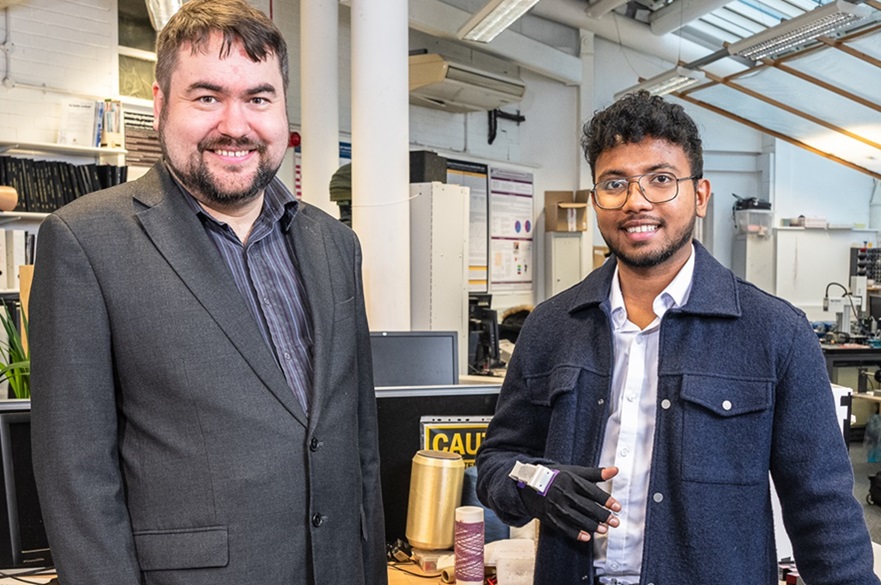
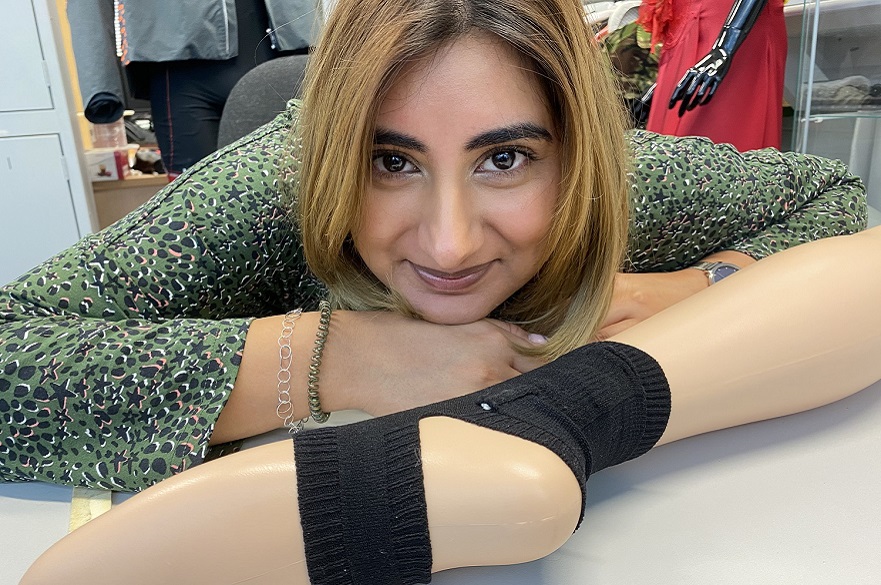
Thousands of people who are born deafblind will understand live conversations for the first time thanks to new research into smart textiles being developed by Nottingham Trent University (NTU).
ntu.ac.uk/news/articles/2025/04/deafblind-people-to-understand-live-conversations-thanks-to-e-textiles-research
-
NEWS
Sock that sounds the alarm before older people fall
20 March 2023Older people will be alerted to the increased risk of falls thanks to a new smart sock created by electronic textiles (e-textiles) experts at Nottingham Trent University.
ntu.ac.uk/news/articles/2023/03/sock-that-sounds-the-alarm-before-older-people-fall
-

NEWS
Clothing embedded with 1,200 tiny solar panels illuminates future of wearable tech
14 October 2022Textiles embedded with more than a thousand miniature solar cells - which are capable of charging a smart watch or mobile phone - have been developed by researchers at Nottingham Trent University.
ntu.ac.uk/news/articles/2022/10/clothing-embedded-with-1,200-tiny-solar-panels-illuminates-future-of-wearable-tech
-

NEWS
Shoelaces that light up to increase safety for joggers and cyclists
7 January 2021Textiles experts at Nottingham Trent University have designed shoelaces that light up and flash to improve safety at night for joggers and cyclists.
ntu.ac.uk/news/articles/2020/12/shoelaces-that-light-up-to-increase-safety-for-joggers-and-cyclists