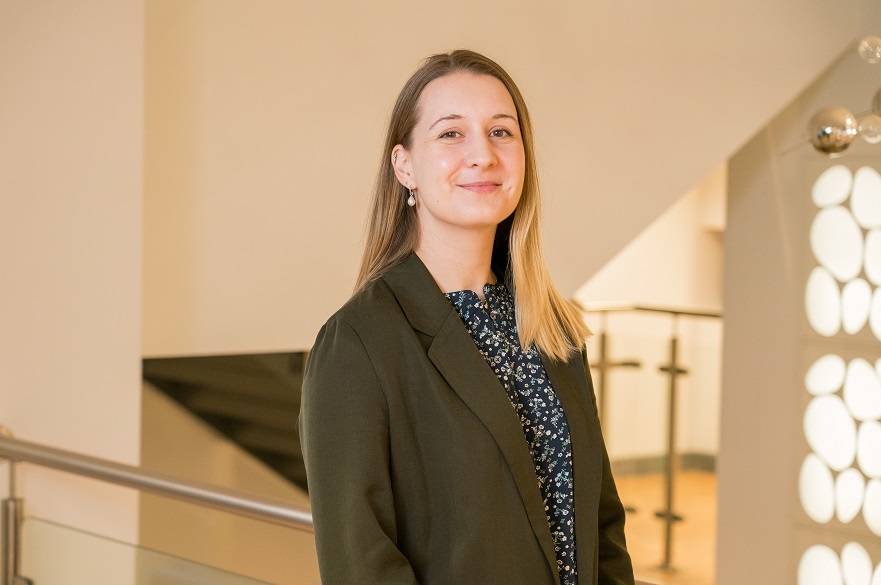

Role
Senior Lecturer in Psychology (Cognitive Psychology and Cognitive Neuroscience).
Career overview
Dr Angharad Williams (hear my name) joined NTU Psychology as a senior lecturer in September 2021. Prior to this Angharad was a postdoctoral researcher at the Max Planck Institute for Human Cognitive and Brain Sciences (Leipzig, Germany), and at Cardiff University Brain Research Imaging Centre (CUBRIC) (Wales, UK). She completed her BSc in Applied Psychology and PhD in Cognitive Neuroscience at Cardiff University.
Research areas
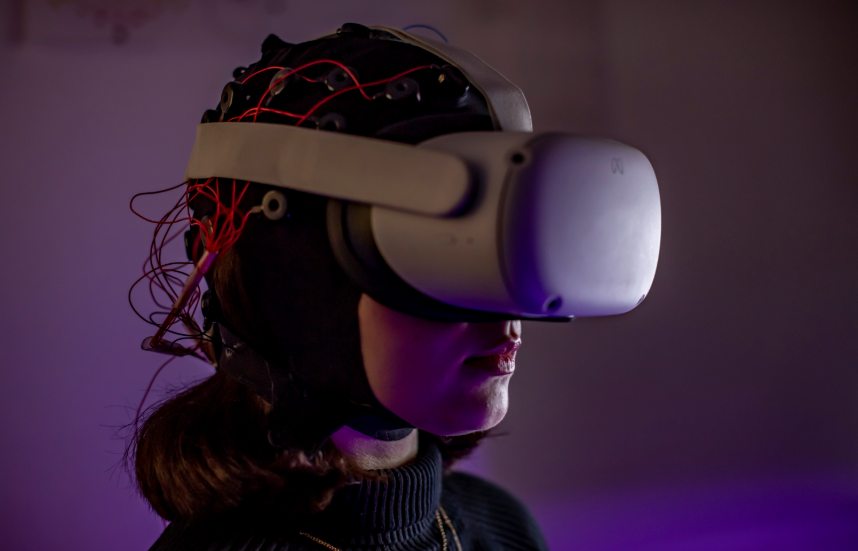
More broadly, her research examines how cognitive functioning is influenced by biological factors, and how these processes relate to everyday functioning and quality of life. Her research is increasingly focused on how internal physiological states, including hormonal fluctuations across the menstrual cycle, may influence memory processes and their neural correlates using psychophysiological methods. This includes an interest in how attention and memory operate in real-world contexts, and how variation in these processes may influence behaviour across different domains.
- episodic memory
- autobiographical memory
- attention
- perception
- schema-based memory
- future thinking
- brain-behaviour relationships
- menstrual cycle
External activity
Ad hoc reviewer for: Journal of Neuroscience, Nature Sustainability, Frontiers in Psychology (Sections: Psychopathology, Cognition), Neuropsychologia, Brain and Neuroscience Advances, Memory and Cognition, Neuroscience Letters
Sponsors and collaborators
- Dr Roland Benoit (Max Planck Institute for Human Cognitive and Brain Sciences, Leipzig, Germany)
- Dr Carl Hodgetts (Royal Holloway, University of London, England)
- Professor Kim Graham (Cardiff University, Wales)
- Professor Andrew Lawrence (Cardiff University, Wales)
- Professor David Linden (Maastricht University, Netherlands)
- Professor Edward Wilding (University of Birmingham, England)
- Dr Lisa Evans (Cardiff University, Wales)
Publications
Hodgetts, C. J., Postans, M., Williams, A. N., Graham, K. S., & Lawrence, A. D. (2025). Pre-commissural fornix involvement in human navigational learning. Neuropsychologia, 109350. https://doi.org/10.1016/j.neuropsychologia.2025.109350
Hodgetts, C. J., Berry, S. C., Postans, M., & Williams, A. N. (2025). Individual differences in experiential diversity shape event segmentation granularity. iScience, 28(8). 113134. https://doi.org/10.1016/j.isci.2025.113134
Xing, Y., Williams, A. N., & Knight, A. (2024). Developing a biophilic behavioural change design framework-A scoping study. Urban Forestry & Urban Greening, 94, 128278. https://doi.org/10.1016/j.ufug.2024.128278
Zsido, R. G., Williams, A. N., Barth, C., Serio, B., Kurth, L., Mildner, T., ... & Sacher, J. (2023). Ultra-high-field 7T MRI reveals changes in human medial temporal lobe volume in female adults during menstrual cycle. Nature Mental Health, 1(10), 761-771. https://doi.org/10.1038/s44220-023-00125-w
Subramanian, L., Skottnik, L., Cox, W. M., Lührs, M., McNamara, R., Hood, K., ... & Linden, D. E. (2021). Neurofeedback training versus treatment-as-usual for alcohol dependence: results of an early-phase randomized controlled trial and neuroimaging correlates. European Addiction Research, 1-14. https://doi.org/10.1159/000513448
Williams, A. N., & Benoit, R. G. (2021). Imagining our better selves. Nature Sustainability, 4(5), 381-382. https://doi.org/10.1038/s41893-020-00671-6
Mehler, D., Williams, A. N., Whittaker, J. R., Krause, F., Lührs, M., Kunas, S., ... & Linden, D. E. (2020). Graded fMRI neurofeedback training of motor imagery in middle cerebral artery stroke patients: a preregistered proof-of-concept study. Frontiers in Human Neuroscience, 14, 226. https://doi.org/10.3389/fnhum.2020.00226
Williams, A. N., Ridgeway, S., Postans, M., Graham, K. S., Lawrence, A. D., & Hodgetts, C. J. (2020). The role of the pre-commissural fornix in episodic autobiographical memory and simulation. Neuropsychologia, 142, 107457. https://doi.org/10.1016/j.neuropsychologia.2020.107457
Hodgetts, C. J., Stefani, M., Williams, A. N., Kolarik, B. S., Yonelinas, A. P., Ekstrom, A. D., ... & Graham, K. S. (2020). The role of the fornix in human navigational learning. Cortex, 124, 97-110. https://doi.org/10.1016/j.cortex.2019.10.017
Williams, A. N., & Wilding, E. L. (2019). On the sensitivity of event-related potentials to retrieval mode. Brain and Cognition, 135, 103580. https://doi.org/10.1016/j.bandc.2019.103580
Williams, A. N., Postans, M., & Hodgetts, C. J. (2019). How the Human Brain Segments Continuous Experience. Journal of Neuroscience, 39(17), 3172-3174. https://doi.org/10.1523/JNEUROSCI.3041-18.2019
Mehler, D. M., Williams, A. N., Krause, F., Lührs, M., Wise, R. G., Turner, D. L., ... & Whittaker, J. R. (2019). The BOLD response in primary motor cortex and supplementary motor area during kinesthetic motor imagery based graded fMRI neurofeedback. NeuroImage, 184, 36-44. https://doi.org/10.1016/j.neuroimage.2018.09.007
Williams, A. N., Evans, L. H., Herron, J. E., & Wilding, E. L. (2016). On the antecedents of an electrophysiological signature of retrieval mode. PLOS One, 11(12), e0167574. https://doi.org/10.1371/journal.pone.0167574
Evans, L. H., Williams, A. N., & Wilding, E. L. (2015). Electrophysiological evidence for retrieval mode immediately after a task switch. NeuroImage, 108, 435-440. https://doi.org/10.1016/j.neuroimage.2014.12.068
Course(s) I teach on
-
 Undergraduate | Full-time
COURSE
Psychology - BSc (Hons)
https://www.ntu.ac.uk/course/social-sciences/ug/bsc-hons-psychology