Concerns raised over aspects of wellbeing for primary school pupils in England as resilience levels decline
A new study has highlighted the continued need for wellbeing support for pupils impacted by the 2020-2021 pandemic lockdowns.

Aspects of school wellbeing of primary school children have been highlighted as a concern in a new report of 21,000 Key Stage 2 primary school pupils in England by RS Assessment from Hodder Education, SchoolDash and Nottingham Trent University.
The research, funded by the Nuffield Foundation, highlights a reduction in resilience, motivation, self-efficacy and positivity levels among children aged 7 to 11 years, some of whom would have begun their education at the time in which the country saw an unprecedented interruption to learning.
The key findings from the paper include:
- Since the pre-pandemic period, the proportion of children whose responses were satisfactory fell across four dimensions of academic wellbeing (see image above). The decreases were small for positivity and motivation which both decreased by 7%, whereas self-efficacy decreased by 18% and resilience decreased by 11%.
- Year 3 saw the largest reductions in satisfactory responses across every dimension. While this year group showed the highest levels of positivity before the pandemic, more children in Year 3 now report either some vulnerability or not feeling positive about school compared to pre-pandemic levels, an 8% increase.
- Compared to the pre-pandemic period, self-efficacy (defined as children’s beliefs about their capability to succeed and pursue their goals) has had the largest decrease in satisfactory responses. The majority of Key Stage 2 pupils in the most recent school year report feeling some vulnerability in self-efficacy with large (14%), drops across all years since 2018.
- A higher percentage of girls than boys are responding that they feel motivated, positive and resilient at school, however, the gender difference has reduced over time.
- Since the pandemic a higher percentage of boys report that they feel capable at school than girls. Only 36% of girls say they believe they are capable compared to 43% of boys, a reduction of 27% in girls’ self-efficacy since 2018.
- Since the pandemic, schools in the North of England have more children with satisfactory responses across all dimensions than schools in the South. For the most recent school year: 17%more for self-efficacy, 9% more for resilience, 7%more for positivity and 10% more for motivation.
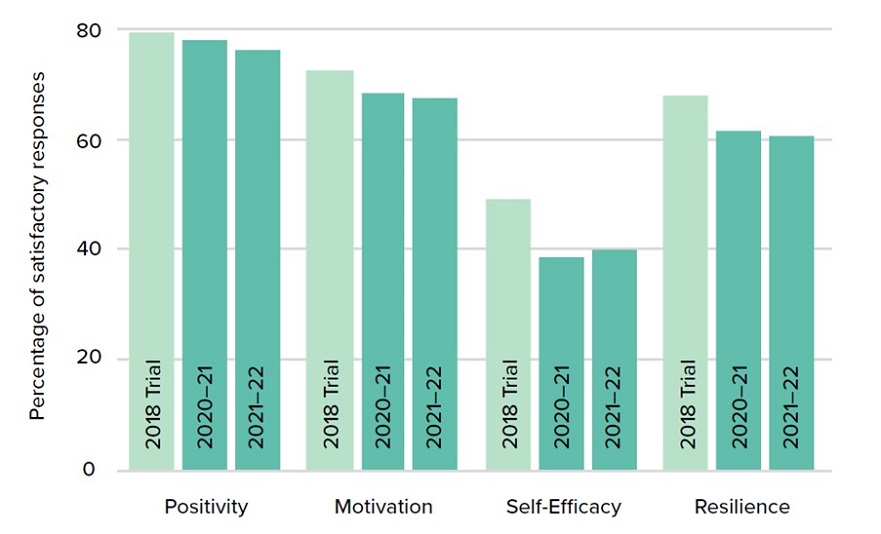
Change in the proportion of responses in the green zone for each dimension of wellbeing, over time
The research analyses survey responses from schools using the Wellbeing and Attitudes to Learning: Survey and Strategies, an online survey tool provided by RS Assessment from Hodder Education. This is the first analysis of the data collected since September 2020 and provides a valuable opportunity to understand broad differences between groups and look for early indications of trends that may assist with providing targeted support to children.
Katie Blainey, Director, Assessment Product at RS Assessment said: “We must keep an eye on the positivity, motivation and resilience dimensions to ensure downward trends don’t further decline to below satisfactory levels. At the moment, self-efficacy is the only dimension of wellbeing which presents itself as a real area of concern for Key Stage 2 pupils, and understanding this provides more evidence for where to prioritise support for pupil wellbeing in schools, and helps with understanding where investment may be required to enable all children to achieve their best in school. Moreover, measures such as regular check-ins with pupils, group and individual sessions when needed, and making wellbeing part of the school curriculum can help to strengthen overall pupil wellbeing and bridge gaps where pupils need it.”
Professor Clare Wood from Nottingham Trent University's School of Social Sciences said: “Paying close attention to the wellbeing and motivation of pupils in Key Stage 2 is critical to helping their recovery from the impact of school disruptions in 2020 and 2021. This is particularly true for Year 3 pupils, whose introduction to formalised education was interrupted, impacting their ability to self-regulate and manage the academic and emotional challenges of school. We need to consider a more thoughtful approach to education as a result, one that is more conscious of this impact and focused on both their academic and psychological recovery.”
A focused wellbeing webinar is set to take place on Monday 5 December at 3:30pm. A panel of key researchers and a user school of the survey will discuss key findings of the report, the importance of paying attention to pupil wellbeing in schools, and ways in which we can help strengthen key areas for pupils, such as resilience and self-efficacy. The virtual event will be free to attend and hosted by RS Assessment from Hodder Education.