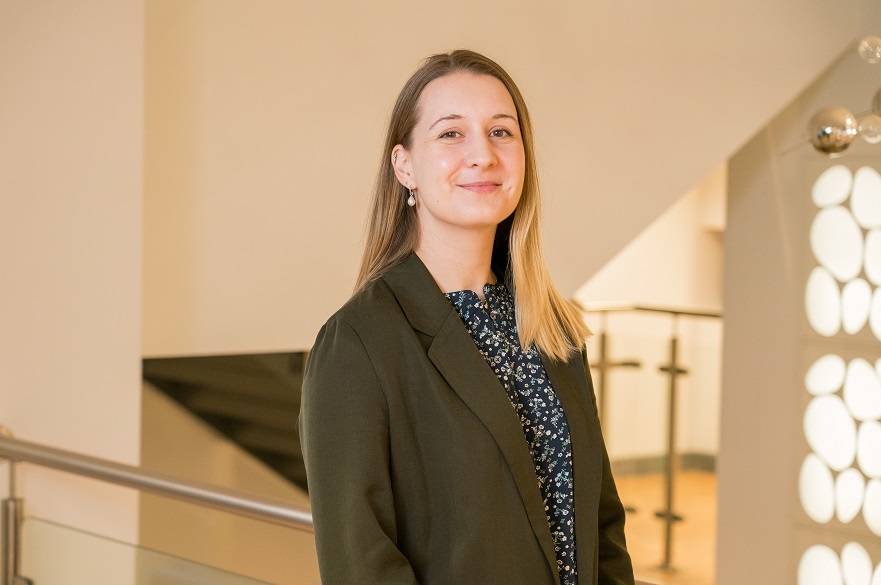
Role
Daniel Vera is Professor of Industrial Digitalisation at Nottingham Trent University. His role focuses on building industry-led research and innovation programmes that embed the academic excellence of NTU’s research outputs into real‑world solutions aligned to industrial needs.
Academic role at NTU
At NTU, Daniel links research and teaching activities to real-world usecases, industrial testbeds, data sets, and teaching platforms derived from collaborative R&D outputs. His teaching and supervision activities are focused on equipping graduates and professionals with the knowledge and vision necessary to lead digital transformation, and on developing skills in data engineering, digital systems integration, and AI‑enabled automation.
Role in the ADMC Centre
As a lead member of the Automated Distribution and Manufacturing Centre (ADMC), Daniel focuses on digital systems integration, the engineering of robust and scalable manufacturing data models, advanced sensing and perception, and the design of solutions to digitise and augment human operations.
Career overview
Daniel began as a Mechanical Engineer at PSA Group’s Forge Factory, then moved to Loughborough University, where he completed a PhD on virtual prototyping for manufacturing systems engineering, informing his later work on digital twins and process simulation. In 2013, he joined WMG at the University of Warwick, progressing to Reader in the Automation Systems Group. There, he co‑founded and co‑led the group, defining its research strategy and providing day‑to‑day leadership for a team working on Digital System Integration (DSI), Sensing and Perception for Advanced Manufacturing (SPAM), Digitally Augmented Manual Process Optimisation (DAMPO), and practical AI deployment.
Between 2017 and 2024, Daniel represented WMG in the High Value Manufacturing Catapult (HVMC) strategy group, chaired digital manufacturing working groups, and led testbed development for the Smart Factory Innovation Hub. He led the mapping of HVMC digital capabilities across UK SMEs, RTOs, and universities. As PI or Co‑I, he delivered major UK and EU projects (Innovate UK, APC, ATI, ERDF, EPSRC, EU FP7), including Knowledge Driven Configurable Manufacturing, Arrowhead (IoT service interoperability), HVEMS, High Energy Density Battery, and DI4M programmes. These initiatives combined fundamental research with industrial demonstrators for partners such as Lear, BMW, SKF, Royal Mail, Airbus, Safran, Atlas Copco, Apollo Tyres, Innovare Engineering, and UKBIC.
Between 2010 and 2016, Daniel held a key industry role at Fully Distributed Systems Ltd (FDS) as Technical Lead, consultant, and account manager. At FDS, he led the engineering and deployment of the vueOne virtual process modelling platform, rooted in his PhD research. He expanded vueOne to cover manual processes (V‑Man), robotic operations (V‑Rob), and ergonomic risk assessment (V‑Care). Over six years, Daniel managed the roll‑out of vueOne and its modules across Ford (Fox, Panther, Puma, Cougar) and JLR’s DVM4 engine assembly lines, significantly increasing virtual validation and reducing station design and deployment costs by around 20%. FDS’s business model provided software licences and technical support, embedding virtual engineering in industrial practice.
Prof. Vera is recognised as a domain expert in digital manufacturing systems engineering, contributing to ISO 23247 digital twin standardisation, the IEC Arrowhead framework for IoT interoperability, and advisory roles in national initiatives such as Smart Manufacturing Data Hub and Made Smarter. His blend of academic leadership, deep industrial engagement, and commercial productisation underpins his role at NTU and as a lead member of the future ADMC Centre, where he continues to shape and deploy the next generation of digital manufacturing capabilities.
Research areas
Prof. Vera’s research focuses on creating data‑centric, cyber‑physical manufacturing systems that can be rapidly deployed at scaled in real industrial environments.
Research expertise
Daniel has led the development of architectures that connect operational technologies with enterprise IT systems, enabling robust data capture, management and analysis of large multivariate production data sets across complex factories and manufacturing organisations. He also specialises in the deployment of low‑cost, vision‑based sensing for manufacturing, ergonomic and fatigue modelling, and human‑in‑the‑loop solutions that enhance operator safety, well‑being and performance in highly automated environments.
Major programmes and Impactful research projects
Over his career, Prof. Daniel Vera has been PI or Co‑I on more than 25 major programmes funded by Innovate UK, ATI, APC, ERDF and the HVM Catapult, often working with partners such as Lear, BMW, Atlas Copco, Royal Mail, UKBIC, Airbus and Safran. Flagship initiatives include the Lear Smart Manufacturing and Lear Future Factory programmes, the D4iM digital innovation initiative, and HVM Catapult workstreams on Digital Core, Digital Representation and Human‑in‑the‑Loop, where he has shaped digital platforms and demonstrators now used across multiple sectors.
External activity
Prof. Daniel Vera's activities span strategic thought‑leadership within the High Value Manufacturing Catapult (HVMC), advisory roles to national programmes, membership of expert networks, and extensive conference organisation and editorial work.
Daniel is a recognised advisor on digitalisation for UK manufacturing, providing domain expertise to the Smart Manufacturing Data Hub, BEIS‑linked skills initiatives and national capability mapping exercises. He works directly with senior leaders at companies such as Lear, BMW, Royal Mail, Apollo Tyres, Atlas Copco and UKBIC, advising on technology roadmaps, digital twin deployment, suppliers and solutions selection.
In the international research community, Daniel has served as co‑chair, track chair, local chair, special session chair, industry forum chair and organising committee member for leading IEEE and CIRP conferences. His roles include track and special session leadership at the IEEE International Conference on Industrial Informatics (INDIN), organisation and track chairing at the IEEE International Conference on Industrial Cyber‑Physical Systems (ICPS), contributions to IECON and industry forums, and programme roles at events such as Human Interaction and Emerging Technologies (IHIET‑AI) and Europe‑Korea Conference on Science and Technology. He also coordinates digital manufacturing demonstrators and testbeds showcased at Smart Factory Expo, Innovation Alley, MACH and CENEX, connecting academic and industrial audiences.
Prof. Daniel Vera contributes to editorial and standards bodies as a member of the EPSRC peer review college, special issue editor on Digital Transformation in Manufacturing, and editorial board member for Applied Sciences. He is a peer reviewer for high‑impact journals (including Proceedings of the IEEE, Philosophical Transactions of the Royal Society, Computers in Industry, IEEE Transactions on Industrial Informatics and Journal of Manufacturing Systems), a member of IEEE and the UK‑RAS Network, and a contributor to the IEC Arrowhead framework and ISO 23247 digital twin standardisation activities. Collectively, these roles position him as a key intermediary between research, standards development and industrial practice in digital manufacturing.
Publications
- Janebdar, E., Harrison, R., Ahmad, B., Vera, D., Sousa, D., & Tlegenov, Y. (2024). Proposing a workflow for automating the assembly phase of production. In Proceedings of the 2024 IEEE 29th International Conference on Emerging Technologies and Factory Automation (ETFA) (pp. 1–6). IEEE.
- Chung, V., Vera, D. A., & Zhang, J. (2024). Design and implementation of a marker-based AR-enabled tool tracking system for manufacturing manual operation. In Proceedings of the 11th International Conference on Human Interaction and Emerging Technologies (IHIET‑AI 2024): Artificial Intelligence and Future Applications (Vol. 120).
- Kunz, M., Shu, C., Picard, M., Vera, D., Hopkinson, P., & Xi, P. (2022). Vision-based ergonomic and fatigue analyses for advanced manufacturing. In Proceedings of the 2022 IEEE 5th International Conference on Industrial Cyber‑Physical Systems (ICPS) (pp. 1–7). IEEE.
- Konstantinov, S., Assad, F., Ahmad, B., Vera, D. A., & Harrison, R. (2022). Virtual engineering and commissioning to support the lifecycle of a manufacturing assembly system. Machines, 10(10), 939. MDPI.
- Harrison, R., Vera, D., & Ahmad, B. (2021). Towards the realization of dynamically adaptable manufacturing automation systems. Philosophical Transactions of the Royal Society A, 379(2207), 20200365. The Royal Society Publishing.
- Harrison, R., Vera, D. A., & Ahmad, B. (2021). A connective framework to support the lifecycle of cyber–physical production systems. Proceedings of the IEEE, 109(4), 568–581. IEEE.
- Konstantinov, S., Assad, F., Azam, W., Vera, D., Ahmad, B., & Harrison, R. (2021). Developing web-based digital twin of assembly lines for industrial cyber‑physical systems. In Proceedings of the 2021 4th IEEE International Conference on Industrial Cyber‑Physical Systems (ICPS) (pp. 219–224). IEEE.
- Assad, F., Konstantinov, S., Rushforth, E., Vera, D. A., & Harrison, R. (2021). A literature survey of energy sustainability in learning factories. In Proceedings of the 2020 IEEE 18th International Conference on Industrial Informatics (INDIN). IEEE.
- Assad, F., Konstantinov, S., Rushforth, E. J., Vera, D. A., & Harrison, R. (2021). Virtual engineering in the support of sustainable assembly systems. Procedia CIRP, 97, 367–372. Elsevier.
- Edwards, S. (with contributions from Vera, D. and colleagues). (2021). The opportunity for learning factories in the UK: A report to the Gatsby Foundation. Gatsby Foundation.
- Millington, J., Monfared, R. P., & Vera, D. (2019). Innovative mechanism to identify robot alignment in an automation system. Robotics and Autonomous Systems, 114, 144–154. Elsevier.
- Chinnathai, M. K., Al‑Mowafy, Z., Alkan, B., Vera, D., & Harrison, R. (2019). A framework for pilot line scale‑up using digital manufacturing. Procedia CIRP, 81, 962–967. Elsevier.
- Jbair, M., Ahmad, B., Ahmad, M. H., Vera, D., Harrison, R., & Ridler, T. (2019). Automatic PLC code generation based on virtual engineering model. In Proceedings of the 2019 IEEE International Conference on Industrial Cyber Physical Systems (ICPS) (pp. 675–680). IEEE.
- Ahmad, M., Ferrer, B. R., Ahmad, B., Vera, D., Lastra, J. L. M., & Harrison, R. (2018). Knowledge-based PPR modelling for assembly automation. CIRP Journal of Manufacturing Science and Technology, 21, 33–46. Elsevier.
- Alkan, B. (with co‑authors including Vera, D. A.). (2018). Proposing a holistic framework for the assessment and management of manufacturing complexity through data‑centric and human‑centric approaches. In Proceedings of the 3rd International Conference on Complexity, Future Information Systems and Risk (COMPLEXIS 2018).
- Alkan, B., Vera, D. A., Ahmad, M., Ahmad, B., & Harrison, R. (2018). Complexity in manufacturing systems and its measures: a literature review. European Journal of Industrial Engineering, 12(1), 116–150. Inderscience.
- Zhang, J., Ahmad, B., Vera, D., & Harrison, R. (2018). Automatic data representation analysis for reconfigurable systems integration. In Proceedings of the 2018 IEEE 16th International Conference on Industrial Informatics (INDIN) (pp. 1033–1038). IEEE.
- Alkan, B., Vera, D., Ahmad, B., & Harrison, R. (2017). Assessing complexity of component-based control architectures used in modular automation systems. International Journal of Computer and Electrical Engineering, 9(1). International Academy Publishing.
- Chinnathai, M. K., Günther, T., Ahmad, M., Stocker, C., Richter, L., Schreiner, D., Vera, D., Reinhart, G., & Harrison, R. (2017). An application of physical flexibility and software reconfigurability for the automation of battery module assembly. Procedia CIRP, 63, 604–609. Elsevier.
- Zhang, J., Ahmad, B., Vera, D., & Harrison, R. (2016). Ontology based semantic-predictive model for reconfigurable automation systems. In Proceedings of the 2016 IEEE 14th International Conference on Industrial Informatics (INDIN) (pp. 1094–1099). IEEE.
- Ahmad, M., Ahmad, B., Harrison, R., Alkan, B., Vera, D., Meredith, J., & Bindel, A. (2016). A framework for automatically realizing assembly sequence changes in a virtual manufacturing environment. Procedia CIRP, 50, 129–134. Elsevier.
- Alkan, B., Vera, D., Ahmad, M., Ahmad, B., & Harrison, R. (2016). Design evaluation of automated manufacturing processes based on complexity of control logic. Procedia CIRP, 50, 141–146. Elsevier.
- Alkan, B., Vera, D., Ahmad, M., Ahmad, B., & Harrison, R. (2016). A model for complexity assessment in manual assembly operations through predetermined motion time systems. Procedia CIRP, 44, 429–434. Elsevier.
- Mus’ab H, Ahmad, Ahmad, B., Vera, D., & Harrison, R. (2015). An innovative energy predictive process planning tool for assembly automation systems. In Proceedings of the 41st Annual Conference of the IEEE Industrial Electronics Society (IECON) (pp. 005184–005190). IEEE.
- Ferrer, B. R., Ahmad, B., Lobov, A., Vera, D., Lastra, J. L. M., & Harrison, R. (2015). An approach for knowledge-driven product, process and resource mappings for assembly automation. In Proceedings of the 2015 IEEE International Conference on Automation Science and Engineering (CASE) (pp. 1104–1109). IEEE.
- Ferrer, B. R., Ahmad, B., Vera, D., Lobov, A., Harrison, R., & Lastra, J. L. M. (2015). A knowledge-based solution for automatic mapping in component based automation systems. In Proceedings of the 2015 IEEE 13th International Conference on Industrial Informatics (INDIN) (pp. 262–268). IEEE.
- Ahmad, M., Ahmad, B., Alkan, B., Vera, D.,Harrison, R., Meredith, J., & Bindel, A. (2016). The use of a complexity model to facilitate in the selection of a fuel cell assembly sequence. Procedia CIRP, 44, 169–174. Elsevier.
- Ahmad, M., Ahmad, B., Alkan, B., Vera, D., Harrison, R., Meredith, J., & Bindel, A. (2016). Hydrogen fuel cell pick and place assembly systems: Heuristic evaluation of reconfigurability and suitability. Procedia CIRP, 57, 428–433. Elsevier.
- Carlsson, O., Vera, D., Arceredillo, E., Tauber, M. G., Ahmad, B., Schmittner, C., Plosz, S., Ruprechter, T., Aldrian, A., & Delsing, J. (2017). Engineering of IoT automation systems. In IoT Automation (pp. 197–246). CRC Press.
- Vera, D., Harrison, R., Hamed, B., Le Pape, C., Desdouitis, C., & Derhamy, H. (2017). Application system design—Smart production. In IoT Automation (pp. 367–390). CRC Press.
- Vera, D. A., West, A., & Harrison, R. (2009). Innovative virtual prototyping environment for reconfigurable manufacturing system engineering. Proceedings of the Institution of Mechanical Engineers, Part B: Journal of Engineering Manufacture, 223(6), 609–621. Sage Publications.
- Monfared, R. P., West, A. A., Vera, D. A., & Conway, P. P. (2008). Evaluating a new flexible soldering system for electronics small and medium enterprises. Proceedings of the Institution of Mechanical Engineers, Part B: Journal of Engineering Manufacture, 222(2), 273–283. Sage Publications.
- Vera, D. A., Conway, P. P., Monfared, R. P., & West, A. A. (2008). Virtual prototyping of flexible soldering cells for electronic manufacture. Proceedings of the Institution of Mechanical Engineers, Part B: Journal of Engineering Manufacture, 222(6), 711–722. Sage Publications.
- Park, J., Harrison, R., & Vera, D. (2014). Improving fault diagnosis and accessibility in manufacturing automation systems using X3DOM. In Proceedings of the IEEE International Conference on Industrial Technology (ICIT) (pp. 689–694).
- Jain, H., Vera, D., & Harrison, R. (2010). Virtual commissioning of modular automation systems. Intelligent Manufacturing Systems, 10(1), 72–77.
- Weston, R. H., West, A. A., Harrison, R., Monfared, R. P., Vera, D. A., Chatha, K. A., & Moreiro, J. F. P. (2003). Use of CIMOSA and systems thinking to document and inform the design and development of car engine production systems. In Proceedings of the IEEE International Conference on Computer Integrated Manufacturing (CE) (pp. 851–857).
- Vera, D. A. (2004). Innovative approach to the design and realisation of a virtual prototyping environment for manufacturing systems engineering. © DA Vera.
- West, A. A., Harrison, R., Weston, R. H., Monfared, R. P., Vera, D. A., Thomas, D. W., McLeod, C. S., Wilkinson, M., Lee, S. M., & Qin, S. F. (2002). Distributed engineering of automotive manufacturing machines under the foresight vehicle programme. SAE Transactions, 227–244. Society of Automotive Engineers, Inc.
- Vera, D. A., West, A. A., Harrison, R., & Thomas, D. W. (2003). Virtual visualisation and prototyping environment for component-based production machinery. Technical Papers—Society of Manufacturing Engineers.
- Monfared, R. P., West, A. A., Vera, D. A., & Conway, P. P. (2006). Flexible soldering cells for small batch productions. In Proceedings of the 8th Electronics Packaging Technology Conference (pp. 249–254). IEEE.
- Vera, D. A., Monfared, R. P., West, A. A., & Conway, P. P. (2006). Novel approach to reflow oven design to control and optimise lead free soldering process. In Proceedings of the 8th Electronics Packaging Technology Conference (pp. 512–517). IEEE.
- Ong, M. H., Vera, D., West, A. A., & Harrison, R. (2002). Human factors issues in the application of a novel process description environment for machine design and control developed under the foresight vehicle programme. SAE Technical Paper.
- Vera, D. (2015). A perspective on Industry 4.0 from Automotive Manufacturing. Manufacturing of Aerospace Technologies, 3. IET Stevenage UK.