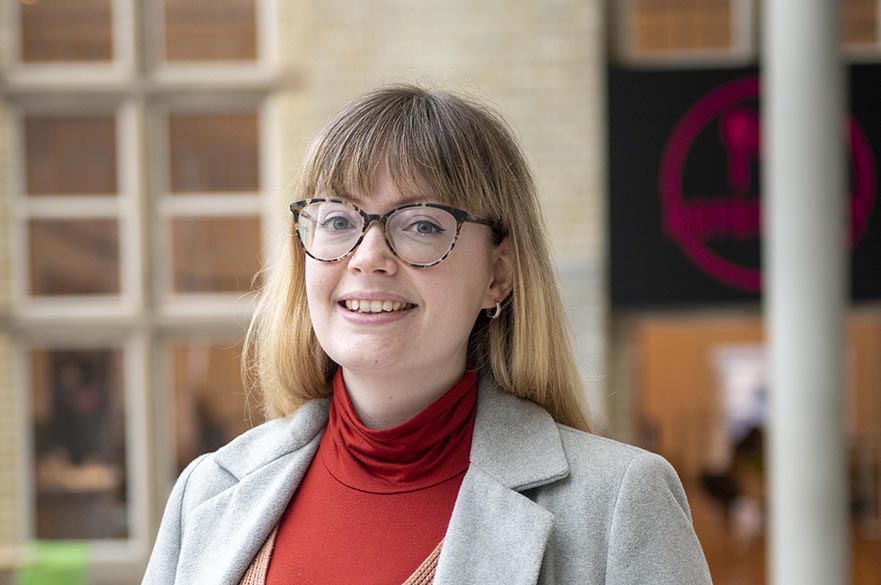
Role
Lydia is a senior lecturer and research expert in psycho-social oncology (support for people affected by cancer), chronic conditions, loneliness and digital health.
Lydia has teaching responsibilities across the undergraduate Psychology courses, and the MSc Cyberpsychology. She leads the undergraduate Health Psychology of Chronic Illnesses module, and is the course leader for the BSc Psychology pathways courses.
Research
Dr Harkin’s research expertise lies in Cyber and Health Psychology. She has led within multidiscipline research teams to deliver intervention developments and service evaluations. She is an expert qualitative and mixed methods researcher. She is particularly interested in projects which examine the potential for technology to support people to live well with and after chronic illness, cancer, and in older adulthood. She has delivered 3* REF returned papers and published in highly reputable journals such as Computers in Human Behaviour, JMIR, European Journal of Social Psychology, Journal of Cancer Survivorship.
Leadership
Lydia has been a member of the Psychology undergraduate course team with significant involvement in supporting the delivery of modules as a year tutor and course leader. She is passionate about student voice and is responsible for supporting course teams to work closely with student representatives to capture regular student feedback, and to 'close the loop', and feedback on changes made as a result of what students tell us.
Scholarship
Lydia has successfully delivered NTU scholarship projects aiming to enhance student experience, including a project designed to understand and enhance mature student community, and a project examining Psychology student perceptions of employability and work-like experience on their course.
Career overview
Lydia Harkin obtained a PhD in 2016 from the University of Central Lancashire in the domain of Health Sciences. She specialises in research exploring technological solutions for supporting people living with long term health conditions including cancer and in older adulthood. She has successfully delivered projects including a UKRI funded development of a digital loneliness intervention in older adulthood, explorations of digital support media for cancer such as podcasts and online cancer communities, and explorations of fake news through social media.
Collaborations
Dr Harkin has collaborated with experts from Psychology, Health, Computer Sciences, and Computer Engineering at University of Exeter, Bournemouth University, The Open University, and the University of Central Lancashire.
Sponsors and collaborators
Lydia’s academic collaborators and co-authors include:
- Professor Kinta Beaver, University of Central Lancashire
- Prof Blaine Price, The Open University
- Dr Daniel Gooch, The Open University
- Dr Emmanuele Fino, Queen's University Belfast
- Dr Catherine Talbot, Bournemouth University
- Professor Paola Dey, Edge Hill University
- Dr Kartina Choong, University of Central Lancashire
Publications
HARKIN, L., STUART, A., STEVENSON, C., TALBOT, C., DALY, R., PARK, M.S.-A., KATZ, D., GOOCH, D. and PRICE, B., 2024. Being cut off from social identity resources has shaped loneliness during the COVID-19 pandemic: a longitudinal interview study with medically vulnerable older adults from the United Kingdom. Journal of Community and Applied Social Psychology, 34 (1): e2724. ISSN 1052-9284
WAKEFIELD, J.R.H., BOWE, M., KELLEZI, B., HARKIN, L.J., BAKER, C.W. and SHALA, A., 2023. “I knew I needed to live what I realised was faith in me”: enacting and transcending religious identity through food aid volunteering. European Journal of Social Psychology. ISSN 0046-2772 (Forthcoming)
Harkin, L., Stuart, A., Stevenson, C., Daly, R., Talbot, C. V., Park, M., … Price, B. (2023). Being cut off from social identity resources has shaped loneliness during the COVID-19 pandemic: A longitudinal interview study with medically vulnerable older adults from the United Kingdom. Journal of Community and Applied Social Psychology, 34: e2724. doi:10.1002/casp.2724
Stuart, A., Yan., R. J., Harkin,. L… Prince, B., (2023). Digital intervention in loneliness in older adults: qualitative analysis of user studies. JMIR Form Res 2023;7:e42172 doi: 10.2196/42172
Stuart, A., Katz, D., Stevenson, C., Gooch, D., Harkin, L., Bennasar, M., ... & Nuseibeh, B. (2022). Loneliness in older people and COVID-19: Applying the social identity approach to digital intervention design. Computers in Human Behavior Reports, 6, 100179, https://doi.org/10.1016/j.chbr.2022.100179
Hadlington, L., Harkin, L. J., Kuss, D., Newman, K., & Ryding, F. C. (2023). Perceptions of fake news, misinformation, and disinformation amid the COVID-19 pandemic: A qualitative exploration. Psychology of Popular Media, 12(1), 40–49.https://doi.org/10.1037/ppm0000387
Harkin, L. J., Beaver, K., Dey, P., & Choong, K. A. (2020). Secret groups and open forums: Defining online support communities from the perspective of people affected by cancer. Digital Health, 6, 1-13. https://doi.org/10.1177/2055207619898993
Harkin, L., & Kuss, D. J. (2020). ‘My smartphone is an extension of myself’ – A holistic qualitative exploration of the impact of using a smartphone. Psychology of Popular Media, 10(1), 28-38. https://psycnet.apa.org/doi/10.1037/ppm0000278
Harkin, L. J., Beaver, K., Dey, P., & Choong, K. (2017). Navigating Cancer using Online Communities: a Grounded Theory of Survivor and Family Experiences. Journal of Cancer Survivorship, 1-12. https://doi.org/10.1007/s11764-017-0616-1
Course(s) I teach on
-
 Undergraduate | Full-time
COURSE
Psychology - BSc (Hons)
https://www.ntu.ac.uk/course/social-sciences/ug/bsc-hons-psychology
-
 Postgraduate taught | Full-time / Part-time
COURSE
Cyberpsychology - MSc
https://www.ntu.ac.uk/course/social-sciences/pg/msc-cyberpsychology