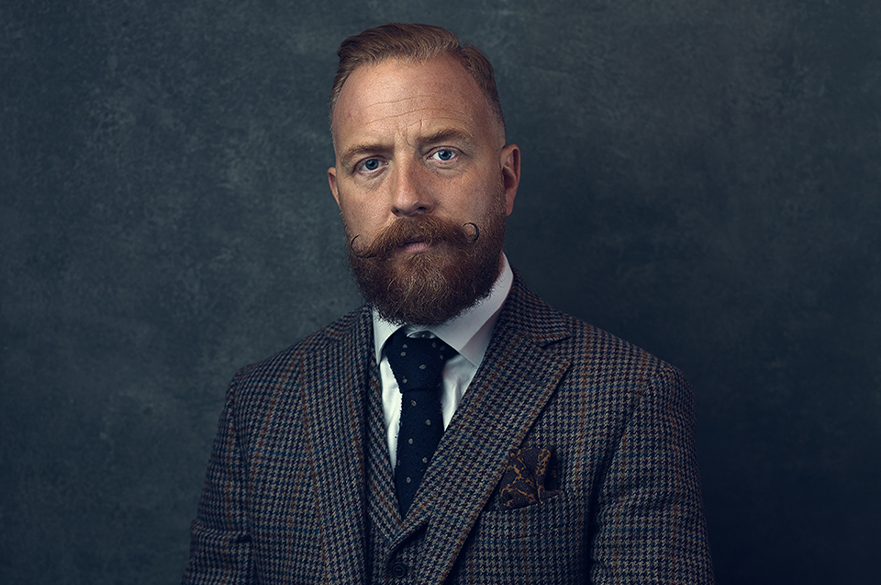
During the course I worked on a number of student productions, designing sets and also painting baroque-style backcloths, which was an invaluable introduction to the craft side of theatre-making.
More about Gary
Why did you choose NTU and your course?
I chose Nottingham Trent because the Theatre Design course had a very clear emphasis on making work for the stage rather than purely studying it academically. What appealed to me was the balance between conceptual thinking and practical realisation — the idea that design exists in collaboration, in workshops, rehearsal rooms and theatres, not just on paper.
What was your favourite thing about studying in the School of Art & Design?
What I valued most was being surrounded by people working across completely different disciplines. Theatre design sits naturally between art, architecture, costume, and storytelling, so being in a school where painters, fashion designers, graphic designers and makers were all working alongside each other was incredibly stimulating. You were constantly exposed to different ways of thinking and making.
What do you think of the course facilities? How do they compare to your work in industry?
What was valuable about the facilities was that they encouraged you to think through ideas physically. Model-making workshops, studio space, and access to technical support meant that designs weren’t just theoretical — you had to consider scale, materials, construction and how something would actually function on stage. That way of working translates directly into the industry, where ideas only really exist once they can be realised by a team of makers and technicians.
Did you get a chance to work on any live projects or competitions during your studies? What was this experience like?
Yes, and that was a very important part of the experience for me. During the course I worked on a number of student productions, designing sets and also painting baroque-style backcloths, which was an invaluable introduction to the craft side of theatre-making. Learning how scenery is actually made — the scale of it, the speed required, and the collaboration involved — gave me a real respect for the workshops and technical teams that bring designs to life.
Did you get involved with any other opportunities at NTU (for example being a course representative, study trips). How did these opportunities improve your experience?
I also had a placement at Bristol Old Vic, which was a significant moment. It was my first real exposure to a professional theatre environment, seeing how decisions are made under pressure and how design functions within a much larger creative and technical structure. It made the industry feel tangible and confirmed that this was the direction I wanted to pursue.
What job are you currently doing and what does it involve?
I work as a set and costume designer for opera, theatre and dance, creating the visual world of productions from the initial concept through to performance. The role involves developing designs in close collaboration with directors, conductors and choreographers, and then working with workshops, costume departments and technical teams to realise those ideas on stage. At the moment I’m working on new productions of Nabucco at Teatro alla Scala in Milan and Siegfried at the National Centre for the Performing Arts in Beijing. Both projects involve designing large-scale environments that need to function musically, dramatically and technically — from early research and sketching through to 3D modelling, model-making, costume development and rehearsals in the theatre.
How has your experience at NTU helped you in your current role? Are there any skills you gained at NTU that you now use every day?
One of the most important things NTU gave me was an understanding that design is a process rather than a single idea. Learning how to research, test, adapt and communicate ideas clearly is something I use every day. In theatre and opera, designs evolve constantly in
response to rehearsal, music, budgets and technical realities, so the ability to stay flexible while holding onto a strong visual concept is essential. The course also placed a strong emphasis on collaboration. You learn very quickly that theatre is not a solitary art form — you’re always working with directors, performers, makers and technicians — and that ability to listen, respond and communicate visually
has remained central to my practice.
What would your advice be to current Art & Design students?
Stay curious and make as much work as you possibly can while you have the freedom to experiment. Student years are one of the few times when you can try ideas without the pressures of budgets or deadlines, and that process of testing and refining your own visual language is incredibly valuable. I would also encourage students to develop practical skills alongside conceptual ones. Understanding how things are made — materials, construction, scale, and collaboration — will always make you a stronger designer. The most successful projects come from ideas that are both imaginative and buildable. Finally, be patient with your career. Creative paths are rarely linear, and opportunities often come from relationships and collaborations built over time. Be open, be reliable, and stay interested in the work of others. The industry is smaller than it seems, and generosity and professionalism go a long way. If you remain curious and committed to your craft, the work tends to lead you where you need to go.
What was the process of getting to where you are today?
It was a gradual process rather than a single moment or clear plan. After graduating, I worked across a range of roles within theatre, assisting, designing smaller productions and learning how the industry really functions day to day. Those early years were about building experience, understanding collaboration, and developing a visual language that felt personal rather than trying to follow a fixed career path. Opera and large-scale work came later, as relationships developed with directors and companies who invited me back to collaborate again. Each project led to the next, often through recommendation rather than formal applications, and over time the scale and complexity of the work increased.
What has remained consistent is the need to keep learning. Every production presents new technical and artistic challenges, whether that’s working in a different country, adapting to a new theatre, or finding new ways to combine traditional craft with contemporary technology. Looking back, the process has really been about persistence, curiosity and collaboration — building trust over time and allowing the work itself to open the next door. The foundations for that way of working were very much laid during my time at NTU.
Still need help?
-
STUDENT PROFILE
Adam Wolstenholme
United Kingdom
https://www.ntu.ac.uk/study-and-courses/courses/our-students-stories/architecture-design-built-environment/adam-wolstenholme
-

STUDENT PROFILE
Agil Abdullayev
Fine ArtAzerbaijan
https://www.ntu.ac.uk/study-and-courses/courses/our-students-stories/art-design/agil-abdullayev
-

STUDENT PROFILE
Alessandra Centorbi
BA (Hons) Decorative ArtsItaly
https://www.ntu.ac.uk/study-and-courses/courses/our-students-stories/art-design/my-alumni-story-alessandra-centorbi