British Academy Equitable Partnerships NTU Workshop
On 29th January 2026, NTU hosted a British Academy Workshop on Equitable Partnerships. The theme of the workshop was Shifting Narratives Towards Equitable Global Partnerships: Reflections and Experiences.
Published on 9 February 2026
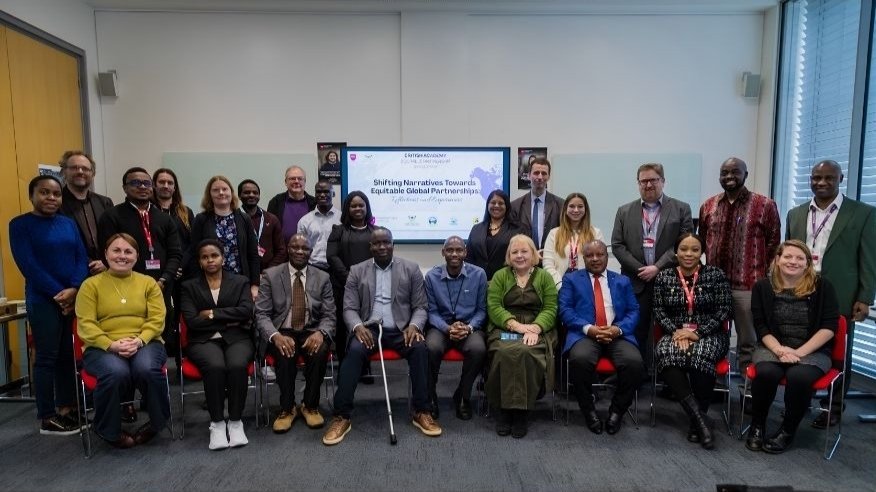
This final workshop followed a series of British Academy workshops held in Uganda, the UK, and online. The workshops created opportunities for researchers, administrators, funders, and other stakeholders to explore how to shift the balance of power relations in collaborative research to make it more equal between partners. Arising from discussions at an earlier conference, participants from across Africa discussed the need for joint projects to strengthen South–South and South–North research partnerships.
The project was built on the experience and lessons from a 15-year research partnership between Nottingham Trent University (NTU) and Makerere University (Mak), Uganda. The project was led by the Ugandan lead of the NTU-MAK partnership, who brought in other Ugandan universities, Uganda Martyrs University (UMU), Mountains of the Moon University (MUMU), and a Ugandan research institute, the National Agricultural Research Organisation (NARO).
Building on the previous webinars and workshops focused on inclusive partnership practices, conducted both online and in partner countries, the UK workshop held at NTU provided insights and implications for those involved in international partnerships seeking to shift power dynamics in the global north. The event provided an opportunity to discuss Power Dynamics in Partnerships, the Challenges of Global Partnerships, and the Impact of Partnerships, prompting engaging debates.
A total of twenty-five individuals participated in the workshop, representing a wide diversity of backgrounds. Participants included academics, researchers, and representatives from funding bodies, spanning disciplines such as public health, the humanities (history), environmental sciences, engineering, education, and social sciences.
The attendees came from a variety of institutions in the UK and Uganda, including NTU, the University of Leicester, the University of Wolverhampton, King's College London, and Nottingham University Hospitals (UK), as well as representatives from Makerere University, Uganda Martyrs University, Mountains of the Moon University, and National Agricultural Research Organisation, and funding organisations such as Global Health Partnerships. This diversity reflected a broad range of perspectives and reinforced the commitment to inclusivity in global academic collaboration.
Professor Linda Gibson (UK lead of the NTU-Mak partnership) welcomed participants to the event. In her opening remarks, she reflected on the 15-year partnership between NTU and Makerere University. This was followed by an introduction session by the Ugandan lead of the NTU-Mak partnership and the BA Equitable Partnerships Project, Associate Prof David Musoke.
Associate Prof David Musoke highlighted:
After holding several engagements on equitable partnerships in Uganda, it is great to be having this workshop at Nottingham Trent University. The diversity of the participants, including those from academia, funders, and students, will ensure that the deliberations address the major players in facilitating collaboration across disciplines, countries, and continents. I wish to thank our UK partners for organising this event, which will be a major output for our BA-funded project.
Associate Prof David Musoke, Makerere University
The workshop focused on three key themes:
- The challenges of global partnerships
- Power dynamics in partnerships
- The impact of global partnerships
One of the speakers, Dr Walter Odongo (NARO Uganda), reflected on the challenges of global partnerships, highlighting the importance of shared ownership, effective communication, and an understanding of the social context. He further mentioned institutional bottlenecks that cause delays and inadequate institutional support for partnerships, especially in allocating paid time to academic staff to carry out partnership activities. The workshop highlighted that sustainable global partnerships require clear communication, mutual ownership, and institutional commitment to supporting partners' engagement.
Dr Albert Luswata (UMU, Uganda) reflected on power dynamics in partnerships. He explained that power dynamics in partnerships may create unequal roles and remuneration between global north and global south partners. Dr Luswata noted that addressing power imbalances is essential to achieving genuine equity in international collaborations.
Dr Fredrick Mutabaruka (MMU, Uganda) and Ms Bonny Natukunda (Wakiso District, Uganda) also reflected on the impact of global partnerships. Dr Mutabaruka highlighted that his current project has used a multidisciplinary approach and a north-south, bidirectional learning approach, both of which have proved effective. He stated:
Collaborative partnerships foster both institutional growth and community-level improvements through shared learning and inclusive approaches.
Dr Fredrick Mutabaruka, Mountains of the Moon University
Further, Dr Fredrick Mutabaruka mentioned that the involvement of university leadership in institutional workshops helped remove hurdles. Ms Natukunda submitted that global partnerships brought about improvements at the individual, institutional, and community levels, with over 1,000 Community Health Workers (CHWs) in Uganda receiving training in antimicrobial stewardship (AMS).
After the speaker presentations, there was an interactive question-and-answer session on the impact of partnerships and the way forward, led by Professor Mazeda Hossain, Director of the NTU Eastern Africa Centre. Many participants noted that it is challenging to quantify all partnership impacts with quantitative measures, resulting in the loss of rich data. A key message was to build equity from the start of partnerships, foster an inclusive culture, and give partners equal opportunities to contribute to all project activities.
Alongside these perspectives, participants engaged in active debate about the nature and extent of equity in existing partnerships. Some attendees questioned whether current initiatives went far enough to address structural imbalances, while others argued that measurable progress had already been made through ongoing projects.
Differing viewpoints were shared about the best ways to ensure genuinely inclusive decision-making, with suggestions ranging from more frequent partner consultations to formal agreements on equitable resource distribution. This exchange of varied perspectives enriched the workshop discussions and underscored the value of critical engagement with the themes at hand.
Dr Kevin Deane from Open University stated:
It was great to be invited to this final workshop and to participate in the discussions. As many disciplines grapple with the need to decolonise and re-centre research, it is clear that equitable, ethical, and sustainable research partnerships between institutions across the globe will be central to this. Projects such as this that draw on the experiences of many years of research collaboration are well placed to enable a reflection on the wide range of complex and interlinked challenges
Dr Kevin Deane, Open University
To conclude the workshop, Professor Robert Dingwall (NTU) noted that the NHS's preference for hard (quantitative) data poses methodological challenges, making it difficult to capture all impacts of partnerships at the community level. He suggested:
Importantly, we learn from our experiences. We experiment and learn to apply these lessons across… using our existing resources. Often, it's not about new resources but about finding better ways to utilise what we already have. We can revisit these approaches multiple times and refine them ourselves.
Professor Robert Dingwall, Nottingham Trent University
The key recommendations are to adopt a multidisciplinary approach and to promote bidirectional learning between partners in the global north and global south. As we reflect on these outcomes, an important question arises: What does equitable partnership look like to you and at your institution?
Learn more about the NTU-Mak Partnership project work on the EAC research project page.