Project
Banter vs Bullying: Research, Resources and Guidance
Unit(s) of assessment: Psychology, Psychiatry and Neuroscience
Research theme(s): Safety and Sustainability
School: School of Social Sciences
Banter plays an important role in our social lives. When it is mutual, reciprocal and enjoyable for everyone involved, it can strengthen friendships, create a sense of belonging, and help relieve stress and boredom. Our research shows that positive banter can contribute to healthy peer relationships.
However, banter is complex. Behaviours that cause harm are sometimes dismissed as "just banter", making it difficult for children, young people, and adults to recognise when the line has been crossed. The same interaction may be experienced very differently by those involved, meaning that intent and impact do not always align.
Our research explores where that line exists and provides practical guidance to help schools, practitioners, and families recognise when banter remains positive and when it becomes harmful.
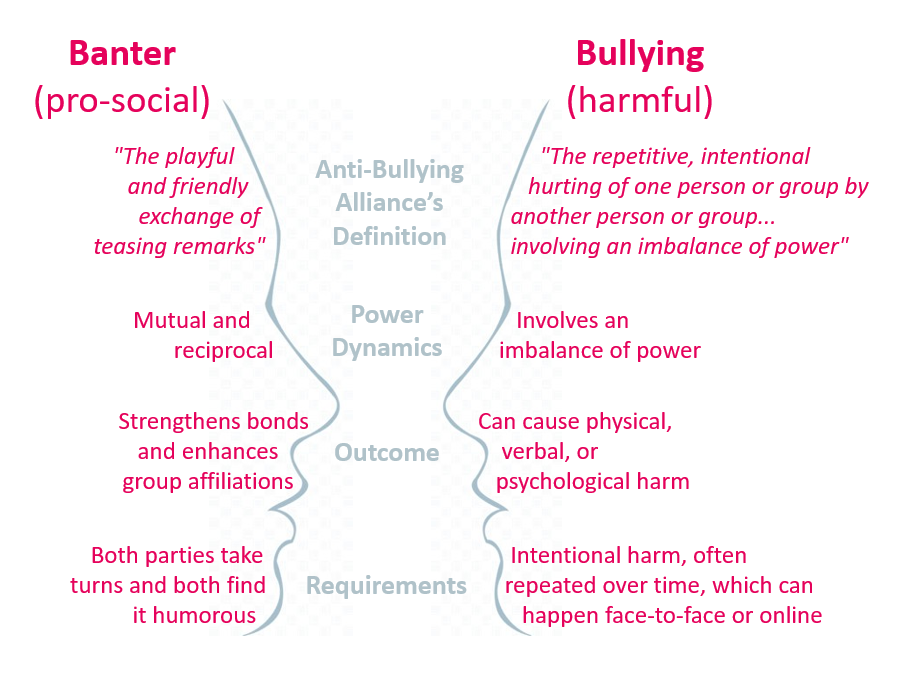
Banter (pro-social)
Anti-Bullying Alliance (ABA) Definition
"The playful and friendly exchange of teasing remarks."
Power dynamics
Mutual and reciprocal.
Outcome
Strengthens bonds and enhances group affiliations.
Requirements
Both parties take turns and both find it humorous.
Bullying (harmful)
Anti-Bullying Alliance (ABA) Definition
"The repetitive, intentional hurting of one person or group by another person or group... involving an imbalance of power."
Power dynamics
Involves an imbalance of power.
Outcome
Can cause physical, verbal, or psychological harm.
Requirements
Intentional harm, often repeated over time, which can happen face-to-face or online.
Our research
There is often a fine and subjective line between banter and bullying. Our research programme has explored how children, young people, and university students understand and experience banter across offline, online, and educational settings. Across multiple studies, we consistently found that there is often a fine and highly subjective line between playful banter and bullying. While banter can strengthen relationships, humour that causes harm is frequently minimised as “just banter”, making it difficult for those involved and those witnessing it to recognise when intervention is needed.
Our recent research explored teachers’ perceptions and management of banter in UK schools. Surveying 873 teachers across primary, secondary, and college settings, we found that while teachers recognised banter and bullying as distinct behaviours, many agreed there is a fine and subjective line between them. Teachers reported feeling less confident managing banter than bullying and highlighted the need for clearer guidance, training, and practical resources to help identify when banter remains positive and when it has crossed the line into harmful behaviour. These findings have directly informed the development of the Nottingham Model and our accompanying educational resources.
Read the full paper: Exploring UK Teachers’ perceptions and Management of Banter versus Bullying.
Rather than viewing banter as either entirely positive or entirely harmful, our research recognises that context matters. Drawing together findings across our programme of research, we developed the Eight Ways Banter Can Cross the Line of Acceptability.
The eight ways
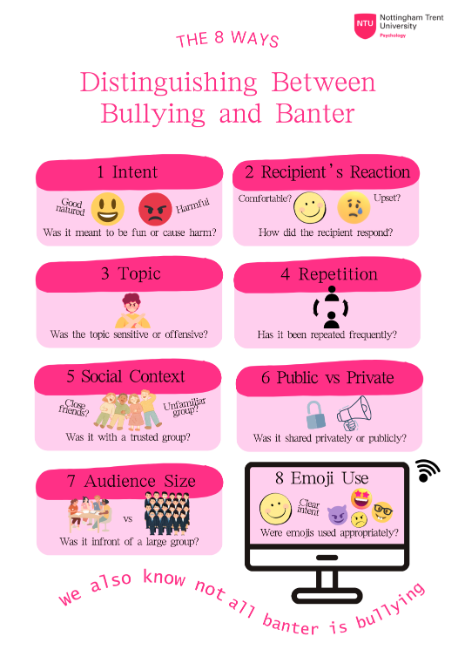
Understanding the distinction between appropriate (pro-social) banter, inappropriate banter, and bullying is crucial. Our research shows that banter can become harmful depending on the context, intent, and impact on those involved. These eight indicators can be used to help determine if an interaction remains appropriate or has crossed the line from appropriate banter to bullying type behaviours:
The eight ways: distinguishing between banter and bullying
1. Intent
Was it meant to be fun or cause harm?
2. Recipient's reaction
How did the recipient respond?
3. Topic
Was the topic sensitive or offensive?
4. Repetition
Has it been repeated frequently?
5. Social context
Was it with a trusted group?
6. Public vs private
Was it shared privately or publicly?
7. Audience size
Was it infront of a large group?
8. Emoji use
Were emojis used appropriately?
We also know not all banter is bullying.
Promoting positive banter
Our work at NTU is not about discouraging banter. Instead, it aims to promote positive, pro-social banter while ensuring harmful behaviours are recognised and addressed rather than being dismissed as “just banter”.
Our research recognised that banter is a positive communication behaviour that can strengthen friendships, promote social cohesion and create a sense of belonging when it takes place within respectful relationships. The Positive Banter Experience Framework, developed from our systematic review of the research literature, highlights the key features that underpin positive banter. These include reciprocal exchanges between friends, shared understanding, equal participation, appropriate topics, and humour that is intended to build relationships rather than cause harm.
The framework also recognises that banter is subjective and shaped by context. Whether an interaction is experienced as positive depends not only on what is said, but also on the relationship between those involved, the social situation and how the behaviour is received. When these expectations are not met, banter may become inappropriate or harmful.
Building on this research, the Nottingham Model provides schools with a practical framework that encourages respectful interactions while helping staff recognise when banter has crossed the line to bullying. Rather than discouraging humour and playful interactions, the model supports schools to encourage positive banter while ensuring harmful behaviours are never minimised as "just banter".
Tools:
We have developed a range of evidence-informed resources to help schools, teachers, and practitioners recognise, discuss and respond to banter and bullying. Each resource has been developed directly from our research and is designed to support the promotion of positive banter while helping identify when interactions have crossed the line into harmful behaviour.
| Resource name | What this resource does |
|---|---|
| The Nottingham Model | What is it? The Nottingham Model is a practical, whole-school framework for understanding and managing banter. It supports schools to promote positive, pro-social banter while ensuring that inappropriate or harmful behaviour is recognised and addressed rather than dismissed as “just banter”. Who is it for? School leaders, teachers, pastoral staff and other professionals responsible for behaviour, safeguarding and anti-bullying practice. How can it be used? The model can support the development and review of school policies, staff training and consistent approaches to responding to banter across the school community. Link: The Nottingham Model |
| Decision Trees | What is it? The decision trees are practical tools designed to help children consider whether an interaction is positive banter, inappropriate banter or bullying-type behaviour. How were they developed? They were co-created with Key Stage 2 pupils and informed by our research into the factors that influence when banter crosses the line of acceptability. Who is it for? Children, teachers, parents, carers and practitioners working with primary-aged pupils. How can it be used? Children can work through the questions independently or with adult support to reflect on the relationship, context and impact of an interaction. |
| Banter vs Bullying Toolkit (ABA/NTU) | What is it? Developed in partnership with the Anti-Bullying Alliance, this toolkit provides practical guidance and activities to help schools understand the distinction between banter and bullying. Who is it for? Teachers, school leaders, pastoral teams, and other professionals working with children and young people. How can it be used? The toolkit includes research-informed guidance, discussion activities and practical materials that can be used to explore when banter is appropriate, when it becomes harmful and how adults should respond. |
| CPD: Banter or Bullying? Navigating the Line of Accessibility (ABA/NTU) | What is it? This professional development course, developed with the Anti-Bullying Alliance, explores the complex and subjective boundary between banter and bullying. Who is it for? Teachers, school leaders, pastoral staff, safeguarding leads and other professionals working with children and young people. How can it be used? The course supports participants to recognise the characteristics of positive and harmful banter, understand how context and impact influence an interaction, and respond more confidently when banter may have crossed the line. |
| Anti-Bullying Week 2023 Resources | What is it? These research-informed classroom resources were developed by the Anti-Bullying Alliance for Anti-Bullying Week 2023 to support conversations about banter, bullying and positive peer relationships. Who is it for? Primary and secondary schools, including teachers, pastoral staff and pupils. How can it be used? The activities can be used in lessons, assemblies, tutor sessions or small-group discussions to help pupils explore the difference between positive banter and harmful behaviour. |
To find out more about our research – links to papers and podcasts:
Explore our research
Our practical resources are underpinned by a programme of research exploring how banter is understood and experienced by children, young people, university students, teachers and practitioners across educational, sporting and online settings. If you would like to explore the evidence behind our work, the following publications and media provide further insight.
Peer-reviewed publications
Explore our published research examining the characteristics of banter, the factors that influence when it becomes harmful, and its implications for education, sport and online environments.
- Understanding Banter: A Systematic Review of Literature to Conceptualize the Behaviors That Characterize Banter: https://onlinelibrary.wiley.com/doi/10.1111/sjop.70127
- Exploring UK teachers’ Perceptions and Management of Banter versus Bullying: https://www.tandfonline.com/doi/pdf/10.1080/15388220.2026.2699681
- The role of digital cues in online banter: a systematic review of adolescents’ and emerging adults’ views, uses and interpretations, 2024: https://link.springer.com/article/10.1007/s12144-024-06698-8
- “It’s all part of the culture”: undergraduate students’ experiences of banter in university sports clubs and societies, 2023: https://link.springer.com/article/10.1007/s12144-023-05026-w
- Banter Versus Bullying: a University Student Perspective, 2021 https://link.springer.com/article/10.1007/s42380-020-00085-0
- “I feel like everyone does it” – adolescents’ perspective and awareness of the association between humour, banter and cyberbullying, 2020: https://www.sciencedirect.com/science/article/abs/pii/S0747563220300522
- “People think it’s a harmless joke” young people’s understanding of the impact of technology, digital vulnerability and cyberbullying in the United Kingdom, 2017: https://www.tandfonline.com/doi/abs/10.1080/17482798.2016.1233893
The Conversation: Seven Ways that Banter Can Become Bullying
A research-informed article explaining how banter can escalate into bullying and highlighting the warning signs for parents, educators and practitioners. https://theconversation.com/seven-ways-that-banter-can-become-bullying-171462
Podcasts
Listen to members of the research team discuss how banter can foster belonging and friendships, why it can sometimes become harmful, and what schools can do to promote positive peer relationships. This includes:
- When Does Banter Cross the Line? (Reframe Podcast Series)
- Banter vs Bullying: Influencing Classroom Culture – Teacher Special (Reframe Podcast Series)
Video resources
Watch examples of banter and bullying in practice and learn more about the factors that help distinguish between the two.
Research impact
Our research has informed national anti-bullying guidance, classroom resources, and whole-school approaches to managing banter. Working collaboratively with schools, local authorities and the Anti-Bullying Alliance, we aim to support safer and more inclusive educational environments where positive banter can thrive, and harmful behaviour is recognised early.
Research team
This work has been developed by researchers within the Nottingham Trent University Banter and Bullying Research Group.
Other research contributors
- Filipa Godinho Duarte, research assistant
- Agii Badrakh, PhD researcher
- Hannah Lindsell, research assistant
We also thank and acknowledge the contributions of collaborators and students who have contributed to individual projects across the research programme.
Get in touch
Do you have questions? Are you interested in collaborating? Do you want to use our resources?
Contact us at BAB.research@ntu.ac.uk.