Top reasons to choose Veterinary Nursing at NTU
Graduating from the FdSc Veterinary Nursing course will open a wide range of career opportunities for you. You’ll develop competencies across all elements of the role, including the provision of skilled supportive care for sick animals; undertaking theatre work, laboratory diagnostic tests and radiography; assisting in consultation rooms; ordering medication; and ward work, including the general care and treatment of in-patients.
We work with a huge range of partners, so that you'll get expert insight from renowned industry professionals who regularly join our own world-leading academics; learning from the very best in the field. Our FdSc Veterinary Nursing degree is also accredited by the Royal College of Veterinary Surgeons (RCVS), enabling successful graduates to register as fully qualified veterinary nurses.
Real-world experience
On our FdSc Veterinary Nursing course, you will spend a minimum of 1,800 hours in clinical placement in an approved veterinary practice.
Graduate employability
100% of our Veterinary Nursing Top-up graduates are in work or further study within 15 months of finishing their degrees (of those available for work or study, latest Graduate Outcomes Survey 2023/24).
Graduate employers
Graduates from this course have successful careers in organisations such as Medivet, Vets4Pets, Animal Trust, Frank Pets Surgeons, Companion Care Vets, Prince Bishops Veterinary Hospital and Linnaeus Group.
Graduate salary
Recent graduates from this course are typically earning £25,000 within 15 months after leaving NTU.
Learn by doing - ECG analysis
ECG analysis has many uses within veterinary treatment and diagnosis but is most commonly used to measure heart rate and heart rhythm by attaching electrodes to the patient's limb points. Monitoring these measurements allows for indication of many health problems but is most commonly used while the patient is under anaesthesia - to ensure the patient is reacting safely to the ongoing treatment.
Developing practical skills like this is essential for your future career as a veterinary nurse, giving you the hands-on experience and confidence needed to carry out diagnostic procedures accurately in a clinical setting. This taster session offers a glimpse into the real-world techniques you’ll use in practice and helps prepare you for the responsibilities of the role.
Tyler Leek - Veterinary Nurse
After graduation Tyler went straight into a job that was directly related to his course and has now worked as a Veterinary Nurse for just over a year.
Get more from your course
Our courses are built around practical learning, particularly on our FdSc Veterinary Nursing degree. You will complete a minimum of 1,800 hours in clinical placement to facilitate your development of employment skills and provide you with the opportunity to apply your acquired skills and knowledge. You will also have lectures from industry experts, one-to-one tutorials with course tutors and visit specialist veterinary practices to build industry connections.
See your subject in action
Watch our subject videos and explore the facilities you'll be using to get real insight into what it's like to study Veterinary Nursing at NTU.
A day in the life of a Veterinary Nursing student
Wondering what your days might look like as a Veterinary Nursing student? We've crafted an example timetable to give you a glimpse into your first year. You are likely to study six modules over the year. You will also have practical sessions to cement your learning.
Please note that this is only an example timetable and does not reflect your actual timetable. Modules, contact days and times are subject to change. You will receive your full timetable when you enrol at NTU.
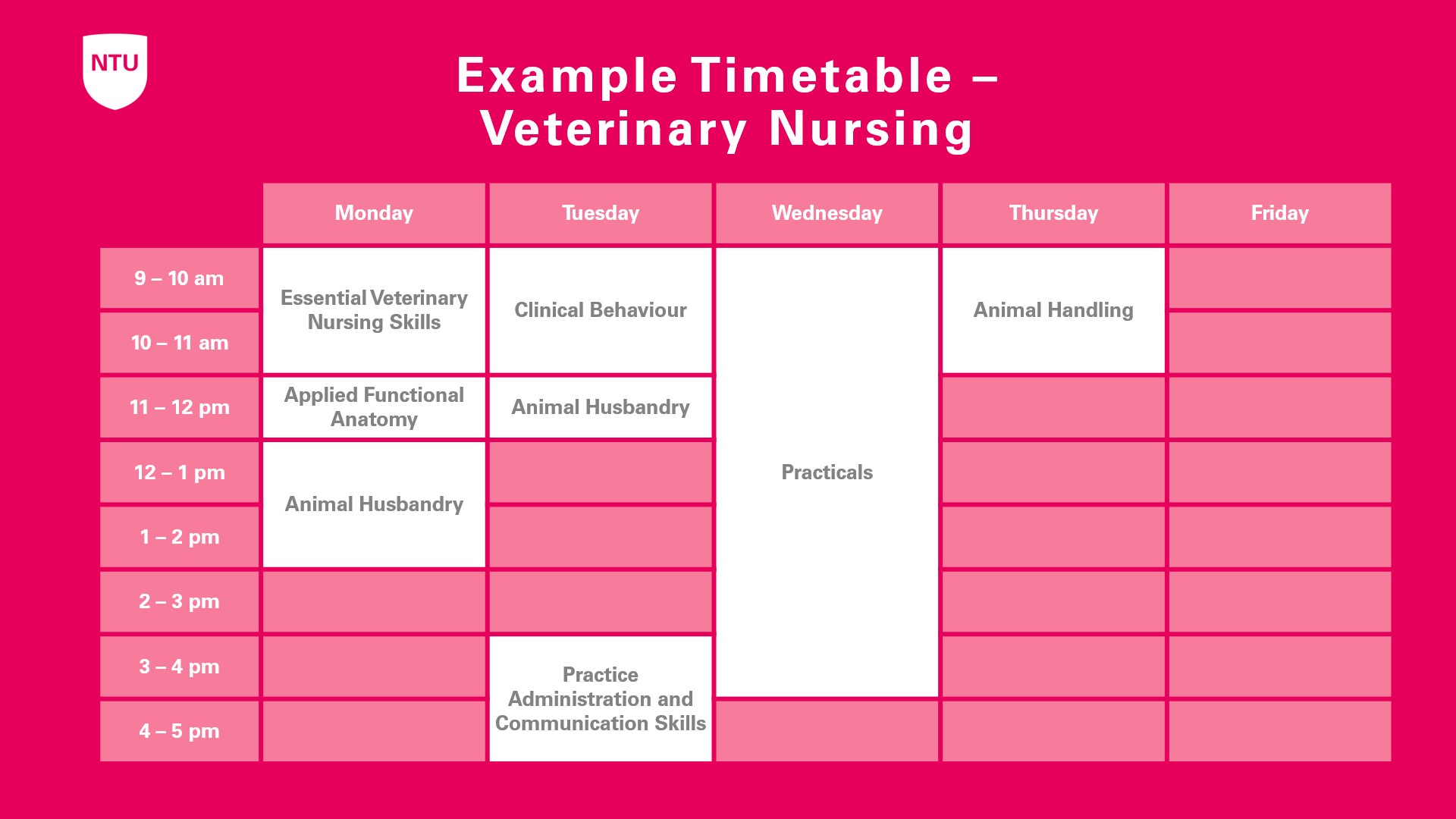
In this example students have a skills session on Monday morning, followed by two lectures. On a Tuesday there are 3 lectures, Thursday is taken up with practical skills, and there is one 2-hour lecture on a Thursday morning.
There's so much more to look forward to!
Find out about all the additional opportunities and extra-curricular activities you can get involved in as a student at NTU.
Study abroad as part of your NTU degree
Our study abroad opportunities offer you a flexible way to gain invaluable international experience as part of your degree. We have partnerships with over 300 institutions worldwide – study from one week to a whole year.
University Language Programme
The University Language Programme (ULP) provides language courses at different levels of proficiency to students, staff and members of the public.
See some of the facilities you'll get to use
You will be based at our Brackenhurst Campus – home to our specialised Veterinary Nursing Centre and Animal Unit. It is only a short hop to the bright lights of Nottingham city centre though, so you really do get the best of both worlds.
Veterinary Nursing Centre
The Veterinary Nursing Centre houses a simulated practice where you can train on a variety of equipment including simulation x-ray machines. The centre also includes a reception, dispensary, consultation rooms, theatre and a full surgery preparation area.
Animal Unit
You'll also have access to our Animal Unit to gain experience in handling a range of species. Our range of on-site animals is truly amazing – there are several hundred from over 70 different species, including dogs, cats, reptiles, rodents and birds!
What else you need to know about studying at NTU
Why study at NTU?
NTU is one of the most popular universities in the UK – find out why we should be your next step.
Accommodation
We make accommodation easy. Our halls of residence are secure, inclusive of all bills, and within easy reach of campuses and amenities, giving you more time to focus on your studies, settling in, and making friends.
Student life
University isn't just about your studies. Everything’s on offer here - there’s sport, art, music, food, and so much more. Find out about living here or how to commute to NTU.
Fees and funding
Everything you need to know about fees and funding while you’re at university, including tuition fees and living costs, how you’ll pay for your studies, and bursaries and scholarships.
The Stoneygate Award Programme
This award is worth £3,250 for each year of a student’s undergraduate degree (excluding any placement year). Hold an offer on a full-time undergraduate course for September 2026, check out the full eligibility criteria and apply here.
Take your next steps towards joining NTU
Whether you're ready to accept your offer, or still want a little time, we've got you covered.
If you've applied directly to NTU, or are progressing from Nottingham Trent International College (NTIC), log into the NTU Applicant Portal to check your next steps.
Meet your new course mates
Don't just take our word for it. Find out what it's really like to study at NTU and the amazing opportunities on offer from our students.
View your course page
Still need more information? Browse your course page for further details, including a list of all available course modules and potential graduate career options.