Artificial Intelligence (AI) is transforming the creative industries and reshaping how we design, make, and experience art, music and design. At NTU, we are leading the national conversation on AI in creative education, ensuring that our students are prepared to thrive in a future shaped by both human creativity and technological innovation.
Our approach focuses on curiosity, critical engagement, and responsible innovation, exploring how AI can expand creative potential, not replace it.
Empowering students for the future of creative work
As generative AI becomes part of everyday creative practice, NTU’s art and design courses ensure that students graduate with both technical fluency and critical awareness.
Through studio projects, collaborations and live briefs, students explore:
- How to use AI as a creative partner in ideation
- How to challenge bias and authorship in algorithmic image-making
- How to position their creative practice in an evolving digital landscape
By learning to use AI ethically and imaginatively, NTU graduates are ready to shape the future of the creative industries, equipped with the adaptability and insight employers demand.
Designed with students, for students
We believe students should help shape the conversation about AI in creative education. Developed with current students, staff and industry partners, our Generative AI Learning & Teaching Position Statement outlines how we approach AI across learning and teaching at Nottingham School of Art & Design.
NSA&D Generative AI Learning & Teaching Position Statement
This position statement was created in conversation with students and colleagues, and draws from discussions with our industry partners and wider NTU and sector communities. We will continue these important conversations about complex issues, and will review and update this statement regularly as conversations progress.
We recognise the many different individual values and positions about AI and its impacts, and value these varied perspectives that help us explore complex ideas as we learn together. Our approach is human-centred, and we commit to curiosity, critical engagement, and responsible innovation when exploring when, how and whether we might use AI to expand our creative potential, not replace it.
Our research and strong connections with industry partners help us make sure that teaching in NSA&D includes opportunities to experiment with relevant technologies and approaches, enabling students to develop key knowledge, skills, and experience relevant to both existing and emerging roles, within the creative industries and beyond.
Given the diversity of subjects in NSA&D, we do not promote one way of thinking about or using AI. Whilst use of AI is not a requirement for learning outcomes, we continue to make opportunities for learning, exploring varied perspectives with space to critically reflect and learn more about the impacts and ethical considerations of using AI.
Being informed about AI will help prepare our students to shape and influence the role of these tools in their future careers, guided by their knowledge, values, and a critical understanding of power, ethics, sustainability, and inclusivity.
Our values continue to help us (staff and students) develop our approaches:
1. We will continue our conversational approach that supports us in learning together and from each other.
2.We will respect each other’s views on AI regardless of whether we agree.
3.We will prioritise creativity and learning, and reflect critically on AI tools and their influence on our work.
4.We will be transparent about our use of AI.
5.We will remain accountable for our work, no matter how it was created.
Supporting our conversations
Our conversational approach is supported by our Educators Toolkit which was co-developed by members of staff, students and industry. The topics included represent key themes and ideas that often appear in conversations about our practice.
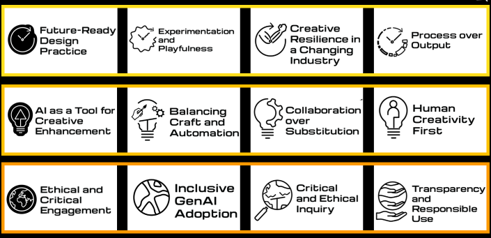
Art, Design & Artificial Intelligence: An Educator’s Toolkit
Definition: AI in this statement refers to Generative AI which includes tools that can be used to probabilistically generate outputs including text, images, video and sound etc.
A responsible and human-centred approach to AI
At NTU, we see AI not as a replacement for creativity, but as a new tool for expression, experimentation and critique.
Our focus is on developing responsible designers and artists who can engage thoughtfully with technology by balancing innovation with ethics, sustainability, and inclusivity.
It’s vital that universities consider not only how AI affects the way we experience and create art and design, but how students can become responsible designers who rise to this new creative challenge.
Professor Natalie Brown, Deputy Dean, Nottingham School of Art & Design
How are art and design courses responding to AI
Here are a few examples of how our courses are responding to generative AI.
In Fashion Communication and Promotion, students are supported to treat GenAI as a collaborator in L4, and use it alongside more traditional approaches. As a result, students are exposed to exciting and fresh possibilities for innovation, evidenced in both digital and physical outputs. In L6, students use GenAI to help visualise creative ideas and support pitch presentations to industry clients. In briefs involving ambitious or high-budget concepts, GenAI has enhanced students’ visual communication and contributed to students’ industry readiness.
As part of an externally-funded QAA collaborative project, Textile Design worked with a Liberty Fabrics, University of the Arts, London and Norwich University of the Arts to explore the role of generative AI in design education. Final year BA & MA students engaged with a wide range of GenAI tools to support ideation, visualisation, storytelling, and critical reflection. The open brief allowed for diverse approaches aligned to individual specialisms, while also supporting students to interrogate authorship, sustainability, and the ethical use of GenAI platforms. The project has informed future curriculum development and positioned Textile Design students as agile, digitally literate graduates ready for a changing industry.
In Illustration, students learn how to utilise GenAI platforms as ‘creative muses;’ prompting questions around topics, project ideas, and concept development. Academics create custom applications which support tasks including knowledge checks, answering simple queries, and providing prompts in art, philosophy, and theory which students can then explore further. Students also benefit from a range of tools to produce images, videos, and mood boards, as well as real-time GenAI outputs that students can critique and debate. Text-to-speech models are also used to improve accessibility for students. In addition, students learn how to perform tasks coding using plain language, enabling their work to come to life or take on new forms in a variety of ways.
Students spend time exploring the use of GenAI in suggesting starting points for research, curating basic reading lists, highlighting ongoing debates, and suggesting relevant thinkers and leaders in a particular space. By doing so, students develop an understanding of the benefits of using GenAI as part of their process, and its role in society. Students also explore the limitations of GenAI, including its tendency to validate the user rather than provide factual information, therefore not providing an objective or genuine approach.