Helping people experience nature became just as important to me as protecting it.
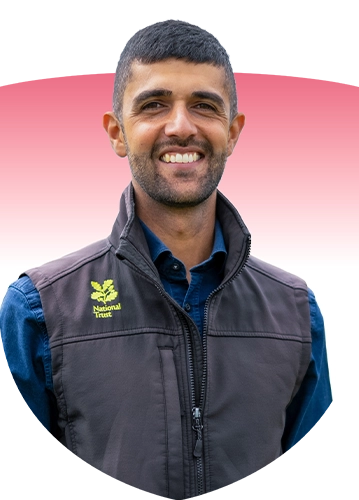
From NTU to bringing people closer to nature
I’m Ajay, and this is my story.
Nature has always been a big part of my life. Growing up in Market Deeping in South Lincolnshire, I spent most of my childhood outdoors, walking by the river, feeding ducks with my family and flicking through an old bird identification book. I didn’t always know what I was looking at, but something about being outside held my attention. Wetlands, birds and open spaces just felt familiar, and very much like home.
As I got older, that curiosity grew deeper. Learning about climate change, pollution and habitat loss made me realise that the natural world couldn’t and shouldn’t be taken for granted. Nature and the environment shifted from something I enjoyed, to something I wanted to help protect.
I realised this could be my future.
A week volunteering as a teenage ranger changed everything for me. It was the first time I saw conservation work up close: the early starts, the physical graft and the commitment behind it. I remember thinking: this is it. Not just an interest, but something I could build a life around.
The advice I received was simple – volunteer, gain experience and get a qualification. That guidance pointed me towards NTU’s Brackenhurst. I visited once and never looked back.
University helped me grow into the work.
I chose NTU because Brackenhurst felt like the right place to develop. From my first visit, it just felt right. Being surrounded by people who cared about conservation as much as I did, in a place that reflected the subject itself, made me feel I’d found where I belonged.
The course gave me practical skills in ecology, fieldwork and conservation law, but it also changed how I thought. Our lecturers encouraged us to question decisions, look at issues from different angles and understand that conservation is rarely straightforward. Those lessons have stayed with me throughout my career.
My career has taken me further than I ever expected.
After graduating, I began working on nature reserves, including Blakeney Point on the Norfolk coast. It’s remote, exposed and often challenging, but incredibly rewarding. I still remember guiding my first group and watching people experience wildlife up close for the first time. Seeing that connection happen never gets old.
Of course, the realities of conservation could be challenging. Long hours, predator control and living in a remote place were all part of the job. But some of the best moments came from helping people experience the landscape around them. I’ll never forget taking a group of local children out to the point, many of whom had never visited despite living nearby, and watching their faces as they experienced it for the first time.
Careers aren’t always linear – mine certainly wasn’t.
My original plan was simple: get a degree, volunteer, secure a placement and work in conservation. And I did that, albeit with more volunteering than anticipated before finally getting my first paid job. But then unexpected opportunities came along, from local radio to national television and working on BBC’s Springwatch, writing blogs and eventually books.
I realised I enjoyed communicating about nature just as much as working hands-on with it. Those unexpected turns shaped my career in ways I never anticipated.
It’s great helping others to experience nature.
Conservation is about more than protecting the natural world. You can protect spaces by keeping visitors out, but in the long term you also need public understanding and support. Through writing and broadcasting, I’ve tried to make nature feel more accessible. When people feel part of it, they’re much more likely to want to protect it.
I always try to stay positive.
We’re living through a biodiversity and climate crisis, and it can sometimes feel as though nature isn’t high enough on the political agenda. That can be extremely frustrating. But if all people hear is bad news, it’s easy for them to switch off. I think optimism helps keep people engaged, and that matters because engaged people are more likely to take action.
The results keep me going.
Conservation takes patience. You can spend months, even years, restoring a habitat without seeing immediate results, and then gradually wildlife returns. A rare bird nests. Wetland restoration attracts new species. Those moments remind me why the work is worthwhile.
My advice to everyone is to stay curious.
I’d recommend that you keep saying yes to opportunities you might not have expected. NTU gave me the skills and experience to get started, but so much of my career has come from staying open, following my interests and seeing where they led. There’s still so much to discover, and I’m excited to see where the next opportunity takes me.
Feeling inspired
Related profiles
Abbi McGlennon
"If you’d told me 10 years ago I’d complete a PhD, I’d have laughed at you. But here I am!"
Rowena Hill MBE
"Ask yourself not what you want to do, but where you want to spend your value."
Aaliyah Jabbar
"For any women worrying about joining a traditionally male-dominated industry, just ask yourself — why not you? Because I did it!"