The British Shoe Corporation: its legacy in the British footwear industry
How the British Shoe Corporation shaped the UK footwear industry and left its mark on Leicester. An explainer by Dr Naomi Braithwaite of the Nottingham School of Art & Design
By Dr Naomi Braithwaite | Published on 20 October 2026
Categories: Press office; Research; School of Art & Design;
What you need to know:
Founded in 1956 by Charles Clore, the British Shoe Corporation (BSC) grew into the UK’s largest footwear retailer through the acquisition of established shoe brands.
By 1983, BSC held 20% of the UK footwear market, with more than 2,000 retail outlets across the country.
BSC had a significant presence in the East Midlands, with its Leicester headquarters and warehouse supporting local employment, staff benefits and operational innovation.
Despite its dominance on the high street, BSC ceased operations in 1998 following financial losses, changing consumer habits, offshore manufacturing competition and management challenges.
What was the British Shoe Corporation
The British Shoe Corporation (BSC) was founded in London as a footwear conglomerate in 1956 by Charles Clore (1904 – 1979), a British philanthropist, financier, property and retail magnate. Clore later went on to acquire the London department store Selfridges. BSC was formed from an amalgamation between Clore’s J. Sears Ltd holdings and the long-established British footwear brand, Freeman Hardy and Willis Ltd.
How BSC became a market leader in shoes
BSC grew to become the largest footwear retailer within the UK through its continued acquisition of footwear brands which included Manfield and Sons Ltd, Dolcis Ltd, Saxone, Lilley & Skinner, Curtess Ltd, Trueform, alongside Olympus Sport, Hush Puppies, Shoe Express, Roland Cartier and Cable & Co. BSC’s huge portfolio of brands gave it a prominent place on the high street across the United Kingdom, with over two thousand retail outlets, selling ladies’, men’s and children’s shoes, across four sectors, family, quality, fashion and value. By 1983 BSC was the market leader for footwear in the UK, holding 20% market share. The company’s early success was attributed to its focus on its manufacturing position in the UK which shortened lead times for deliveries, and a slick replenishment system between warehouse and retail stores.
BSC and the East Midlands
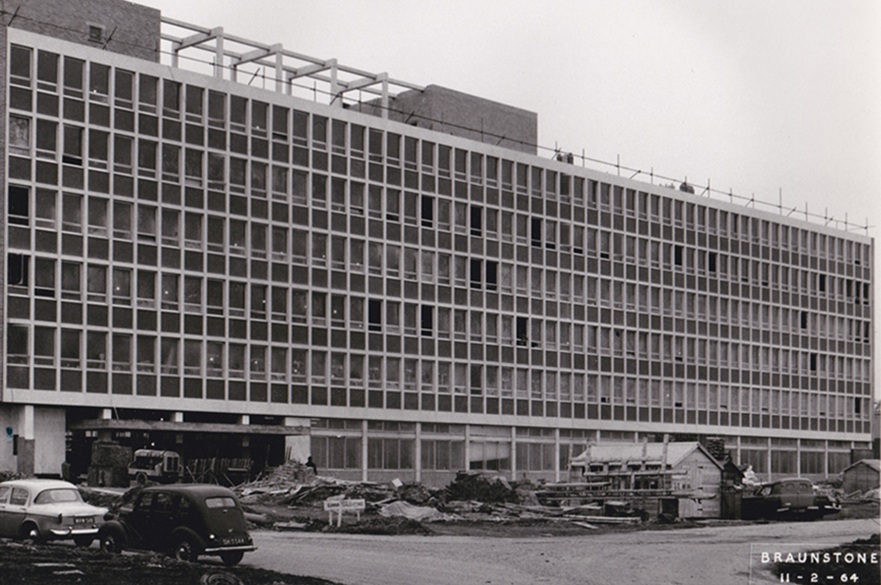
In 1964 BSC moved into a newly built Head Office and warehouse site in Braunstone in Leicester. Transport to and from the Braunstone site was supported by a free staff bus with over 15 routes, which operated into the 1990s when it was eventually axed because of cost cutting measures. The warehouse was the largest of its kind recorded in Europe with workers using bicycles to get around its vast square footage.
A people focused business
BSC offered many perks to its Leicester based staff which included a variety of sports’ clubs, a social club, subsidised dining rooms, overtime shifts and opportunities for career progression.
Innovation
BSC was an early adopter in integrating computer systems and moving towards more sustainable practices with the use of electricity across the retail stores.
The fall of BSC
In July 1998 BSC ceased operations. The 1990s had seen a series of losses and the sale of some of the brand portfolio. BSC’s decline was due to a variety of factors which included the push towards more competitive offshore manufacturing, the shift in consumer purchasing habits and tastes, the rise of clothing brands integrating footwear into their collections and undoubtedly a series of questionable management decisions.
The lasting legacy of BSC
Despite its eventual fall BSC was a significant contributor to the UK footwear industry through its distinct position in fashion retail and dominance on the high street.
Dr Naomi Braithwaite is an Associate Professor in Fashion and Material Culture at Nottingham School of Art and Design. Naomi is an active researcher at NTU leading on projects that use ethnographic methods to question relationships between fashion and identity. Her research is ground breaking with global reach and involves significant collaborations with other HEIs in the UK and worldwide. Naomi’s work is widely published in print and online and she has a strong track record of contributing to public exhibitions and speaking platforms such as the Conversation, the V&A and Chatham House.