
More about Ruth
Ruth Amey graduated with a BSc (Hons) in Mathematics and is now pursuing an MSc in Artificial Intelligence. She joined the Mathematics Undergraduate Research Scholarship (MURS) Scheme: a research experience programme for mathematics students to enhance their studies.
We caught up with Ruth to find out more about her experience studying at NTU so far...
Was was your motivation behind choosing to study Mathematics at university?
Ruth: I studied Mathematics because I have a passion for solving complex problems and experiencing the thrill of eureka moments when overcoming challenging equations. My passion for being challenged and investigating patterns within numbers has greatly influenced my academic choices. I enjoy manipulating equations and delving into the intricacies of mathematical problems. Currently, I am planning to further my studies at NTU with an MSc in Artificial Intelligence.
NTU has significantly influenced my career goals, instilling confidence that becoming a machine learning engineer is within reach. My time at NTU has been immensely enjoyable, motivating me to pursue further studies. This positive experience has led me to stay on for a master's degree, and I am likely to continue onto a PhD afterwards. NTU has played a pivotal role in shaping my aspirations and supporting my journey.
What area of mathematics would you like to explore more of?
Ruth: I thoroughly enjoyed my end-of-year project, which involved analysing mammograms of breast cancer using deep learning to classify tumours as malignant or benign. Given the opportunity to explore any area without limitations, I would delve further into the application of mathematics and machine learning to develop advanced methods for early breast cancer detection. This research could be revolutionary, potentially saving lives by enabling earlier diagnosis and preventing the cancer from spreading undetected.
How was your experience being part of MURS (Mathematics Undergraduate Research Scholarship)?
Ruth: I discovered the MURS Scheme when it was introduced to all students in our department as a potential opportunity. My interest in machine learning and desire to pursue a career in this field motivated me to apply. I was eager to learn the fundamentals with the guidance and support the scheme promised. The reality exceeded my expectations, providing a highly beneficial experience. Not only did I grasp the basics of machine learning, but I also applied this knowledge to several projects, one being my final year project, which was significantly enriched from this scheme.
There was the opportunity to be involved with other students also taking part in the scheme. However, everyone I spoke to was doing something completely different to me, so although it was interesting to hear what they are up to, it wasn’t beneficial for my research. The MURS Scheme prompted me to delve deeper into the mathematical principles underlying various machine learning models, providing me with a comprehensive understanding of how these complex mathematical concepts are applied in real-world scenarios.
During the MURS Scheme, I significantly improved my independent research skills and gained a comprehensive understanding of the fundamentals of machine learning. These skills are invaluable for my future career, particularly when applying for positions that require expertise in machine learning. Additionally, an unexpected benefit was the opportunity to apply theoretical knowledge to practical projects, enhancing my problem-solving abilities and giving me hands-on experience that will be beneficial in any future role.
Tell us about your research project analysing historical health data to predict health conditions?
Ruth: The research project I worked on involved analysing historical health data to predict whether individuals had specific health conditions based on new data. My main responsibilities included ensuring the data was balanced, complete, and properly scaled. After cleaning the data, I experimented with various models to determine which yielded the best results. To evaluate the performance of these models, I used different metrics such as accuracy and ROC curves.
The weekly meetings with my supervisor were instrumental in my project and learning experience. They provided a platform for me to seek help or receive suggestions whenever I encountered obstacles. These meetings also helped me stay on track with my progress, ensuring that I neither fell behind nor took on too much work in a single week.
How do you think other student can get comfortable adjusting to university life?
Ruth: The guidance of your tutor and insights are invaluable, so don't hesitate to seek their help and ask questions. I found learning at home to be challenging, but having access to expert advice in my case significantly accelerated my progress.
The support from tutors and staff at NTU is great. They are always helpful and friendly, creating an environment where questions are encouraged.
If you could give a TED Talk on any subject, what would it be?
Ruth: If I could give a TED Talk, it would be about my final year project on how AI can revolutionise the cancer industry. This topic is crucial for a general audience to understand because AI has the potential to drastically improve early diagnosis of cancer, leading to better patient outcomes. Additionally, AI can be used to discover new drugs more efficiently, reducing the need for extensive animal and human testing. This innovation would not only accelerate the development of life-saving treatments but also make the process more ethical and cost-effective.
Still need help?
-
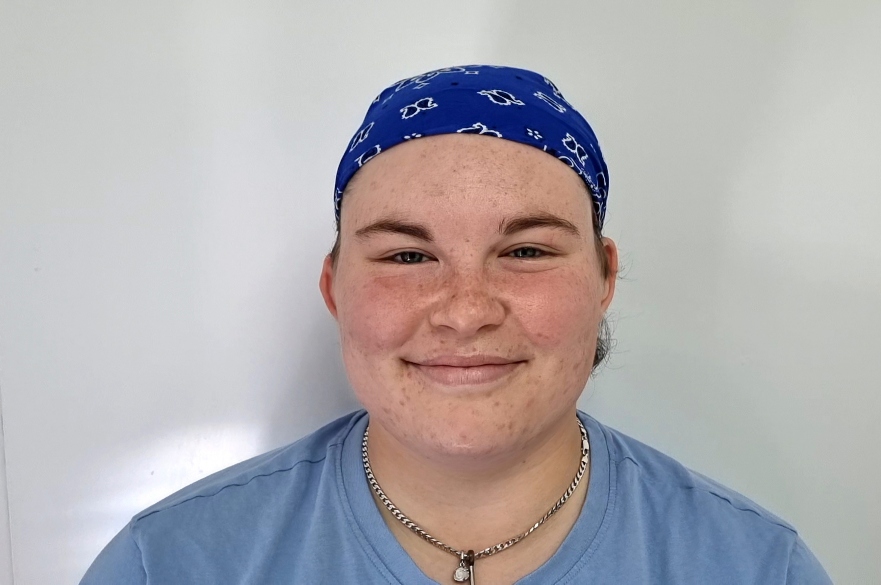
STUDENT PROFILE
Emily Hollingshead
MathematicsUnited Kingdom
https://www.ntu.ac.uk/study-and-courses/courses/our-students-stories/science-technology/emily-hollingshead
-

STUDENT PROFILE
Fiifi Arthur
Financial MathematicsUnited Kingdom
https://www.ntu.ac.uk/study-and-courses/courses/our-students-stories/science-technology/fiifi-arthur
-

STUDENT PROFILE
Jordan Jackson
Financial MathematicsUnited Kingdom
https://www.ntu.ac.uk/study-and-courses/courses/our-students-stories/science-technology/jordan-jackson