Innovative smart textile band will monitor muscle health and improve healthy ageing
Scientists are developing a smart textile band which aims to objectively detect and monitor sarcopenia, an age-related condition defined as loss of muscle mass, function and power.
By Dave Rogers | Published on 25 September 2025
Categories: Press office; Research; School of Art & Design; School of Science and Technology;
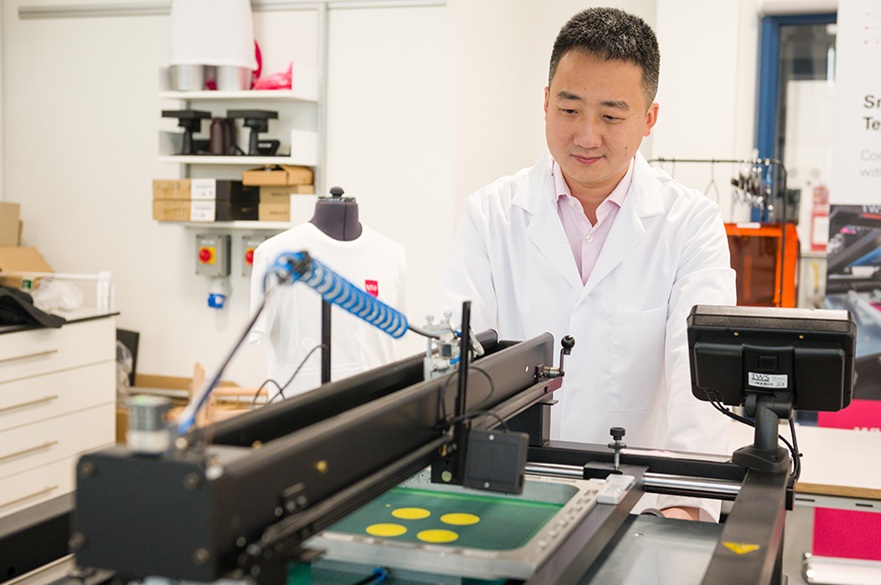
The research brings together experts from Nottingham Trent University, Newcastle University and Axomics Medical Ltd.
It is being supported through funding from Wellcome Leap’s global Dynamic Resilience program, jointly funded with the Temasek Trust, which aims to reduce progression to frailty in those over the age of 65 by 25%, improving the quality of life for older people.
The wearable device, known as the Axoband, will feature fully screen-printed flexible electrodes to measure electrical signals generated by the muscles. It will also include an embedded electronic sensor capable of tracking movement.
The project is being led by Professor Yang Wei in Nottingham Trent University’s Medical Technologies Innovation Facility and is underpinned by earlier work led by Dr Annette Pantall, Co-Principal Investigator, CEO of Axomics Medical Ltd, and formerly of Newcastle University.
Sarcopenia affects about ten percent of people over 60 and is as common as type 2 diabetes. It impacts quality of life and is associated with reduced mobility and an increased risk of falls.
There is also a high economic burden, with muscle weakness and associated falls estimated to cost the UK alone £2.5bn a year.
The number of people diagnosed globally is forecast to rise by more than a quarter in the next 25 years as the population ages.
Despite its prevalence, sarcopenia remains difficult to diagnose due to the lack of objective, quantitative tools, something which also hampers the development of effective treatments aimed at improving muscle mass and function.
The Axoband, designed to be worn on the leg, will be low cost to manufacture, stretchable and washable.
Bespoke software will process signals recorded from the band during clinical tests and will provide a quantitative measure of muscle health and an app will indicate the probability that the patient has sarcopenia.
Having an accurate method of diagnosing sarcopenia and monitoring progression will enable clinicians to start treatment earlier, as well as identifying effective treatments, which can include nutritional, exercise and pharmaceutical interventions. This will help reduce the severity or delay the onset of clinical frailty.
“There is currently no quality way to diagnose, monitor and assess sarcopenia,” said Yang Wei, principal investigator and Professor of Wearable Technology in NTU’s Nottingham School of Art & Design and the academic lead of smart medical textiles in Medical Technologies Innovation Facility (MTIF).
He said: “With sarcopenia becoming a growing problem in an ageing population, this is crucial in ensuring people are diagnosed more quickly and efficiently, allowing the right measures to be put in place as soon as possible.”
Dr Annette Pantall, who laid the groundwork for this new phase of development, said: “We are delighted to be part of Wellcome Leap’s Dynamic Resilience program and to have the opportunity to further develop the Axoband and associated software.
“This innovative device will make a tremendous difference to the quality of life of older adults and also to people with muscle loss associated with chronic diseases such as diabetes, liver disease, chronic obstructive pulmonary disease and cancer.”
Notes for Editors
Press enquiries please contact Dave Rogers, Public Relations Manager, on telephone +44 (0)115 848 8782, or via email.
Nottingham Trent University (NTU) has been named UK ‘University of the Year’ five times in six years, (Times Higher Education Awards 2017, The Guardian University Awards 2019, The Times and Sunday Times 2018 and 2023, Whatuni Student Choice Awards 2023) and is consistently one of the top performing modern universities in the UK.
Students have voted us the best university in the UK and 1st in the UK for student employability (Uni Compare 2025).
NTU is 4th in the UK for number of undergraduate students (HESA 2023-24) with over 36,000 students and more than 4,000 staff located across six campuses. It has an international student population of 6,000 and an NTU community representing over 160 countries.
NTU owns two Queen’s Anniversary Prizes for outstanding achievements in research (2015, 2021). The first recognises NTU’s research on the safety and security of global citizens. The second was awarded for research in science, engineering, arts and humanities to investigate and restore cultural objects, buildings and heritage. The Research Excellence Framework (2021) classed 83% of NTU’s research activity as either world-leading or internationally excellent.
NTU was awarded GOLD in the national 2023 Teaching Excellence Framework (TEF) assessment.
NTU is a top 10 for sport (British Universities and Colleges Sport league table 2025) and was named as Sports University of the Year (Daily Mail University Guide 2025). It has also been ranked as 25th in the UK by the Guardian University Guide 2026.
NTU is a holder of the University Mental Health Charter recognising the commitment an institution has shown towards continuous improvement in the area of mental health and wellbeing.
NTU is the most environmentally sustainable university in the UK and second in the world (UI Green Metric University World Rankings, 2024).