Videogame To Help Protect Nottingham Cathedral And Other Heritage Buildings
By Chris Birkle | Published on 16 October 2025
Categories: Press office; Research; School of Architecture, Design and the Built Environment;
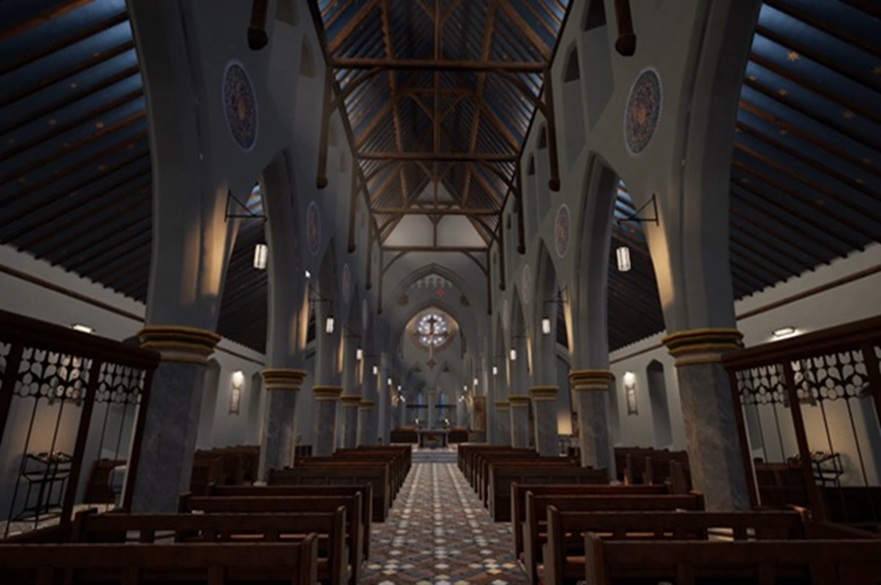
Videogame to help protect Nottingham Cathedral and other heritage buildings
A videogame which allows players to explore a high resolution 3D virtual model of Nottingham Cathedral aims to teach the next generation about the importance of protecting local heritage.
Led by Professor Benachir Medjdoub, an expert in digital architecture at Nottingham Trent University (NTU), ‘Pugin’s Revival’ was co-designed with local schoolchildren to help engage young people in the importance of conserving historic architecture.
It forms a key component of Nottingham Cathedral's 'Restoring Pugin' project which aims to restore the original early Victorian decorations to the Cathedral's east end, whilst at the same time engaging a wide public with the Cathedral's heritage story.
The game, which sees players save the Grade II* listed building from ruin at the hands of structural ‘monsters’, is being rolled out to schools and community spaces across Notts to educate young people about the problems facing heritage buildings, and how they can be tackled.
Designed in collaboration with pupils at Loughborough Schools Foundation, Stanton Vale School in Long Eaton and Bennerley Fields School in Ilkeston, the game is narrated by the voice of Augustus Pugin, the architect who built the Cathedral between 1841 and 1844.
Players are confronted by crack, humidity, and mould ‘monsters’ who damage the building’s fabric and present players with a challenge about which they have to develop knowledge in order to overcome. Once they have acquired the right knowledge, they go on to "conquer" the monster and repair the damage.
The game also contains riddles hidden in secret chests and a map which guides players on where to go. A quiz at the end of the game tests the knowledge learned.
An interview with Professor Benachir Medjdoub
“This game allows young children and adults alike to learn about the real issues being faced by those who are conserving our beautiful architectural heritage,” said Professor Medjdoub, of the School of Architecture, Design and the Built Environment.
“The children we’ve worked with were instrumental in designing this game to make it engaging for the next generation so that they can appreciate and understand how and why our historic architecture must be saved.
“For example, it was the children’s idea to place Pugin as the narrator. They learned how he was a prominent architectural figure in the early Victorian period and that he was the mastermind behind the design of Nottingham Cathedral.
“They also wanted to include the monsters as metaphors for the different ways that damage occurs to heritage buildings, making it a more engaging way to learn.
“It’s important that we not only raise awareness but also give children the knowledge from a technical point of point of view of how these buildings need to be maintained.”
The game is part of a wider £120,000 research project with funding from The National Lottery Heritage Fund. It involved game technology research fellow Annamalai Selvarajan and game environment artist Dora Holloway, both of NTU. Dr Ana Souto, Dr Moulay Chalal, and Dr Nacer Bezai of NTU, were co-investigators.
A 20 minute version of the game has been created for schools and community centres, while a one hour version is available for more serious gamers. A smartphone version will be created going forwards.
People can download and play the game on Windows platform by clicking this link.
Jane Hellings, Project Manager of Restoring Pugin at Nottingham Cathedral, said: “It is an important goal of Restoring Pugin to inform new generations both about the environmental threats to our built heritage, and to inspire them to pursue careers in heritage conservation and restoration.
“Pugin's Revival is a brilliantly engaging and unique tool for young people which will form part of a careers pack rolled out to schools - eventually on a national basis.”
Canon Malachy Brett, Cathedral Dean, said: “We have greatly valued the input of Professor Medjdoub and his team in our project development phase, and are grateful to players of the National Lottery for enabling this funding.
“As the Restoring Pugin project moves forward, with paint restoration now well underway, we look forward to this next phase of working with NTU and their school partners in deploying the videogame.
Notes for Editors
Press enquiries please contact Chris Birkle, Public Relations Manager, on telephone +44 (0)115 848 2310, or via email.
Nottingham Trent University (NTU) has been named UK ‘University of the Year’ five times in six years, (Times Higher Education Awards 2017, The Guardian University Awards 2019, The Times and Sunday Times 2018 and 2023, Whatuni Student Choice Awards 2023) and is consistently one of the top performing modern universities in the UK.
Students have voted us the best university in the UK and 1st in the UK for student employability (Uni Compare 2025).
NTU is 4th in the UK for number of undergraduate students (HESA 2023-24) with over 36,000 students and more than 4,000 staff located across six campuses. It has an international student population of 6,000 and an NTU community representing over 160 countries.
NTU owns two Queen’s Anniversary Prizes for outstanding achievements in research (2015, 2021). The first recognises NTU’s research on the safety and security of global citizens. The second was awarded for research in science, engineering, arts and humanities to investigate and restore cultural objects, buildings and heritage. The Research Excellence Framework (2021) classed 83% of NTU’s research activity as either world-leading or internationally excellent.
NTU was awarded GOLD in the national 2023 Teaching Excellence Framework (TEF) assessment.
NTU is a top 10 for sport (British Universities and Colleges Sport league table 2025) and was named as Sports University of the Year (Daily Mail University Guide 2025). It has also been ranked as 25th in the UK by the Guardian University Guide 2026.
NTU is a holder of the University Mental Health Charter recognising the commitment an institution has shown towards continuous improvement in the area of mental health and wellbeing.
NTU is the most environmentally sustainable university in the UK and second in the world (UI Green Metric University World Rankings, 2024).