Why community-engaged research should play a bigger role across the university sector
Collaboratory Research Hub is bringing universities and communities together to shape research around local priorities. Established in 2022, the partnership now spans five East Midlands universities, supporting 79 doctoral researchers and placement candidates alongside more than 82 community partners. From suicide prevention to youth employment, its work shows how involving communities in research can generate relevant insights, widen access to PhDs and help inform positive change.
By Matthew Gilmour-Young | Published on 28 October 2026
Categories: Press office; Research; NTU Doctoral School;

At a time when universities are often asked to demonstrate the impact of their research, some of the most meaningful impact happens when research is developed with communities rather than simply about them. That belief sits at the heart of Collaboratory Research Hub.
In 2022, Nottingham Trent University, the University of Nottingham, community and civic organisations, as well as local residents, came together with a shared ambition: to create a different model of doctoral research, one where communities have a meaningful place in the research process, where talented people who might not otherwise consider a PhD can access postgraduate research opportunities, and where research helps address priorities and challenges identified by local communities themselves.
Three years later, that ambition has grown into a partnership involving five universities in the East Midlands: the University of Nottingham, Nottingham Trent University, De Montfort University, the University of Leicester and Loughborough University.
Today, Collaboratory supports two regional chapters across Nottinghamshire and Leicestershire and Rutland, bringing together more than 82 community partners, 172 academic supervisors, and 79 doctoral researchers and citizen science research placement candidates, including a policy research placement training programme delivered in partnership with the University of Derby and the East Midlands Combined County Authority (EMCCA).
While those numbers tell one part of the story, the real value of Collaboratory lies in its approach.
Traditionally, research questions are often designed within universities before communities become involved. Collaboratory takes a different approach. Community organisations and local residents help identify priorities, shape projects, and remain involved throughout the research journey through the Local Voices in Research Workshops, organised annually across Nottinghamshire and Leicestershire and Rutland. As a result, the research is not only academically rigorous but grounded in the realities of the communities it aims to serve.
This approach creates a different relationship between universities and local communities. Instead of research being conducted about communities, it is developed alongside the people it matters to most.
Research that starts with real-world challenges
One of the advantages of community-engaged research is its ability to connect academic expertise with lived experience.
Across Collaboratory, researchers are exploring issues such as knife crime, suicide prevention, child-friendly cities, community wellbeing and the use of public spaces. These are complex challenges that cannot be understood through a single lens.
By bringing together researchers, community organisations and local people, the programme creates opportunities for different perspectives and forms of knowledge to inform the research process. The result is research that is more closely connected to local priorities and more likely to create meaningful change.
This does not end here. The programme also invites community and civic sector professionals from across the East Midlands each year to meet researchers working on projects designed with local communities, for the benefit of local communities. Attendees can learn about the latest research findings from our candidates and how they can inform positive change, share opinions and insights on how the programme's research should grow and evolve directly with researchers, and network with like-minded individuals who are all working to improve life in our communities.
For universities, this approach strengthens relationships with the communities they serve. For communities, it creates opportunities to influence the research agenda and contribute directly to the development of new knowledge, particularly around what is important to them.
Rethinking who gets to do a PhD
Community-engaged research is not only about changing how research is done. It is also about changing who gets to take part. For many people, doctoral study can feel out of reach. Traditional academic routes do not always reflect the diverse experiences and backgrounds that exist within our communities.
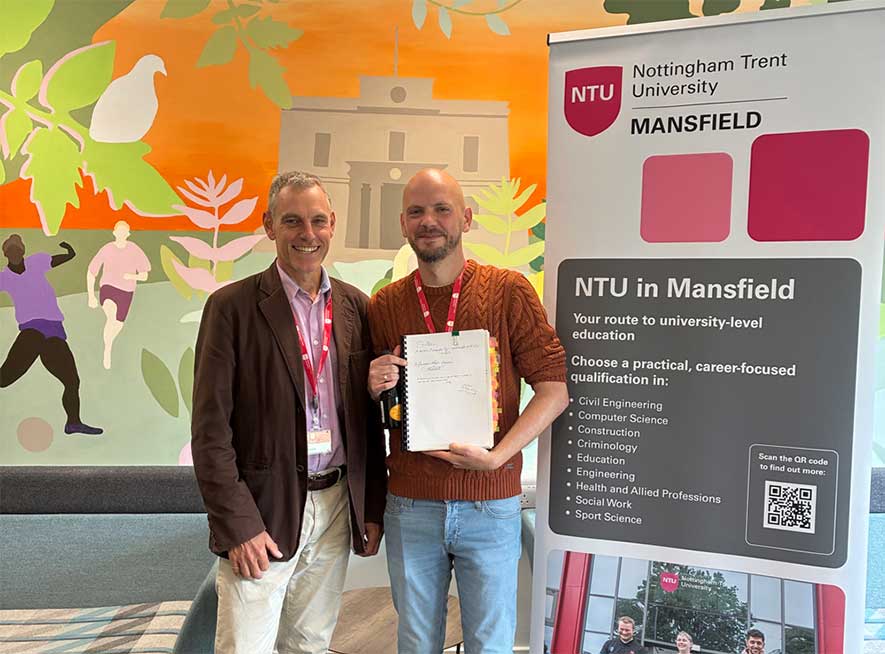
One person who challenged that perception is Dr Stuart Greensmith White. Growing up in Mansfield, Stuart never imagined he would one day complete a PhD.
After studying business, teaching in further education colleges and working in school administration, Stuart came across a Collaboratory studentship on Facebook with just days remaining before the deadline. He applied and joined the programme's first cohort.
In September 2026, he became Collaboratory's first doctoral researcher to successfully submit his PhD thesis without making amendments.
"I never thought I would get the chance to do a PhD. I am the first person in my family to go to university."
Dr Stuart Greensmith White
His research, What does it mean to be ‘work-ready’? Investigating the education-employment transition for young people in former coalfield areas, explores an issue with direct relevance to communities across the region.
It has generated a richer understanding of how young people and families in Mansfield and Ashfield experience the transition between education and employment.
One important finding is the need to challenge deficit-based assumptions about former coalfield communities. While employability policy can focus on individual aspiration and motivation, participants described a more complex picture shaped by local opportunities, family experiences, structural factors and access to support.
The research also found that families could feel excluded from formal careers advice despite influencing young people’s decisions. Listening directly to young people and families has provided insight that could inform future employability policy and support.
The work has reached wider audiences through conference presentations, with publication opportunities also being considered. However, the partnership recognised that meaningful impact may depend less on academic publication than on sharing findings through local networks and influencing education and employment policy or practice. The PhD also strengthened Stuart’s confidence, critical thinking and academic capabilities, providing an opportunity he had previously considered out of reach.
Stuart's story demonstrates the value of opening doctoral opportunities to people from different backgrounds, experiences and career paths. The challenges facing our communities are diverse, and the people researching them should be too.
A model for the future?
Through Collaboratory, we have seen the benefits of bringing communities into the research process from the beginning. Community partners help shape research questions, researchers develop skills beyond academia, and projects remain connected to the people and places they are intended to benefit.
As universities continue to think about research impact, civic responsibility and widening participation, community-engaged research offers a powerful way to bring these priorities together.
There is no single model that every institution should follow. However, the principle is simple: listen to communities, involve them early, value lived experience, and create meaningful opportunities for collaboration.
Collaboratory has shown that this approach can work at scale while maintaining academic excellence. More importantly, it has shown that when communities and universities work together, research can become more relevant, more inclusive, and more impactful.
As Collaboratory enters its final recruitment round, we hope to see more researchers join this growing movement that is rethinking what a PhD can be and who it can be for.
Collaboratory is a pioneering eight-year, £7.4 million project funded by Research England, part of UK Research and Innovation (UKRI), and supported by Nottingham Trent University, the University of Nottingham, the Universities for Nottingham partnership, the University of Leicester, De Montfort University, Loughborough University and the Universities Partnership.
Applications for our fully funded 2027 PhD studentships are now open.