Why were there no werewolf trials in Britain and Ireland?
While thousands of people faced witchcraft prosecutions across early modern Europe, Britain and Ireland recorded no werewolf trials. Professor Helen Hall examines what folklore can reveal about cultural beliefs and the criminal justice system.
By Rev'd Professor Helen Hall | Published on 27 October 2026
Categories: Press office; Research; Nottingham Law School;
Many people are familiar with the wave of witchcraft trials that swept Europe and colonial North America during the early modern era. Exact statistics are not available, but contemporary scholarship estimates that between 40,000 and 60,000 people were executed during these persecutions.
The phenomenon was closely tied to a belief that witches were people who made a pact with the Devil, imagining that they would receive supernatural powers in return.
Theories differed as to whether or not Satan kept his side of the bargain and actually enabled his followers to perform evil magic, but some scholars were adamant that this was a possibility. The ability to transform into a werewolf was one of the dark arts that a person might acquire, meaning that werewolves were understood as a subcategory of witch.
Consequently, werewolf trials were a feature in many European jurisdictions, with the notorious case of Peter Stumpp in 1589 being a famous example. After being coerced into confessing, Stumpp was tortured and executed, alongside his teenage daughter and a woman accused of being his mistress. The brutality of the punishment was shocking even by the standards of the sixteenth century and reflects the fear that werewolves provoked.
There were numerous similar cases, particularly in German- and French-speaking regions. However, the Atlantic Archipelago did not see a single werewolf prosecution.
Why might this have been? It is fair to observe that England, Ireland and Wales experienced far fewer witchcraft trials than many neighbouring countries, but none of these places escaped entirely.
Furthermore, around 6,000 people were prosecuted for witchcraft in Scotland between the sixteenth and eighteenth centuries. The total Scottish population was only around 800,000 during this period, making that number of trials even more striking. Despite this, no trace of werewolves has survived in the records.
Could the disappearance of wolves explain the absence of trials?
One possible explanation is that wolves were driven to extinction at a comparatively early date in these islands, meaning that fear of them receded. If there were no wolves in the wilderness, the threat of an unnaturally intelligent and savage wolf may have seemed too remote to latch onto the popular imagination.
The difficulty with this theory is that wolves kept their place in folklore, and rumours of a few packs surviving in remote areas appeared plausible as late as the 1700s in the Scottish Highlands. Wolves were reliably attested in Ireland until the 1780s.
Werewolves weren't always seen as evil
An alternative possibility is that werewolves did not feature in the narratives of witch trials because they were presented differently in cultural terms.
In Ireland, there were stories that depicted werewolves positively. For instance, Gerald of Wales, an Anglo-Norman chronicler, includes a tale of godly werewolves in his account of Ireland. He describes a travelling priest meeting a distressed werewolf, who begs him to give last rites to his dying wife, who is also in wolf form. The priest agrees, and the female werewolf is able to end her life as a medieval Christian would wish.
Gerald leaves the reader in no doubt that although the couple are doomed to live their lives as beasts, due to a curse on their community, they are benevolent, in possession of human souls and have a place in Heaven. Nor are they unique as human-wolf hybrids who are presented positively.
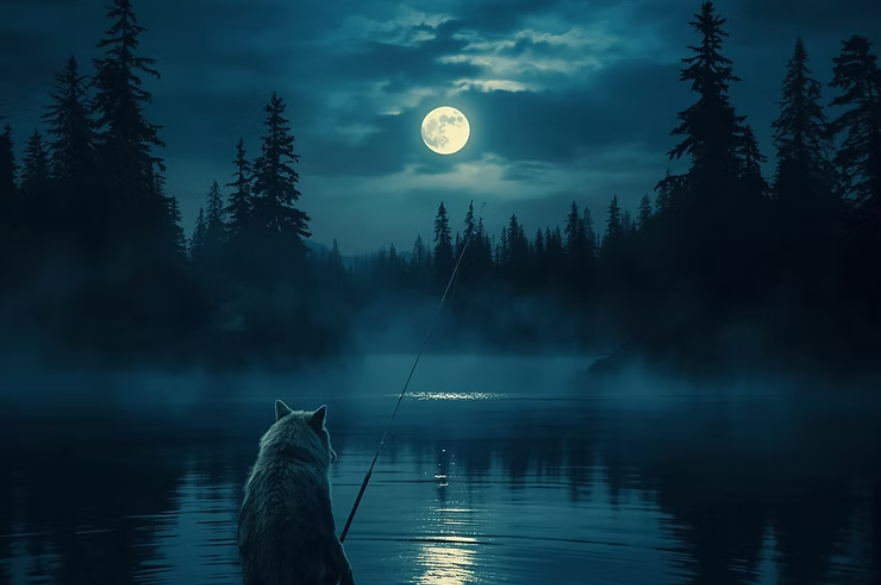
The wulver features in the mythology of the Shetland Islands and has the physical traits of a werewolf, with a human-like body and a wolf's head, but a kindly disposition. They live like hobbits in caves dug into the hillsides and spend most of their time fishing. Wulver are known for helping travellers lost in the mist and leaving gifts of fish on the windowsills of the poor and the sick.
It might be that the peoples of Great Britain and Ireland liked the werewolves who padded their way through fireside tales, and therefore did not readily associate them with monstrous traitors making pacts with the Devil and slaughtering their neighbours.
There were reports of shape-shifting within the witch trials, but these were framed in relation to the general activities of witches or fairies. Werewolves were quite literally on the side of the angels.
What werewolf stories tell us about criminal justice today
This is an intriguing possible solution to the curious incident of the werewolf doing nothing in the nighttime, but it also raises some wider questions about the operation of law.
It is well established that supernatural narratives are of importance when it comes to the investigation of crimes and the testimony of witnesses. To operate effectively, people working within justice systems need to understand that individuals will make sense of their experiences, and frame their accounts, in terms that are in harmony with their worldview.
Whether or not third parties share those perceptions and ideas, they need to understand what is being expressed. So, for example, if a witness refers to a ghost having revealed something to them, it is possible to listen to the information being conveyed without necessarily accepting the reality of ghosts.
However, we are perhaps less inclined to appreciate that collective narratives, including those in folklore and popular culture, shape the way in which entire systems operate. The sphere of criminal justice is not exempt. Choices about which crimes to prosecute, as well as the ways in which cases are presented by lawyers and received by judges and juries, are influenced by the assumptions and ideas current within society.
Tropes about gender, social class, age and countless other factors influence perceptions of culpability, vulnerability, trustworthiness and suspicion. This was true in the era of European witch trials, but remains an observable reality today.
Further reading:
Brian Levack, The Witch-hunt in Early Modern Europe (Longmans: Harlow), 1995.
A Rowlands, Witchcraft and Masculinities in Early Modern Europe (Palgrave Macmillan: London), 2009.