Recently Appointed To The Board Of Peace Blair Is Uniquely Unqualified To Oversee Gaza Reconstruction
By Dr Matt Barr | Published on 26 January 2026
Categories: Press office; Research; School of Social Sciences;
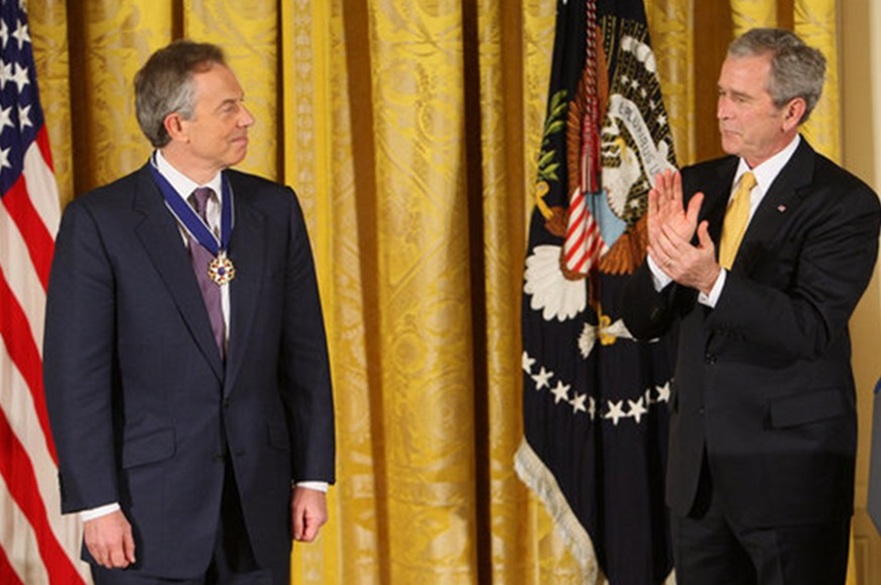
Tony Blair’s appointment as part of a newly created Gaza ‘board of peace’ by Donald Trump should raise eyebrows given his central role in the illegal invasion of Iraq in 2003. Rather than a peacemaker, his reputation in the region – and largely at home – is that of a warmonger. However, more significantly than any semantical debate around this title, his record of failure regarding post-war reconstruction in Iraq, officially overseen under his leadership as one of the legally recognised occupying powers, should be uniquely disqualifying for any role in post-conflict Gaza.
The lack of post-war planning for Iraq was a central criticism of the Iraq Inquiry, published in 2016. The 2.6-million-word report laid out in exhaustive detail the Blair government’s post-war failings, describing the planning as “wholly inadequate”. The report is scathingly critical not just of the policies but the decision-making processes that produced them, including the informal “sofa government” style that excluded experts, dissenting voices, and even Cabinet ministers. Blair was also faulted for failing to identify clear ministerial responsibility for post-war preparations. The Inquiry further described the war planning itself as a strategic failure, insufficient to secure the country after invasion, and with Britain’s six-year occupation yielding only “meagre” results, despite enormous human and financial costs.
Alone, these failings should disqualify Blair from any role in post-conflict reconstruction, especially in the Middle East. However, post-war failure in Iraq was not just about technical mistakes or unpreparedness. Added to this, Blair’s biases towards, and ignorance of, the region led to significant misjudgements, which doesn’t bode well for success in Gaza.
Initially, the post-war policy was one of ‘liberate and leave’: rapidly withdrawing after the military victory having turned over the country to Iraqis to administer following top-tier reforms of government institutions. This presumed the existence of functioning state structures capable of governance following Saddam’s overthrow. The reality was these agencies had been hollowed out after decades of Ba’athist governance, war, and sanctions. Prior to the war, Iraq functioned as a “shadow state”, with institutions transformed to prioritise maintaining Saddam’s power rather than governing society. That Blair viewed this as a viable option exposes not only his ignorance of the country he sought to transform, but a refusal to engage seriously with those who understood it.
This illusion collapsed once troops entered Baghdad, whereby post-war policy was rapidly recalibrated, shifting from swift withdrawal to a prolonged occupation that saw no elections until 2005. Prioritising their own strategic objectives over creating a broad-based, centralised democracy, Blair and the US fundamentally recast Iraqi politics. As a Chatham House retrospective outlines, the Coalition “feared the emergence of strong institutions that could provide a cornerstone for any one group to centralize power and move against their interests.”
With power unavailable through democratic institutions, contests moved away from formal structures, fragmenting political authority. This fostered localised power struggles and patronage, undermining inclusive governance and coherent national institutions, leading to significant civil violence and creating the conditions in which ISIS emerged.
Despite this, Blair blames sectarianism as the cause of post-war failure, something experts have described as being “historically and sociologically illiterate”, and leans towards an Orientalist understanding of the region. This essentialist view is ahistorical, missing elements such as inter-faith marriage being commonplace before 2003, especially in places like Baghdad, a city that then became segregated after outbreaks of civil violence post-2003. Focusing on sectarianism, whilst on the surface is perhaps understandable, masks the broader power dynamics at play, largely the result of the disastrous post-war governance Blair oversaw which prioritised at all costs the US-UK occupation and their strategic objectives.
Blair’s view also contrasts starkly to anyone who has been to Northern Iraq who can tell you of the clear divide between two Kurdish factions – the PUK and KDP – contesting authority between themselves, Likewise, whilst violence between Sunni and Shia’s was extreme after the 2003 invasion, these groups are not monoliths, with even the Iraq Study Group – overseen by former US Secretary of State James Baker – acknowledging that intra-sectarian violence was prevalent amongst the Shias in southern Iraq after 2003.
This ‘clash of civilisations’ type logic – that it is an intractable (religious) conflict – is often also applied to Israel-Palestine, likewise, obscuring the broader political and historical dynamics at hand; Blair’s precedent in this regard is worrying in the context of any role he may have in reconstructing Gaza.
Fraught with difficulty, well-intentioned mistakes happen in post-conflict situations, be that Iraq post-2003 or Gaza today. Yet, Blair’s repeated refusals to apologise for his role in the Iraq War suggests an unwillingness to learn, which inspires no confidence that time has made him better placed to succeed in Gaza where he failed so catastrophically in Iraq.
Rebuilding Gaza – devastated by a tonnage of explosives reported to exceed the equivalent of six Hiroshima-sized atomic weapons – is urgently needed, but given his past failures and enduring blind spots, Tony Blair is perhaps uniquely unqualified to help do so.
Dr Matt Barr is a senior lecturer in international relations in the School of Social Sciences