Nottingham Business School conference prepares students for AI driven world of work
More than 1,200 students gained first hand insight into the rapidly changing world of work at Nottingham Business School’s (NBS) inaugural Future of Work Conference, where industry leaders and global experts explored how artificial intelligence, emerging technologies and shifting workplace expectations are reshaping future careers.
By Helen Breese | Published on 5 March 2026
Categories: Press office; Nottingham Business School;
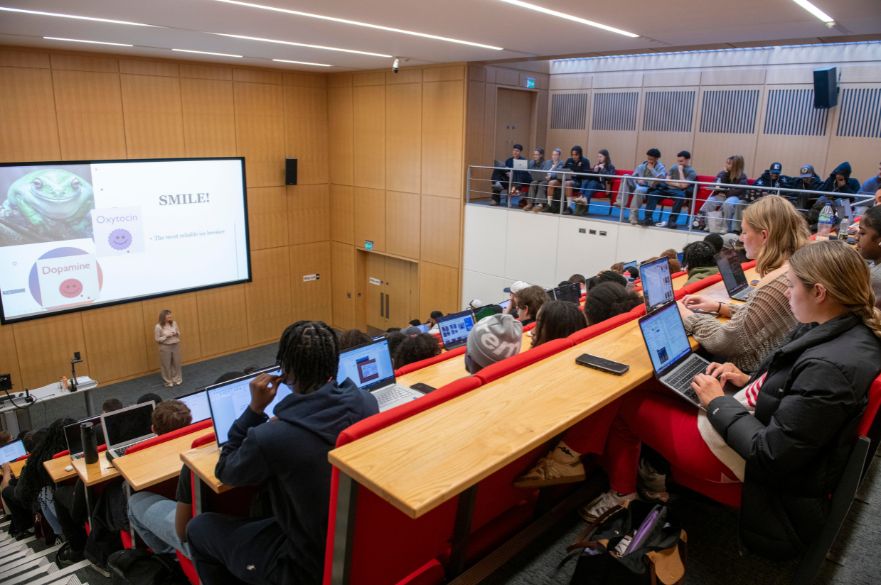
The week-long conference was shaped by real‑world expertise, giving students the chance to learn directly from more than 80 speakers.
Guests included investment bankers, public sector leaders, HR directors, founders of AI start‑ups, digital nomads, sustainability experts, behavioural psychologists, social commerce entrepreneurs and senior civil servants – many of whom were NBS alumni returning to share insights from diverse and international careers.
They covered a breadth of topics, from behavioural economics to hybrid work, sustainability, personal branding, global skills and finance.
This year’s programme also included hands‑on sessions in project management, entrepreneurship, side‑hustle creation, finance, global mobility and workplace resilience. Live placements Q&As, networking practice sessions and sustainability workshops gave students practical tools for building their CVs and future career pathways.
The conference forms a central part of NBS’s commitment to preparing future‑ready graduates with the skills, confidence and practical insight needed to succeed in a rapidly changing world.
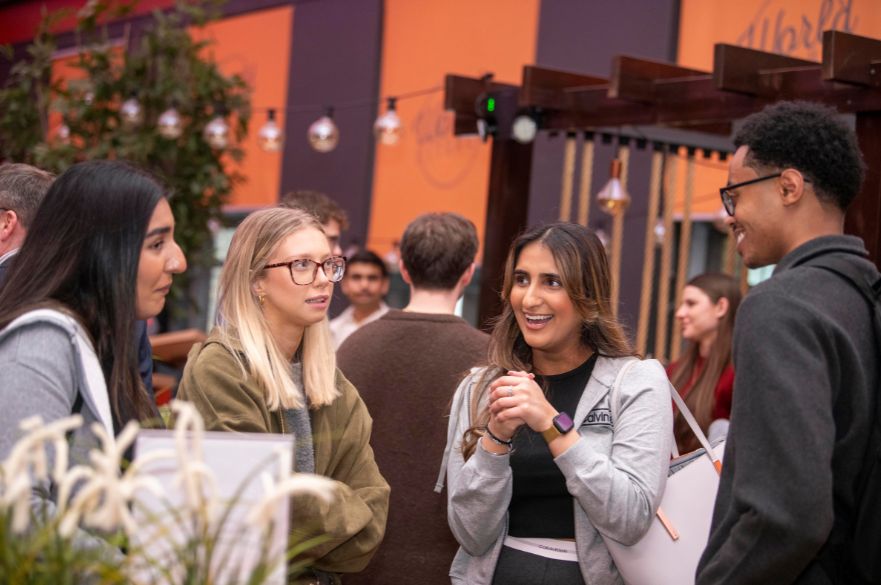
The event aimed to build confidence and make NBS graduates future ready.
A strong theme running throughout the week was the importance of AI literacy, with sessions covering AI screening in recruitment, machine‑human collaboration, responsible innovation, digital personal branding and the risks of generic AI tools, AI‑augmented decision‑making in finance, and robotics and future job creation.
Speakers working at the cutting edge of AI all emphasised that future graduates will need to combine technical understanding with human qualities such as adaptability, critical thinking and emotional intelligence.
Sheray Rufai‑Graham, second‑year Business Management and Marketing student, said: “My experience at the Future of Work Conference was very insightful and relevant for my course, but I loved how the talks were suited for all business courses.”
Dr Shelley Clark, Head of Personalisation and Experiential Learning at NBS, said: “Future‑focused skills and meaningful real‑world experiences are at the heart of what we do at Nottingham Business School.
“This week was about empowering our students to understand the changing landscape of work, explore new possibilities and build the confidence to take ownership of their career journey.
“Their energy and engagement demonstrate just how ambitious and capable our students are, and we’re excited to continue supporting them as they grow into the leaders and innovators of tomorrow.”
Notes for Editors
Press enquiries please contact Helen Breese, Public Relations and Research Communications Manager, on telephone +44 (0)115 848 8751, or via email.
About Nottingham Business School at Nottingham Trent University
Nottingham Business School (NBS) at Nottingham Trent University (NTU) is a leader in experiential learning and personalisation of business, management and economics education and research, combining academic excellence with positive impact on people, business and society. NBS has an unrivalled level of engagement with business, public and voluntary organisations. With more than 8,500 students, NBS is also one of UK’s largest business schools.
NBS is triple crown accredited by EQUIS, AACSB, and AMBA, placing it amongst the top 1% of business schools globally. NBS is also accredited by Small Business Charter, providing support and development for SMEs, and is a PRME Champion - held up as an exemplar and beacon by the United Nations Principles of Responsible Management Education (PRME).
In The Guardian University Guide 2026, all NBS courses were ranked in the UK Top 20. Subject areas covering Accounting and Finance, Business and Management, Economics and Marketing and PR were all recognised for excellence in teaching, high student satisfaction and strong graduate career prospects.
About Nottingham Trent University
Nottingham Trent University (NTU) has been named UK ‘University of the Year’ five times in six years, (Times Higher Education Awards 2017, The Guardian University Awards 2019, The Times and Sunday Times 2018 and 2023, Whatuni Student Choice Awards 2023) and is consistently one of the top performing modern universities in the UK.
Students have voted us the best university in the UK and 1st in the UK for student employability (Uni Compare 2025).
NTU is 4th in the UK for number of undergraduate students (HESA 2023-24) with over 36,000 students and more than 4,000 staff located across six campuses. It has an international student population of 6,000 and an NTU community representing over 160 countries.
NTU owns two Queen’s Anniversary Prizes for outstanding achievements in research (2015, 2021). The first recognises NTU’s research on the safety and security of global citizens. The second was awarded for research in science, engineering, arts and humanities to investigate and restore cultural objects, buildings and heritage. The Research Excellence Framework (2021) classed 83% of NTU’s research activity as either world-leading or internationally excellent.
NTU was awarded GOLD in the national 2023 Teaching Excellence Framework (TEF) assessment.
NTU is a top 10 for sport (British Universities and Colleges Sport league table 2025) and was named as Sports University of the Year (Daily Mail University Guide 2025). It has also been ranked as 25th in the UK by the Guardian University Guide 2026.
NTU is a holder of the University Mental Health Charter recognising the commitment an institution has shown towards continuous improvement in the area of mental health and wellbeing.
NTU is the most environmentally sustainable university in the UK and second in the world (UI Green Metric University World Rankings, 2024).