Ultrasound-activated ‘nanoagents’ kill superbugs hiding in biofilms
Scientists have designed nanoagents that act like smart drug‑delivery capsules – carrying an antibiotic deep into bacterial infections sites and releasing it only when activated by gentle ultrasound.
By Dave Rogers | Published on 2 March 2026
Categories: Press office; Research; School of Science and Technology;
Delivering antibiotics locally, directly to the site of an infection, is important, because treating the whole body with high doses increases the chances of bacteria developing resistance. Nanoagents can carry drugs straight to the infected area providing localised therapy with minimal amount of drug, reducing the risks of antibiotic resistance.
Publishing their findings in JACS Au, researchers from the University of Birmingham and Nottingham Trent University reveal the results of designing the particles so they can hide an antibiotic, rifampicin, in their interior and testing their antibacterial activity when ultrasound is applied. An antimicrobial drug, rifampicin is used to treat tuberculosis and Staphylococcus aureus infections, including those associated with medical implants.
Many bacterial infections form biofilms - sticky, protective layers that make them very hard to treat. Biofilms cause a lot of infections and resist many antibiotics because the drugs cannot easily penetrate their thick structure. Water repelling antibiotics like rifampicin are especially ineffective because they struggle to get deep inside these moist, gel like biofilms.
In their studies the researchers show that low frequency ultrasound not only helps the nanoparticles to move deeper into the biofilm but also causes tiny bubbles that shake the drug loose from the particles at just the right time.
Professor Zoe Pikramenou, from the University of Birmingham, said: “We found that these nanoparticles are only activated with ultrasound to release the drug and they kill bacteria in biofilms far better than rifampicin alone, as they travel through all the layers of the biofilm.”
“The particles are biocompatible and showed low toxicity to human epithelial cells, suggesting strong potential for future medical use. We’ve found a new way to deliver difficult antibiotics more effectively, using an approach that could be adapted for other hard-to-deliver drugs, potentially including cancer therapies.”
Dr Sarah Kuehne, Associate Professor of Microbiology in Nottingham Trent University’s School of Science and Technology, said “Deploying such particles may mean that lower doses of the drug are needed, reducing the risk of antibiotic resistance and unwanted side-effects.
“Biofilm infections are common in wounds, , implants, and medical devices but hard to treat. This approach allows hard-to-reach areas to be treated.”
Staphylococcus aureus biofilms treated with nanoparticles combined with ultrasound killed 90% of the biofilm. Without ultrasound they achieved only 20 % reduction, while treatment with free rifampicin and LFUS resulted only in a 10 % reduction. Without ultrasound, the nanoparticles only reached the top 1.6μm of the biofilm, but with ultrasound they reached about 5.6μm, nearly the entire thickness.
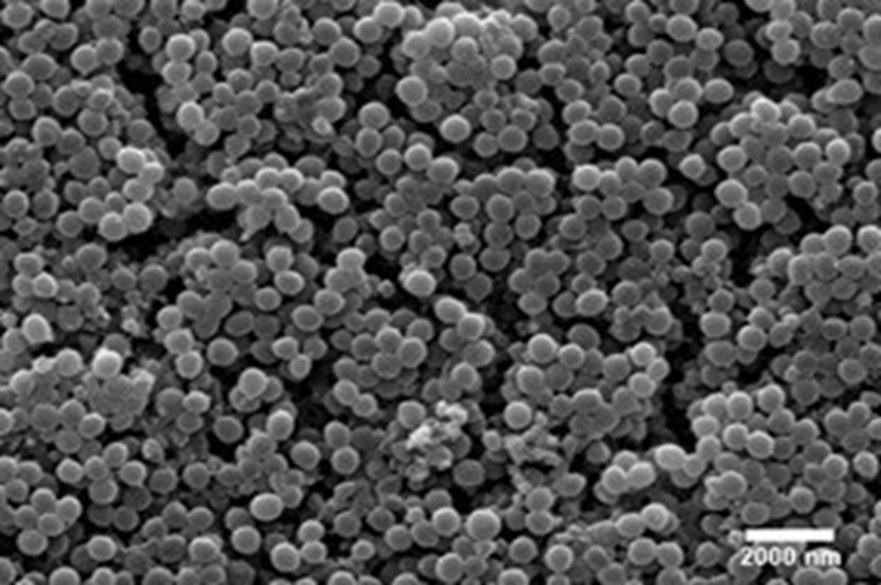
The nanoagents are tiny silica particles designed with a water repelling inner core to hold the drug and a ‘water-loving’ outer shell so that they remain stable in biological environments. Researchers also made a fluorescent version of the particles by adding dye so they could track them inside the biofilms, supporting the localised delivery of the drug and penetration depth.
An excellent team of early career researchers supported the studies drawing expertise from nanoparticles, ultrasound, microbiology and solid state particle characterisation. The project was funded by EPSRC, “SONATA” grant led by Zoe Pikramenou, Damien Walmsley, and Sarah Kuehne.
Professor Pikramenou leads a nanochemistry group at the University of Birmingham. The team runs a broad range of research projects based on light-activated nanoparticles for detection and localised therapies.
Notes for Editors
Press enquiries please contact Dave Rogers, Public Relations Manager, on telephone +44 (0)115 848 8782, or via email.
‘Ultrasound-Responsive Nanoparticles Enable Hydrophobic Antibiotic Release and Deep Penetration for Biofilm Treatment’ - Maria L. Odyniec, Daniel J. Bell, Benjamin M. Gallant, Rininta Firdaus, Grace Ball,a Liam Hughes, Rebecca Oxtoby, Benjamin J. Hewitt, Christopher M. Williams, Asier R. Muguruza, Tim W. Overton, Hung-Ji Tsai, Yu-Lung Chiu, Dominik J. Kubicki, A. Damien Walmsley, Sarah A. Kuehne, and Zoe Pikramenou is published in JACS Au.
Nottingham Trent University (NTU) has been named UK ‘University of the Year’ five times in six years, (Times Higher Education Awards 2017, The Guardian University Awards 2019, The Times and Sunday Times 2018 and 2023, Whatuni Student Choice Awards 2023) and is consistently one of the top performing modern universities in the UK.
Students have voted us the best university in the UK and 1st in the UK for student employability (Uni Compare 2025).
NTU is 4th in the UK for number of undergraduate students (HESA 2023-24) with over 36,000 students and more than 4,000 staff located across six campuses. It has an international student population of 6,000 and an NTU community representing over 160 countries.
NTU owns two Queen’s Anniversary Prizes for outstanding achievements in research (2015, 2021). The first recognises NTU’s research on the safety and security of global citizens. The second was awarded for research in science, engineering, arts and humanities to investigate and restore cultural objects, buildings and heritage. The Research Excellence Framework (2021) classed 83% of NTU’s research activity as either world-leading or internationally excellent.
NTU was awarded GOLD in the national 2023 Teaching Excellence Framework (TEF) assessment.
NTU is a top 10 for sport (British Universities and Colleges Sport league table 2025) and was named as Sports University of the Year (Daily Mail University Guide 2025). It has also been ranked as 25th in the UK by the Guardian University Guide 2026.
NTU is a holder of the University Mental Health Charter recognising the commitment an institution has shown towards continuous improvement in the area of mental health and wellbeing.
NTU is the most environmentally sustainable university in the UK and second in the world (UI Green Metric University World Rankings, 2024).