Public asked to help select UK wildlife to appear on new banknote series
The public are being asked to give their views on a selection of wildlife, native to the UK, that will appear on the next series of banknotes in a consultation launched today.
By Dave Rogers | Published on 3 June 2026
Categories: Press office; Research; School of Animal, Rural and Environmental Sciences;
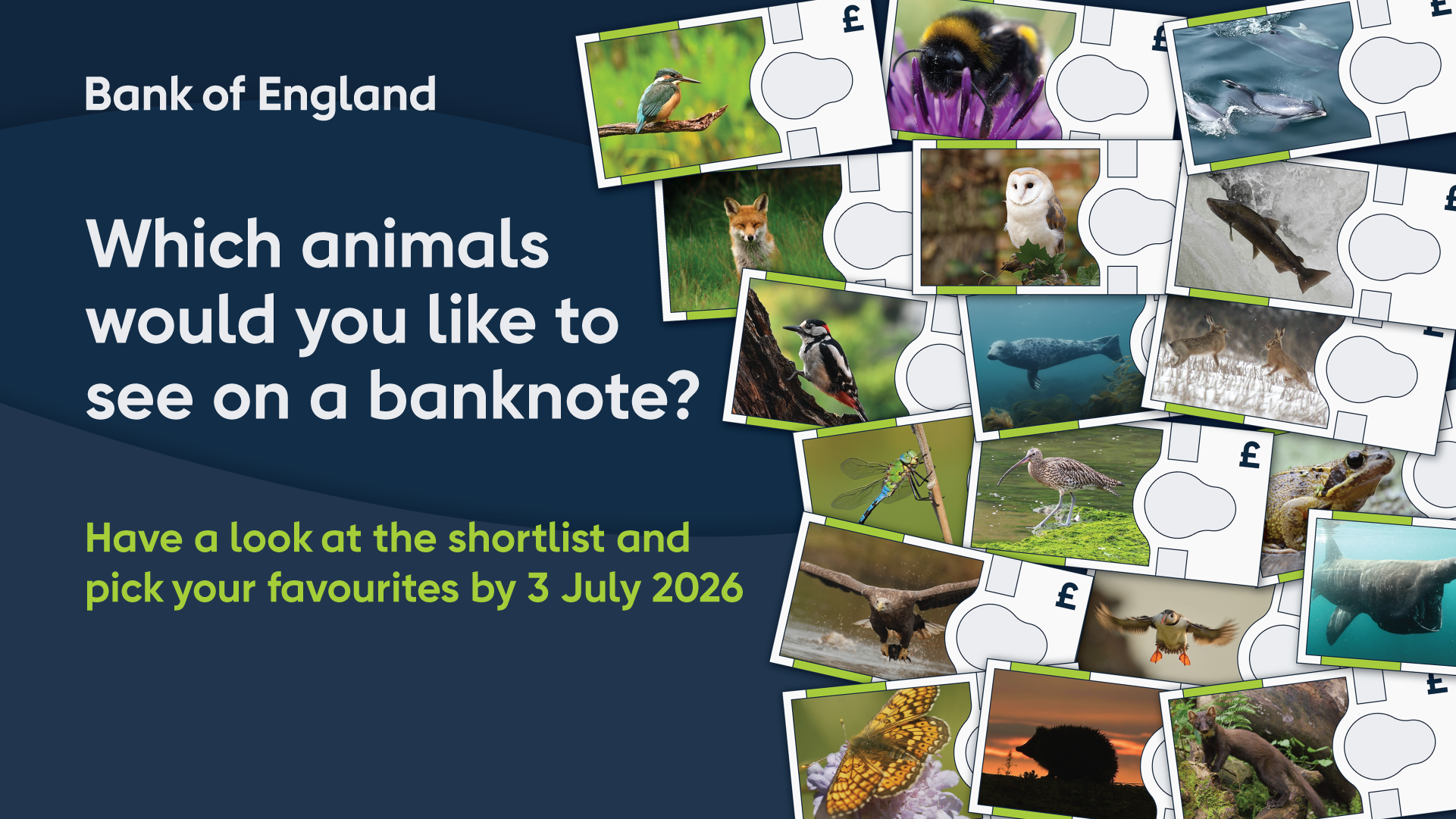
Working with a panel of wildlife experts from across the UK, the Bank of England has produced a shortlist of animals that could become the central image on the £5, £10, £20 and £50 notes.
Nottingham Trent University's Professor Dawn Scott - who is Executive Dean of the School of Animal, Rural and Environmental Sciences and has a background in researching urban wildlife ecology - is on the expert panel.
The list has been grouped into three categories, which cover a variety of species and environments. Each banknote will feature a different animal, making them easily recognisable to the public.
The shortlist is:
Mammals: Bottlenose dolphin, brown hare, European hedgehog, grey seal, pine marten, red fox.
Birds: Atlantic puffin, barn owl, common kingfisher, Eurasian curlew, great spotted woodpecker, white-tailed eagle.
Amphibians, insects and fish: Atlantic salmon, basking shark, buff-tailed bumblebee, common frog, Emperor dragonfly, marsh fritillary butterfly.
The public can select up to two examples from each category in a consultation running until 3 July. Only the animals on the shortlist published today can feature as the central images on the new series. The Bank is not seeking alternative nominations.
In July 2025, the Bank announced that work will begin on designing the next series of banknotes, with the goal to increase counterfeit resilience, and launched a consultation on the theme for the design.
In March 2026, the Bank announced that nature, with a particular focus on wildlife, had been chosen as the theme for the next series of banknotes. The nature theme received the highest proportion of nominations in last year’s public consultation and much of the feedback referred to wildlife that is native to the UK. Animals are vital to our landscapes, ecosystems and everyday lives and have long inspired iconic works of art, music and literature.
The views of the public will be an important consideration in making the final decision on the design. Each denomination will need to be easy to tell apart. It is important that there are four distinct animals across the four denominations and that they are able to represent different environments from across the UK. The central images will be complemented with additional elements from wildlife and nature.
Given this, it is possible that the Bank may not necessarily choose the four animals that receive the highest number of responses. Andrew Bailey, the Governor of the Bank of England, will make the final decision, taking into account the public’s feedback. The Bank will announce the outcome of this consultation by the end of 2026.
Victoria Cleland, Bank of England Chief Cashier, said: “I very much hope the public will enjoy engaging in our consultation to choose the animals to feature on our next series of banknotes. The shortlisted animals demonstrate the rich variety of wildlife we have to celebrate in the UK.”
It will be a number of years before the next series is launched. It is a detailed, multi-year process to design, test and print the notes, ensuring they are high-quality, resilient, accessible and incorporate the latest anti-counterfeiting technology. The next series will continue to include a portrait of the monarch. Representation of the Home Nations will also be an important feature in the design.
Since 1970 the Bank has showcased many inspirational historical figures who have helped shape national thought, innovation, leadership and values on its banknotes. The first of the current G series has been in circulation since 2016, when the Churchill £5 banknote was issued. Banknotes are updated periodically to incorporate the newest security and accessibility features.
The change to wildlife imagery, supported by the public consultation and feedback, provides an opportunity to celebrate another important aspect of the UK. The chosen animal imagery will be combined with security technology to help prevent counterfeiting. Animals are especially well suited for this, giving us many options to feature recognisable forms and movements within the security features.
Notes for Editors
Press enquiries please contact Dave Rogers, Public Relations Manager, on telephone +44 (0)115 848 8782, or via email.
The consultation can be found here and closes at 11.59pm BST on Friday 3 July 2026. The Bank is seeking responses in particular from residents of the UK and British citizens living abroad. They can be submitted via an online form available on the Bank’s website or by post.
In March 2026, the Bank announced that nature had been chosen as the theme for the next series of banknotes. Nature received the highest proportion of nominations in last year's consultation, as well as support in focus groups commissioned by the Bank with 60% of respondents selecting it as one of their preferred themes. Architecture and landmarks was the second-most popular at 56%. This was followed by notable historical figures at 38%, arts, culture and sport at 30%, innovation at 23% and noteworthy milestones at 19%.
The Bank explained in March 2026 that it would not include household pets as part of the options.
The Bank engaged a panel of wildlife experts who have helped create the shortlist of wildlife for the public to consider. The panel consists of: Katy Bell, Ulster Wildlife; Gordon Buchanan MBE, wildlife filmmaker; Miranda Krestovnikoff, wildlife presenter; Steve Ormerod, Cardiff University; Nadeem Perera, wildlife presenter; Dawn Scott, Nottingham Trent University
The Bank appointed the external expert panel based on several factors: selecting named specialists with recognised expertise in the UK’s wildlife; ensuring strong links to relevant nature organisations; prioritising diversity across background, region and experience; and drawing on individuals with broad professional or academic credentials.
While the use of cash for transactions has declined over the past decade, it remains the preferred payment method for about one in seven people and is used by many more. The amount of cash in circulation has also continued to increase, reaching £91.5 billion at the end of February 2026.
The current series of banknotes represents each of the Home Nations with a shield that appears on all four denominations.
The first of the current notes (Series G) was the £5 issued in September 2016. This was followed by the £10 in September 2017, the £20 in February 2020 and the £50 note in June 2021. The current series features portraits of Winston Churchill (£5), Jane Austen (£10), JMW Turner (£20) and Alan Turing (£50).
The Bank has been issuing notes since soon after its founding in 1694. Since then, the Bank has updated them periodically to incorporate the newest security and accessibility features. With each redesign, the Bank has changed the visual imagery so that the public can easily tell the difference between the old and the new banknotes. Until the 1920s, all the Bank’s banknotes had a single-sided, calligraphic design. Multi-coloured, graphic designs were introduced in the late 1920s. Since 1970, the Bank has showcased historical figures who have helped shape national thought, innovation, leadership and values on our banknotes.
About Nottingham Trent University
Nottingham Trent University (NTU) has been named UK ‘University of the Year’ five times in six years, (Times Higher Education Awards 2017, The Guardian University Awards 2019, The Times and Sunday Times 2018 and 2023, Whatuni Student Choice Awards 2023) and is consistently one of the top performing modern universities in the UK.
Students have voted us the best university in the UK and 1st in the UK for student employability (Uni Compare 2025).
NTU is 4th in the UK for number of undergraduate students (HESA 2023-24) with over 36,000 students and more than 4,000 staff located across six campuses. It has an international student population of 6,000 and an NTU community representing over 160 countries.
NTU owns two Queen’s Anniversary Prizes for outstanding achievements in research (2015, 2021). The first recognises NTU’s research on the safety and security of global citizens. The second was awarded for research in science, engineering, arts and humanities to investigate and restore cultural objects, buildings and heritage. The Research Excellence Framework (2021) classed 83% of NTU’s research activity as either world-leading or internationally excellent.
NTU was awarded GOLD in the national 2023 Teaching Excellence Framework (TEF) assessment.
NTU is a top 10 for sport (British Universities and Colleges Sport league table 2025) and was named as Sports University of the Year (Daily Mail University Guide 2025). It has also been ranked as 25th in the UK by the Guardian University Guide 2026.
NTU is a holder of the University Mental Health Charter recognising the commitment an institution has shown towards continuous improvement in the area of mental health and wellbeing.
NTU is the most environmentally sustainable university in the UK and second in the world (UI Green Metric University World Rankings, 2024).