The rise of the AI superstar: How AI is changing decision-making at work
Artificial intelligence is reshaping organisations from the inside out. Professor Xiao Ma, Director of the Centre for Business and Industry Transformation at Nottingham Business School, explores how it’s altering not only how tasks are completed, but how people understand their roles, their potential, and their place within the hierarchy.
By Professor Xiao Ma | Published on 24 September 2026
Categories: Press office; Research; Nottingham Business School;
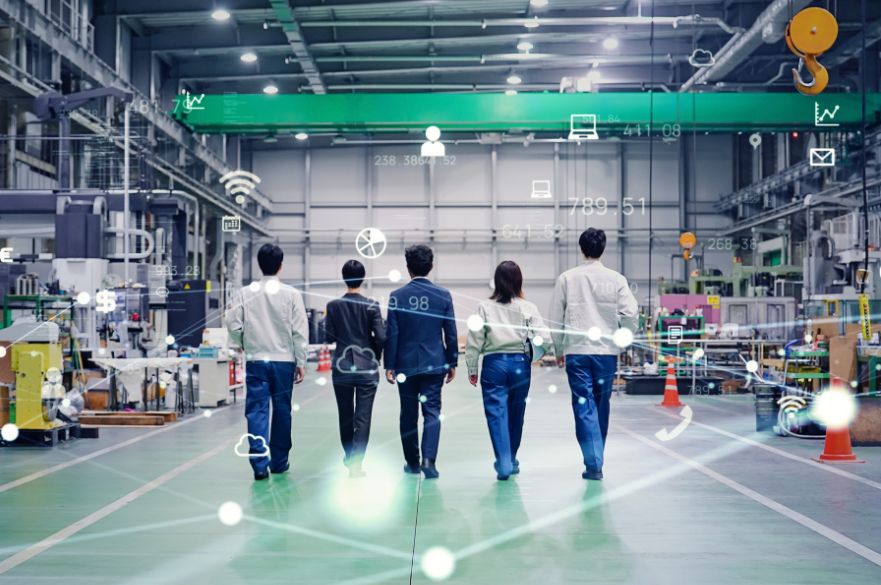
AI is beginning to change not just how work is done, but who gets to make decisions. Across multiple sectors, it is dissolving long-standing structures, expanding the capabilities of frontline staff and redefining what it means to manage, lead or contribute meaningfully to a workplace.
At the Centre for Business and Industry Transformation (CBIT), we have examined this shift through venture-building programmes that demonstrate how AI changes the everyday realities of work. In 2026 alone we trained more than 600 executives, and our portfolio now carries over 30 live ventures.
Our findings suggest that middle managers and frontline workers are already operating in a new organisational landscape - one where autonomy increases, leadership flattens, and employees take on responsibilities once restricted to specialists or senior executives.
Frontline workers are gaining strategic power
For more than a century, organisations have relied on layered managerial structures to coordinate work. Yet signs of strain are increasingly visible.
Manual processes, slow data gathering, and fragmented oversight are poorly suited to environments where decisions must be both rapid and evidence based.
AI changes this dynamic by absorbing routine operational tasks, analysing data and giving frontline staff capabilities once reserved for more senior colleagues.
The result isn’t just greater efficiency; it’s a redistribution of agency. Employees across levels are making higher order decisions, identifying opportunities, and contributing to strategic direction.
One of the most significant findings across our CBIT case studies is how AI transforms the nature of everyday work. Staff once weighed down by manual tasks now outsource much of this burden to automated systems. In turn, they spend time interpreting insights, making judgements, and exploring new opportunities.
Through this, we are seeing the rise of the “AI empowered superstar”- an employee whose productivity and problem solving capacity expand dramatically when supported by autonomous tools.
McKinsey’s global survey of 1,719 respondents, published in August 2026, found the gains are not confined to the top: 76% of individual contributors and 81% of midlevel managers using AI said it had improved their productivity, in line with 80% of C-suite leaders.
For example, at a UK grooming brand, competitor research that once took up to 20 days can now be completed in an hour. Staff use AI to analyse sentiment, size markets, and strengthen supply chain negotiations, effectively elevating frontline roles into positions of strategic responsibility.
In agricultural settings, beef farmers using autonomous monitoring systems have effectively become managers of digital enterprises. AI handles herd health tracking and logistics, giving farmers the space to develop new service models such as predictive livestock analytics.
In another CBIT supported case, a product manager at a consumer goods firm used AI to analyse market gaps, prototype a new product line, and deliver it to market in a matter of weeks - work traditionally requiring several departments.
These examples show how decision-making can move beyond traditional organisational boundaries. When routine operational work is automated, frontline roles expand into areas previously monopolised by specialists.
A recurring theme across the research is the potential for mass entrepreneurship - the idea that every employee has the potential to act like a CEO within their domain, supported by AI for analysis, prototyping, and scenario testing.
Examples include:
*Frontline staff launching new product lines using AI driven market intelligence.
*Customer service teams using autonomous chatbots to free time for redesigning service models.
*Farmers developing entirely new revenue streams from AI generated insights.
These cases show that entrepreneurial capability is no longer limited to founders or senior leadership. When technological barriers fall, initiative becomes a widespread organisational asset.
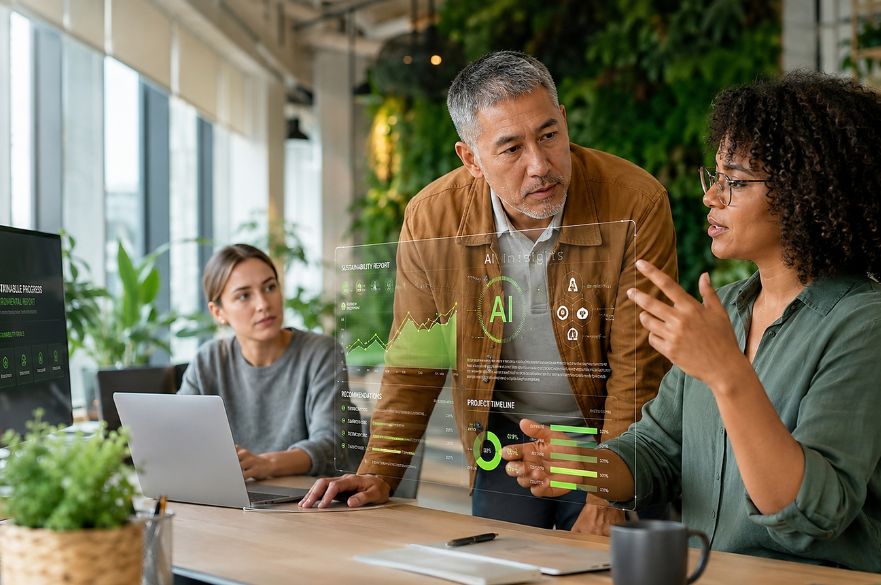
Smaller teams can work smarter
This redistribution of capability also creates opportunities for smaller teams. A model is emerging that we call the LeanCorp - a compact, AI first organisation powered by micro teams of three to five people.
These teams achieve outputs comparable to much larger units by relying heavily on AI agents for testing, analysis, and execution. The UK’s official figures point the same way.
Among businesses using AI, 17% of those with fewer than ten staff use it extensively – almost twice the rate of firms with 250 or more (9%), according to the Office for National Statistics in July 2026.
At AccessID (a pseudonym), a legacy hardware company restructured itself around a three person leadership team supported by autonomous AI agents in engineering, customer operations, and logistics. A project estimated to require six months and dozens of developers was completed in under a week using this model.
It is not an isolated case: in McKinsey’s survey, 32% of respondents said their organisations had decided against buying at least one software product or feature because they could now build it in-house with AI coding agents.
The case highlights how organisational size becomes detached from organisational capability. With AI automating coordination and specialised tasks, the value of human work shifts towards judgement, creativity, and cultural stewardship.
Hierarchies flatten not by ideology, but by necessity.
AI is changing how teams work together
Much public discussion imagines AI as a personal digital assistant, an always on tutor or productivity tool. Our research challenges this framing.
Rather than serving individuals in isolation, AI can act as a dialogic amplifier, stimulating debate, negotiation, and shared interpretation within teams.
In immersive learning settings, staff work collectively with AI tools to explore problems, compare outputs, and build narratives together. The value comes not only from the system’s computational power but from the discussions it triggers.
This collective engagement helps employees understand how persuasive or misleading narratives can emerge from digital systems.
The lesson for organisations is that AI’s true impact may lie in how it reshapes social learning, not just individual productivity.
What AI means for managers and CEOs
Middle-management roles have historically served as conduits, translating strategy from above and coordinating activity below. As AI autonomously handles reporting, monitoring and first-pass analysis, these roles are being reshaped.
In many organisations studied through CBIT’s Venture Builder programme, middle managers now spend less time verifying spreadsheets or manually producing compliance reports, and more time interpreting AI outputs, advising teams and escalating complex decisions when human nuance is required.
This doesn’t eliminate middle management. Instead, it shifts the role from administrative oversight towards coaching, problem-framing and ethical decision-making.
The image we use at CBIT is an exoskeleton, and it fits managers particularly well. Managers carry a disproportionate weight of judgement, coordination and responsibility for others, so they have the most to gain from something that extends their capacity.
AI does not replace the manager wearing it; it extends their reach, enabling them to handle decisions and responsibilities that were once beyond their capacity. And because managers shape how work gets done around them, that amplification extends into their teams.
Managers must also consider how employees develop judgement and competence. When AI absorbs entry-level tasks, newer employees have fewer opportunities to learn foundational skills through gradual practice.
Organisations therefore need to design new pathways for developing judgement and capability. A World Economic Forum report published in June 2026 found that 28% of entry-level workers believe half or fewer of their current skills will still be relevant in three years.
In a workplace where employees at all levels have AI-enhanced capabilities, leadership itself must evolve. Managers become coaches, facilitators and interpreters rather than controllers.
Some organisations are experimenting with fractional leadership roles – specialist executives supported by autonomous AI agents who can operate across multiple companies simultaneously. This model increases organisational flexibility but also demands new forms of trust, transparency and cultural integration.
As AI gives employees greater entrepreneurial capability, the CEO role is changing too. The “super-conductor” CEO seen in LeanCorp models is agile, empowered, deeply embedded in product and organisational flows, and continuously amplified by AI.
AI can provide continuous insight across operations, marketing, finance and customer activity, while helping leaders test scenarios, assess risks and explore opportunities in real time.
The CEO becomes less a distant strategic decision-maker and more an orchestrator of people, AI systems and ideas – using technology to extend their reach while relying on human judgement for the decisions that matter.
The challenges of AI-enabled work
Despite its promise, this shift raises difficult questions. It also starts from a harder baseline than the examples above suggest.
McKinsey’s survey found that while 80% of respondents say AI has improved their own productivity, only 37% report any contribution to earnings, essentially unchanged from a year earlier – not because the technology fails, but, it suggests, because the approach does: nearly three-quarters of the organisations getting the most value from AI had fundamentally redesigned their workflows because of it, against a quarter of everyone else.
First, not all employees want entrepreneurial autonomy. Some prefer clear boundaries and structured expectations. There’s also uncertainty about how novice workers will develop judgement without hands-on foundational tasks.
Second, when AI co-produces outputs, responsibility becomes harder to assign. Decisions made through AI-assisted workflows raise questions about liability, transparency and credit.
Third, organisational identity is disrupted. Work moves from producing inputs to evaluating outputs, a direction some find energising and others disorienting.
The strain falls hardest below the top: McKinsey found that 47% of midlevel managers and individual contributors had experienced at least one negative effect of AI at work, from pressure to take on more to anxiety about their careers, compared with 31% of executives and senior managers.
Teams often create new hybrid roles – such as “exception leads” or “agent operations specialists” – to coordinate between human and AI decision-flows.
These tensions suggest that AI does not simply improve organisations; it forces them to rethink what professional growth, competence and accountability mean.
Many debates about AI focus on whether machines will replace humans. Research portrays a more complex reality.
Looking again at McKinsey’s survey, only 14% of respondents at organisations using AI said it had contributed to a fall in headcount over the past year – less than half the share who had expected cuts a year earlier – although 39% now expect reductions in the year ahead.
AI takes over operational execution, while humans retain responsibility for sense-making, ethical judgement, creativity and empathy.
As agents, dashboards and autonomous systems become more common, the future of work becomes a partnership. The challenge for organisations is determining how to design systems where human dignity and meaning are maintained, even as AI assumes larger portions of the workload.
The impact of AI on middle managers and frontline staff is neither abstract nor distant. It’s already visible in firms rebuilding their structures around micro-teams, in agricultural workers adopting digital business models, in junior staff leading strategic initiatives and in managers rethinking how they develop emerging talent.
AI is not merely an automation tool. It’s a force prompting organisations to rethink hierarchy, leadership and the distribution of human potential. In this new landscape, people are not replaced; they’re repositioned.
The future of work will depend on how organisations balance empowerment with support, autonomy with structure, and machine capability with human judgement.
The question is no longer whether AI will change work, but how thoughtfully we will navigate the change.
A version of this article was originally published by The AI Journal.