Top reasons to choose Conservation and Ecology at NTU
With the sustainability agenda gathering pace, you’ll be graduating into a real growth area. Across the non-profit, public and private sectors, the demand for ecologists and wildlife conservationists is increasing — and especially for ecological consultants, who assess the conservation value of sites, and who prevent new developments from risking biodiversity loss by creating new habitats elsewhere.
We pride ourselves on having an excellent track record of graduate prospects. Our course is designed to set you up ready for the workplace, giving you industry-ready skills (e.g. specific field-based and IT software skills) and transferable skills (e.g. critical thinking, professional writing and problem solving), enabling you to work in the diverse field of wildlife conservation, both in the UK and overseas.
You’ll also develop plenty of valuable transferable skills on this degree, far beyond your specialist knowledge of ecology and conservation — highly desirable and marketable qualities like time-management, teamworking, critical thinking and problem-solving.
Accreditations
Our programmes are accredited by the Chartered Institute of Ecology and Environmental Management for delivering the knowledge and skills required for graduate membership of CIEEM.
NTU is also a founding signatory of the Nature Positive Universities Alliance, a global network of universities that have made an official pledge to work towards halting, preventing and reversing nature loss by addressing their own impacts and restoring ecosystems harmed by their activities.

Joint 1st in the UK for Ecology and Environmental Biology students who are positive about the academic support on their course (Full-time first degrees, National Student Survey 2026)
100% of our BSc (Hons) Ecology and Conservation graduates are in work or further study within 15 months of finishing their degrees (of those available for work or study, latest Graduate Outcomes Survey 2023/24).
Graduates from these courses have successful careers in organisations such as RSPB, Natural England, Trent Rivers Trust, The Living Rainforest, Wildflower and Wetlands Trust, ABR Ecology, The Canine Club and so many more.
Graduates from these courses now work in a wide range of roles such as Ecologist, Forest Ranger, Environment Officer, Land Surveyor, Woodland Creation GIS Officer, Zoo Keeper, Nature Reserve Warden, River Ranger, Reserve Warden and so many more.
Opportunities and Field trips
A previous final year field trip to Mankwe Wildlife Reserve in South Africa.
Conservation and Ecology are global concerns: with an exciting range of field trips on offer (both at home and abroad) to ensure you gain a learning perspective to match.
The opportunities you will have to test your skills and knowledge are incredible. Previously, students have analysed wolf and brown bear populations in Spain, coastal management solutions in Pembrokeshire, and the effects of habitat loss on white rhinos in Mankwe Wildlife Reserve, South Africa.
You will also have the option to spend six months of your course studying abroad on an international exchange, with one of our partner universities in Australia, Canada or Europe.
All of this ensures that you not only gain the vital knowledge ready to take on these real-world challenges but also the practical skills to make an impact as soon as you graduate.
Can my placement lead to a career?
For many students, a placement is a transformative experience, helping them discover their career direction, develop new interests, and build professional connections that can lead to future job opportunities or offers.
Work-like experience
Practical work experience has many benefits for you. It can help you in your day-to-day studies and is often paid. It can enhance your commercial awareness and your ability to link theory and practice which will be an invaluable skill in your future career. Although a work placement is highly recommended, obtaining one is based on an individual’s efforts and is not guaranteed.
Discover how NTU Wildlife Conservation students gain real-world skills and experience through placements with the Royal Society for the Protection of Birds.
See your subject in action
Hear from Course Leaders and current students as they answer your questions. You can also explore the facilities you'll be using to get real insight into what it's like studying Conservation and Ecology at NTU.
A day in the life of a conservation and ecology student
Wondering what your days might look like as a Wildlife Conservation or Ecology and Conservation student? We've crafted an example timetable to give you a glimpse into your first year*. You are likely to study six modules over the year. You will also have practical sessions to cement your learning.
If you have applied for the Integrated Foundation Year (IFY), this timetable will reflect your second year. Please note that for both the BSc and IFY, this is only an example timetable and does not reflect your actual timetable. Modules, contact days and times are subject to change. You will receive your full timetable when you enrol at NTU.
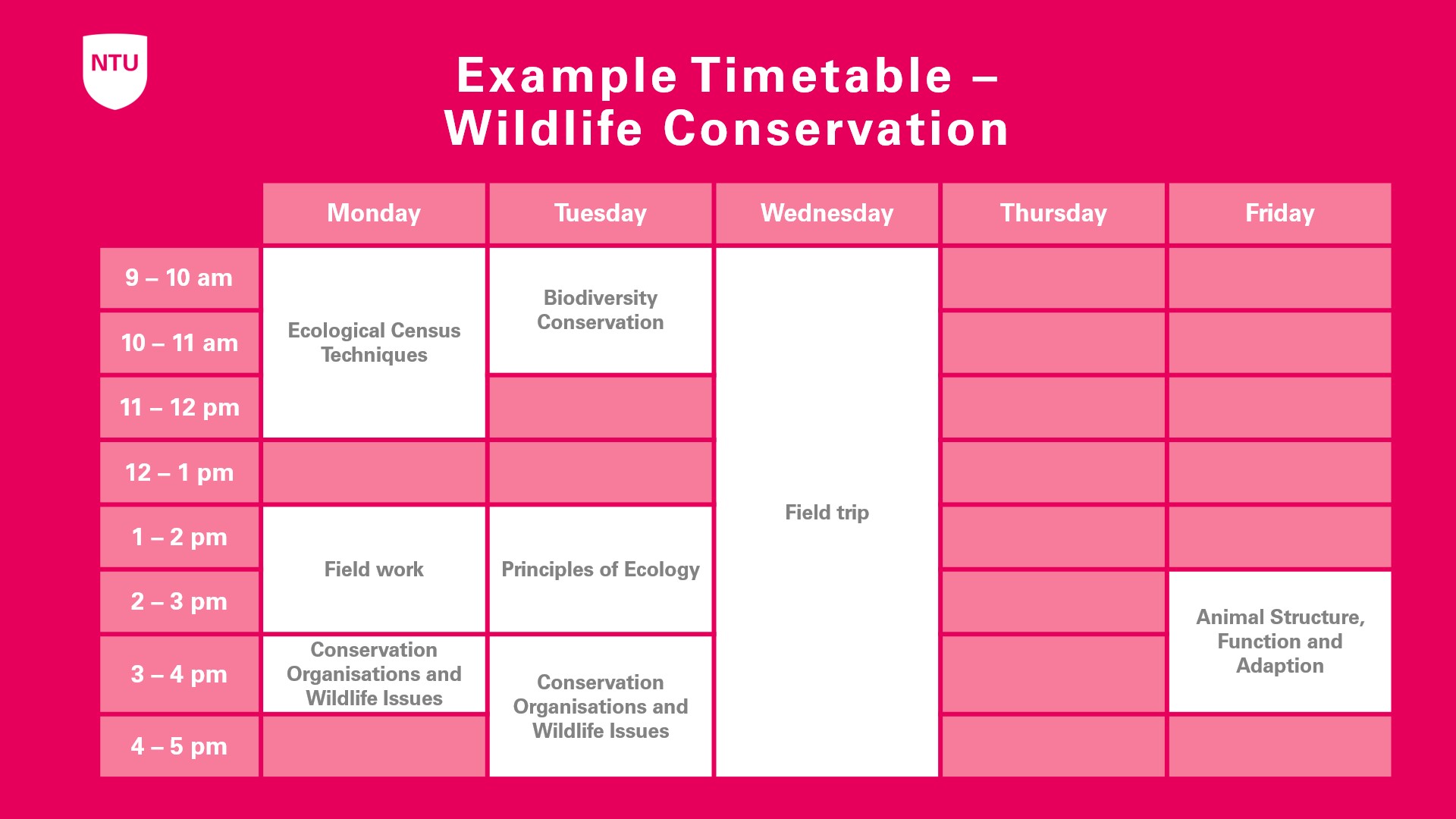
In this example students have two lectures and a fieldwork session on a Monday, three 2-hour lectures on a Tuesday, a field trip on Wednesday, and a 2-hour lecture on a Friday afternoon.

In this example students have a 3-hour lecture on Monday morning, and a 2-hour lecture in the afternoon, followed by time for individual tutorials. On Tuesday they have two 2-hour lectures and further time for tutorials. Thursday is for practical skills sessions, and on Friday afternoon there is a 2-hour lecture.
There's so much more to look forward to!
Find out about all the additional opportunities and extra-curricular activities you can get involved in as a student at NTU.
Study abroad as part of your NTU degree
Our study abroad opportunities offer you a flexible way to gain invaluable international experience as part of your degree. We have partnerships with over 300 institutions worldwide – study from one week to a whole year.
University Language Programme
The University Language Programme (ULP) provides language courses at different levels of proficiency to students, staff and members of the public.
See some of the facilities you'll get to use
You will be based at our Brackenhurst Campus – a stunning countryside estate, which acts as an outdoor classroom and is the perfect place to put theory into practice. It is only a short hop to the bright lights of Nottingham city centre though, so you really do get the best of both worlds.
Our countryside estate includes woodland and wetland habitats, a working farm, and a diverse range of wildlife species. It is the perfect outdoor classroom and allows you to put theory into practice, right from day one. In addition to core study, you can get involved with projects such as ringing birds and surveying great crested newt and small mammal populations, right on campus.
What else you need to know about studying at NTU
Why study at NTU?
NTU is one of the most popular universities in the UK – find out why we should be your next step.
Accommodation
We make accommodation easy. Our halls of residence are secure, inclusive of all bills, and within easy reach of campuses and amenities, giving you more time to focus on your studies, settling in, and making friends.
Student life
University isn't just about your studies. Everything’s on offer here - there’s sport, art, music, food, and so much more. Find out about living here or how to commute to NTU.
Fees and funding
Everything you need to know about fees and funding while you’re at university, including tuition fees and living costs, how you’ll pay for your studies, and bursaries and scholarships.
The Stoneygate Award Programme
This award is worth £3,250 for each year of a student’s undergraduate degree (excluding any placement year). Hold an offer on a full-time undergraduate course for September 2026, check out the full eligibility criteria and apply here.
Take your next steps towards joining NTU
Whether you're ready to accept your offer, or still want a little time, we've got you covered.
If you've applied directly to NTU, or are progressing from Nottingham Trent International College (NTIC), log into the NTU Applicant Portal to check your next steps.
Meet your new course mates
Don't just take our word for it. Find out what it's really like to study at NTU and the amazing opportunities on offer from our students.
View your course page
Still need more information? Browse your course page for further details, including a list of all available course modules and potential graduate career options.