Putting place first: Mayoral event provides global lessons in regional leadership
A recent event hosted by the Centre for Economy, Policy and Place at Nottingham Business School brought together Claire Ward, mayor of the East Midlands Combined County Authority, and Aki Takehisa, former mayor of Setouchi City in Japan.
By Helen Breese | Published on 20 January 2026
Categories: Business; Research; Nottingham Business School;
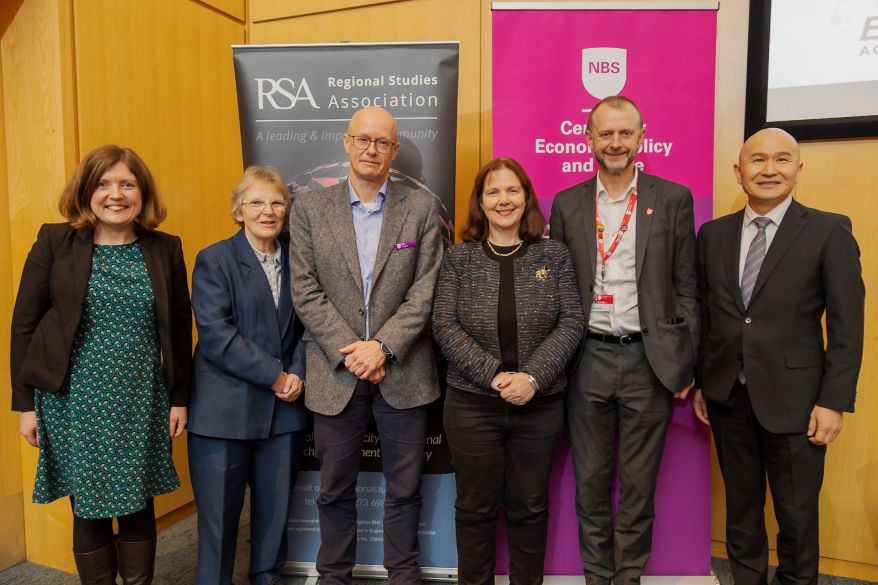
The two leaders compared their experiences of regional leadership, with Japan offering a more mature model of devolution.
Mayor Claire, a former MP, described the mayoral role as distinct from national politics, offering direct accountability to residents and a mandate to speak to central government on behalf of an entire region. She also noted that the position is as much about diplomacy as politics, including listening, translating local needs, and managing complex relationships across a diverse region.
Claire emphasised that place‑based leadership is essential for tackling the wider determinants of health and argued that achieving long‑term inclusive growth relies on improving skills, access to stable jobs, safe and sustainable housing and efficient transport systems.
In her view, consensus‑building around place is essential for genuine progress and should unite politicians, institutions and residents, even amid shifting political environments.
Aki reflected on his own path into office, inspired by a mayoral speech at his graduation. As mayor, he acted as the public face of Setouchi City and worked across almost every policy area. He explained that Japanese mayors have broad powers, supported by a mix of local taxes, non‑tax income and central funding. Unlike the UK, most grants are not ring‑fenced, allowing greater freedom in how money is used.
Aki also highlighted the close relationships between local authorities, landowners and residents in smaller cities, as well as the strong accountability mechanisms within Japan’s system of vertical and horizontal governance.
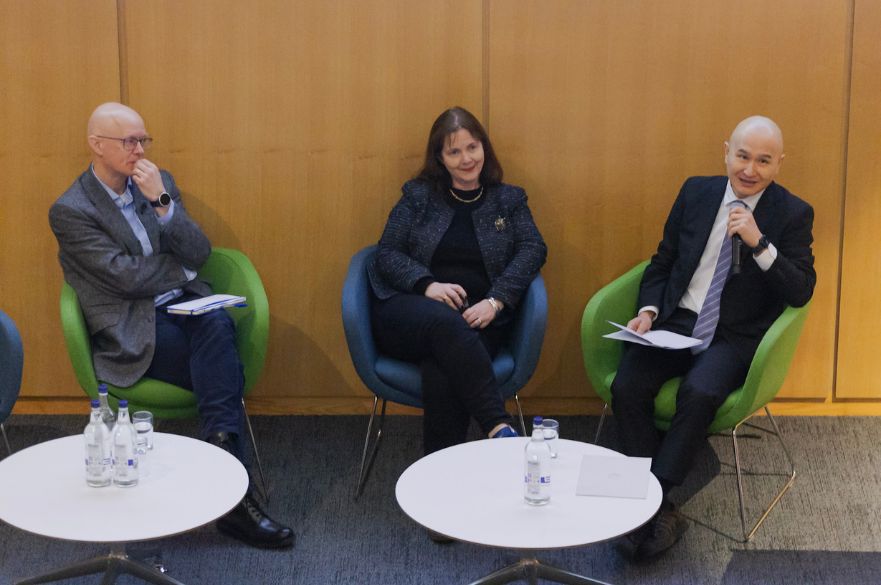
The discussion, supported by the Regional Studies Association, was facilitated by Professor Will Rossiter, director of the Centre for Economy, Policy and Place at NBS.
He said: “This was very much a local event with a global reach. Bringing together mayors from England and Japan created a rare opportunity to compare approaches to leadership and regional governance across entirely different contexts.
“It shows the value of universities as places where international perspectives can be shared, tested and learned from, and where global insights can inform local practice.”
Opening remarks were delivered by Professor Dave Petley, Vice-Chancellor of Nottingham Trent University, with keynote contributions from Professor Anne Green and Dr Abigail Taylor of City-REDI at the University of Birmingham. Their research examines comparative approaches to mayoral leadership in England and Japan.
Professor Green commented: “The evening highlighted the importance of a ‘place‑first vision’ - one that depends on building consensus through strong formal and informal relationships across multiple geographical scales. Effective multi‑level governance requires working vertically between places and horizontally across them, creating the glue that connects institutions and infrastructure and enables progress toward inclusive growth and wellbeing.”
The event marked the launch of a new series from the Centre for Economy, Policy and Place, which focuses on research in economic and public policy, place-based development and public services.
Notes for Editors
Press enquiries please contact Helen Breese, Public Relations and Research Communications Manager, on telephone +44 (0)115 848 8751, or via email.
About Nottingham Business School at Nottingham Trent University
Nottingham Business School (NBS) at Nottingham Trent University (NTU) is a leader in experiential learning and personalisation of business, management and economics education and research, combining academic excellence with positive impact on people, business and society. NBS has an unrivalled level of engagement with business, public and voluntary organisations. With more than 8,500 students, NBS is also one of UK’s largest business schools.
NBS is triple crown accredited by EQUIS, AACSB, and AMBA, placing it amongst the top 1% of business schools globally. NBS is also accredited by Small Business Charter, providing support and development for SMEs, and is a PRME Champion - held up as an exemplar and beacon by the United Nations Principles of Responsible Management Education (PRME).
In The Guardian University Guide 2026, all NBS courses were ranked in the UK Top 20. Subject areas covering Accounting and Finance, Business and Management, Economics and Marketing and PR were all recognised for excellence in teaching, high student satisfaction and strong graduate career prospects.
About Nottingham Trent University
Nottingham Trent University (NTU) has been named UK ‘University of the Year’ five times in six years, (Times Higher Education Awards 2017, The Guardian University Awards 2019, The Times and Sunday Times 2018 and 2023, Whatuni Student Choice Awards 2023) and is consistently one of the top performing modern universities in the UK.
Students have voted us the best university in the UK and 1st in the UK for student employability (Uni Compare 2025).
NTU is 4th in the UK for number of undergraduate students (HESA 2023-24) with over 36,000 students and more than 4,000 staff located across six campuses. It has an international student population of 6,000 and an NTU community representing over 160 countries.
NTU owns two Queen’s Anniversary Prizes for outstanding achievements in research (2015, 2021). The first recognises NTU’s research on the safety and security of global citizens. The second was awarded for research in science, engineering, arts and humanities to investigate and restore cultural objects, buildings and heritage. The Research Excellence Framework (2021) classed 83% of NTU’s research activity as either world-leading or internationally excellent.
NTU was awarded GOLD in the national 2023 Teaching Excellence Framework (TEF) assessment.
NTU is a top 10 for sport (British Universities and Colleges Sport league table 2025) and was named as Sports University of the Year (Daily Mail University Guide 2025). It has also been ranked as 25th in the UK by the Guardian University Guide 2026.
NTU is a holder of the University Mental Health Charter recognising the commitment an institution has shown towards continuous improvement in the area of mental health and wellbeing.
NTU is the most environmentally sustainable university in the UK and second in the world (UI Green Metric University World Rankings, 2024).