Smaller hedgehog populations risk collapse due to roadkill, study suggests
Road traffic kills almost a third of hedgehogs in some British populations each year, a new study shows – and could be putting smaller populations at risk of collapse and local extinction.
By Dave Rogers | Published on 31 July 2026
Categories: Press office; Research; School of Animal, Rural and Environmental Sciences;
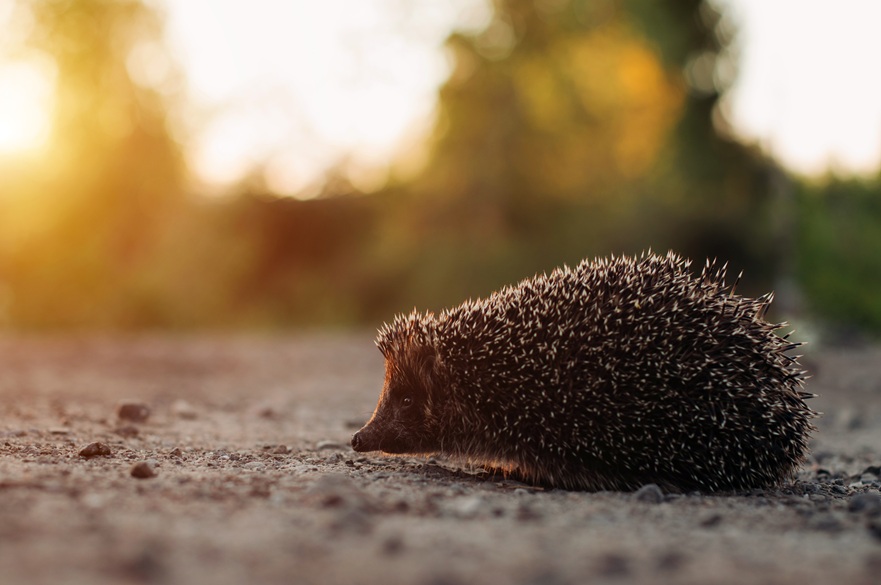
A team led by conservation scientists at Nottingham Trent University found that road traffic killed between 15-29% of hedgehogs in local populations annually, and was responsible for 38-41% of all recorded hedgehog deaths.
The study – funded by The British Hedgehog Preservation Society and People’s Trust for Endangered Species – investigated how road traffic deaths impact local hedgehog populations of different sizes in the short and longer-term.
The researchers studied four hedgehog populations in villages and towns in Nottinghamshire, selected to be representative in terms of habitat and road densities. They walked 838 km of survey routes, measuring population size along with reproductive rates and adult and juvenile survival rates.
The team also completed 269 roadkill surveys over 18 months, aiming to find every hedgehog roadkill within and between the study sites, while recording the location, age and sex of those found.
These data were then used to estimate how road deaths could influence long-term population persistence, particularly alongside future expected increases in UK traffic levels.
The study revealed that the larger hedgehog populations, despite having the highest number of traffic-related deaths, were able to offset these losses through higher overall survival and reproductive rates, as well as the fact that most hedgehogs killed on roads were males rather than females.
For the smaller populations, however – with fewer than 15 individual hedgehogs – even a small amount of roadkill each year had a significant impact and could not be offset through reproduction.
Based on estimates that around 50% of hedgehogs could be killed on roads each year, the researchers calculated that the two smaller populations would halve in size within two years and could face local extinction after nine years.
Even for the larger populations, a 40% mortality rate would be sufficient to cause a decline of 40% in one population and more than half (51%) in the other within 50 years, the study showed.
Traffic was identified as the main cause of recorded hedgehog deaths.
The research shows the importance of bolstering smaller hedgehog populations so that they can better withstand traffic-related deaths. Larger areas of good habitat are also needed to support larger numbers of hedgehogs. Simple actions can help – such as leaving some wild areas in gardens to provide food and nesting sites for hedgehogs.
It is also key to improve habitat connectivity, for instance creating 13cm x 13cm square ‘Hedgehog Highways’ (gaps) in fences and walls, enabling hedgehogs to move freely and safely between gardens and neighbouring populations to increase populations’ viability without the need to cross additional roads.
“Hedgehogs are declining in the UK and we have found how even a small amount of roadkill – perhaps just one or two individuals a year – could have devastating effects on an already small population,” said lead researcher Dr Lauren Moore, who was based in Nottingham Trent University’s School of Animal, Rural and Environmental Sciences at the time of the study.
She said: “In the past, research has assumed that high roadkill rates have a large and negative impact on hedgehog populations and that a small amount does little harm. This does not tell us the full picture and in fact populations vary a lot in terms of size, reproductive rates, other causes of death and food availability.
“We need to better support hedgehog populations until there are tried and tested ways to reduce collisions happening in the first place.”
Fay Vass, Chief Executive at The British Hedgehog Preservation Society, said: “This unique study not only looks at the number of hedgehogs being killed on roads, but examines the wider picture to help us understand how this can impact hedgehog populations now and into the future. We know that hedgehog populations across the UK are in decline – and research like this is vital in helping us understand the underlying causes so we can reverse this worrying trend.”
Dr Silviu Petrovan, Conservation Strategy and Research Manager at People's Trust for Endangered Species & Assistant Research Professor in the Zoology Department at the University of Cambridge, said: “These findings show that the decline in hedgehog populations in rural areas is likely to be exacerbated by roadkill, where many threats relating to land management have already made large areas of our countryside less suitable for one of our nation’s favourite mammals.
“Effective prevention of road mortality for hedgehogs is likely to be difficult given the vast network of existing roads, meaning that we need to consider widespread conservation measures to enable our rural hedgehogs to become more resilient to this important additional threat.”
The study, which also involved the University of Cambridge, University of Reading and Cardiff University, is published in the journal Animal Conservation.
Notes for Editors
Press enquiries please contact Dave Rogers, Public Relations Manager, on telephone +44 (0)115 848 8782, or via email.
About Nottingham Trent University:
Nottingham Trent University (NTU) has been named UK ‘University of the Year’ five times in six years, (Times Higher Education Awards 2017, The Guardian University Awards 2019, The Times and Sunday Times 2018 and 2023, Whatuni Student Choice Awards 2023) and is consistently one of the top performing modern universities in the UK.
Students have voted us first in the UK for course quality, top five in the UK for employability and third best University in the UK (Uni Compare 2027). We are ranked in the top 25 universities in the country (The Guardian University Guide 2026).
We have over 35,000 students and more than 4,000 staff located across five campuses. It has an international student population of over 5,000 and an NTU community representing over 160 countries.
NTU owns two Queen’s Anniversary Prizes for outstanding achievements in research (2015, 2021). The Research Excellence Framework (2021) classed 83% of NTU’s research activity as either world-leading or internationally excellent.
NTU was awarded GOLD in the national 2023 Teaching Excellence Framework (TEF) assessment.
NTU is a top 10 for sport (British Universities and Colleges Sport league table 2025) and was named as Sports University of the Year (Daily Mail University Guide 2025).
NTU is a holder of the University Mental Health Charter, recognising the commitment an institution has shown towards continuous improvement in the area of mental health and wellbeing.
NTU is the most environmentally sustainable university in the UK and third in the world (UI Green Metric University World Rankings, 2025).
About The British Hedgehog Preservation Society (BHPS):
BHPS is a registered UK charity, founded in 1982, dedicated to helping & protecting hedgehogs native to the UK (Erinaceus europaeus). Through our campaigns, advocacy and educational projects we work to raise awareness of the practical steps we can take to help reverse the decline of hedgehogs in the wild, improve their welfare and safeguard the future of this much-loved animal. We also fund research that provides important new insights into the conservation and welfare of hedgehogs.
Visit www.britishhedgehogs.org.uk and follow BHPS on Facebook, Bluesky, Instagram, YouTube and LinkedIn
About People’s Trust for Endangered Species (PTES)
PTES, a UK conservation charity created in 1977, is ensuring a future for endangered species throughout the world. We protect some of our most threatened wildlife species and habitats, and provide practical conservation support through research, grant-aid, educational programmes, wildlife surveys, publications and public events.
PTES’ current priority species and habitats include hazel dormice, hedgehogs, water voles, noble chafers, stag beetles, traditional orchards, native woodlands, wood pasture and parkland and hedgerows.
Visit www.ptes.org and follow PTES on Facebook, Bluesky, Instagram, YouTube and LinkedIn.