The Royal British Legion Poppy Appeal: A Critique
Dr Colin Alexander, an expert in political communications, explores the Royal British Legion's Poppy Appeal and wartime propaganda
By Dr Colin Alexander | Published on 3 November 2026
Categories: Press office; Research; School of Social Sciences;
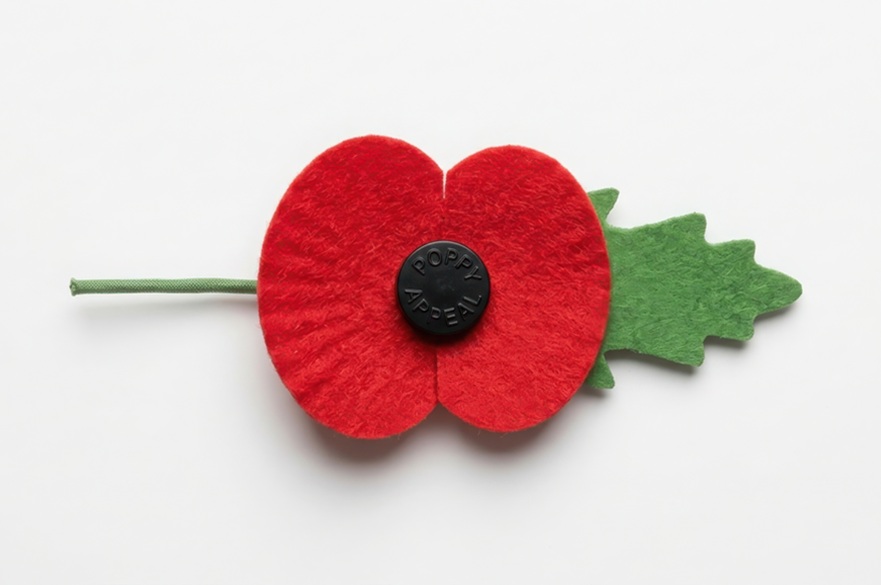
The red poppy with a black buttonhole is widely worn as a symbol of war remembrance in the UK and several other Commonwealth countries during late October and early November. This occurs in the lead up to Remembrance Sunday that marks the anniversary of Armistice Day (11 November 1918) at the end of World War I.
The wearing of a red paper poppy – usually attached to clothes on the chest or breast but sometimes as a pin on a hat – has formed a key part of public fundraising by the Royal British Legion (RBL) (formerly the British Legion until its Royal charter in 1971) since it launched the appeal in 1921. It has become a part of the cultural fabric of the nation, with funds from the appeal going towards helping ex-servicemen and women and supporting the wider functioning and work of the charity.
In today’s UK society there exists a degree of poppy ignorance and even fascism. My high school was a military feeder school, and we were mandated to buy and wear a poppy each year. My sons attend their local Scout troop and Remembrance Sunday and the wearing of a poppy appears to be considered an uncontestably ‘good’ and important thing. E.g. the communications to parents do not consider that there might be a range of opinions on the subject.
Many professional sports teams will wear jerseys with a poppy and [almost] everyone appearing on television in early November will be asked to wear one. Prominent individuals who have refused, e.g. the Irish footballer James McClean and the Serbian footballer Nemanja Vidic, have found themselves publicly vilified. Few people appear willing to listen to their explanation, but the reality that they are asked to explain themselves at all is also important.
In propaganda studies, we academics employ a rule of thumb that when a concept, idea, organisation, symbol or individual appears to be beyond social critique or when a taboo surrounds the contemplation that its status as a self-evident social good is contestable, then manipulative forces are usually at work. This was a key argument in my recent book on propaganda during the Covid-19 pandemic. Furthermore, the employment of mass communications strategies (particularly censorship and the encouragement of self-censorship) to bolster its position or to lessen the platform of critique for others tells us that the object in question is – in fact – in great need of critique given that it has to employ artificial means to protect itself.
The poppy is not a peace symbol though, and neither is it a national flag or other emblem. As the most important public fundraising source of the RBL it is raising money for a private organisation. Like all the other approximately 200,000 registered charities in the UK then, people should be able to choose which ones they support and which they do not – freely and without vilification for refusal. As a charity, the RBL is no different from any other nonprofit or humanitarian organisation with a mission under one of the charitable purposes detailed in the Charities Act. To be derogatory towards someone for not wearing a poppy is the equivalent of castigating someone for not donating to the RNLI or RSPB. Indeed, charitable giving, by its nature, is an undemocratic act of favouritism.
Of greatest controversy though is RBL’s decision to accept money from the weapons industry. These organisations – including BAE Systems most prominently – owe their financial buoyancy to the selling of arms around the world, which is predicated on a wider environment of fear, distrust, othering and, ultimately, violence or the credible threat to use violence. To this end, it can be argued that the weapons industry represents a social parasite that dresses itself up as a fine place to work with good pay and many other perks. Supporting veterans’ charities thus forms part of its justificatory marketing of itself through social outreach and self-styled ‘corporate social responsibility’. It is the RBL’s choice to partner with these companies, and they must accept all the criticism that goes with taking money from the conveyor belt of war.
In a previous blog, published on the Movement to Abolish War’s website – I discussed the dearth of veterans’ charities that are vocally anti-war and why that is the case. RBL is thereby one of many such organisations that does not express anti-war sentiment, accepts vital funds from the weapons industry, has signed the Armed Forces Covenant and are often led, steered and/or influenced by former military personnel. At the very least these actions and allegiances highlight the urgent requirement for an informed public discussion of the merits of the poppy appeal, its affiliations, and whether it does indeed represent the public good that it is framed as.
The final question for this blog surrounds why this wider ecosystem in the UK has emerged concerning the poppy appeal. This answer is open to contest, but I will provide my analysis for what it is worth. It appears to come down to three key factors – none of which the RBL are directly responsible for – and each of which concerns the role of propaganda and how the World Wars are discussed.
The first – and perhaps most crucial – is that the UK was on the winning side in both World Wars. These conflicts are not remembered in the same way on the European continent – especially not among what were the Axis Powers. The focus here tends to be on aspects like Holocaust Memorial sites and Holocaust Memorial Day (27 January – the day the Soviet army reached Auschwitz in 1944). Thus, Remembrance Sunday has emerged as a reflection of British victory. The narrative has an air of vindication to it, where ‘good’ (us) triumphed over ‘evil’ (them). Assured by that sense of righteousness, critical reflection is pushed to the margins.
The second concerns the broader cultural nostalgia that exists in the UK for the 1930s and 1940s as a time of glamour, romance and even comedy (think: Dad’s Army and even Basil Fawlty’s ‘Don’t mention the war’). Attend a summer fete in the UK and you might find yourself watching a performance of attractive young women singing wartime songs by Vera Lynn dressed in mock period military uniforms, intimating that it was a time of class, high standards, commitment, unity and duty. The contemporary singing group The D-Day Darlings even state that their objective is to, “keep the wartime spirit alive by putting it into a new generation”, which could be viewed quite sinisterly.
The looters, racketeers, kleptocrats and businesses who made millions from war are rarely featured in collective memories of the World Wars. Likewise, the conscientious objectors and others who protested the encouragement of mass armed violence and who refused to comply are also absent. Thus, we are left with a filtered, sanitised and highly distorted impression of life in the early twentieth century that the modern poppy appeal feeds from, and which does not lend itself to critical understanding of armed conflict and the promotion of pacifism.
The final reason concerns the language used to describe the war dead each November. The barbarity of how most died – and the false consciousness of most of it – is kept from us. For example, we are regaled with heroic tales of daring, bravery and survival against the odds. Those who died aren’t the “dead” they are the “fallen”. Romanticised as young men who will never grow old. I must be blunt here: a teenage boy who dies after being shot in a muddy and cold field entwined in razor wire and then set on fire by a flame thrower has not “fallen”.
Alternatively, there were the thousands of men shot by their commanding officers for refusing to fight. Their crime: for being unwilling to take another man’s life or simply being too scared. The irony then that their refusal, and the known consequences of doing so, make it possibly the bravest act of all. How a problem is discussed is important, and the language and descriptions used here do not act as a modern deterrent to the barbarity of war.
BAE Systems – alongside other British manufacturers of weaponry - operates under the UK Defence Act and the UK Arms Export Licensing Act, which allows the government to authorise the design, manufacture, and sale of weapons when they are needed for national defence and foreign policy objectives.
RBL has stated that the partnership with BAE Systems enables the organisation “to reach even more members of the Armed Forces community with life-changing support. We are grateful to BAE Systems for their generosity and their continued commitment to the RBL’s work with veterans and their families.”
Dr Colin Alexander is Senior Lecturer in Political Communications and Course Leader for the Masters in Global Media and Communications. His research interests include propaganda, public diplomacy, the role of charity and philanthropy in society, critical journalism studies, China and Taiwan, North Korea, colonialism and colonial India.