Smart vest to prevent hypothermia deaths in elderly
By Chris Birkle | Published on 9 February 2026
Categories: Press office; Research; School of Art & Design;
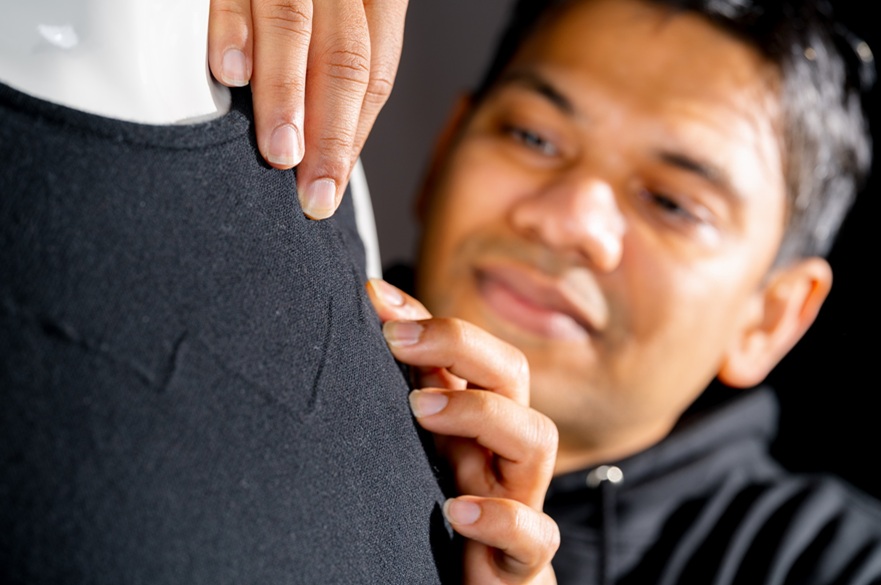
Scientists have developed a smart textiles vest which can monitor body temperature and detect risk of hypothermia in older people.
The technology aims to mitigate the increased risk that elderly people face due to losing body heat faster, having impaired temperature regulation, chronic conditions, medications and frailty.
Led by Dr Theo Hughes-Riley of Nottingham Trent University’s (NTU) Advanced Textiles Research Group (ATRG), the research centres on four miniature thermistors that are embedded into the yarn of the vest to detect sustained changes in body temperature.
A video interview about the smart vest
The thermistors - which are 1mm long and 0.5mm wide - are connected to a microcontroller via Bluetooth which allows real-time data to be transmitted to a mobile phone or other device and could raise the alarm if abnormal readings persist over time.
Encapsulated in resin to make them fully washable, and covered in a polyester braid, the thermistors are placed at key parts of the body, with two on the chest and two on the scapula, but cannot be felt by the wearer.
A prototype has been tested across a range of everyday movements - such as sitting, walking, jumping, and reaching - to ensure it responds accurately in real-world use. The data collected during the trials revealed unique temperature change patterns that could help identify abnormal physiological responses before they become dangerous.
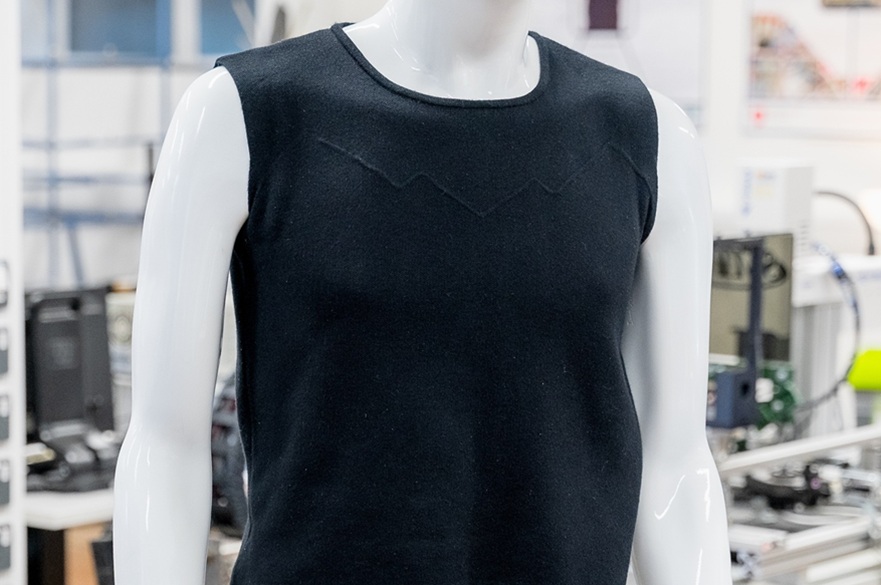
A close up photo of the smart vest
“Hypothermia is a very dangerous condition, particularly for those who are elderly and live alone without anyone to raise the alarm for them should they become ill,” said Dr Hughes-Riley, of the Nottingham School of Art & Design.
“By combining electronic textiles with an everyday garment such as a vest, carers and medical professionals would be able to respond immediately to any detected risk and help save the lives of older people who may need urgent support.”
The thermistors – placed on flat contact surfaces help maintain consistent connection with the skin - operate on a semiconductor principle where resistance decreases as temperature increases.
They are calibrated specifically for the yarns used in the vest, and the data they give are inferred to estimate core body temperature in the wearer.
Senior research fellow Dr Arash Moghaddassian Shahidi said: “By utilising smart textiles technology in this way, we can help ensure that vulnerable older people are monitored around the clock for serious health conditions like hypothermia, where it is paramount that they receive urgent treatment.”
PhD researcher Kalana Marasinghe, who tested the prototype, added: “This research shows how smart textiles have the potential save people’s lives by providing carers and clinicians with real-time data about a person’s health to help ensure they receive appropriate treatment.”
The project also includes Experimental Officer Carlos Oliveira, Dr Zahra Rahemtulla and Emeritus Professor Tilak Dias.
Notes for Editors
Press enquiries please contact Chris Birkle, Public Relations Manager, on telephone +44 (0)115 848 2310, or via email.
Nottingham Trent University (NTU) has been named UK ‘University of the Year’ five times in six years, (Times Higher Education Awards 2017, The Guardian University Awards 2019, The Times and Sunday Times 2018 and 2023, Whatuni Student Choice Awards 2023) and is consistently one of the top performing modern universities in the UK.
Students have voted us the best university in the UK and 1st in the UK for student employability (Uni Compare 2025).
NTU is 4th in the UK for number of undergraduate students (HESA 2023-24) with over 36,000 students and more than 4,000 staff located across six campuses. It has an international student population of 6,000 and an NTU community representing over 160 countries.
NTU owns two Queen’s Anniversary Prizes for outstanding achievements in research (2015, 2021). The first recognises NTU’s research on the safety and security of global citizens. The second was awarded for research in science, engineering, arts and humanities to investigate and restore cultural objects, buildings and heritage. The Research Excellence Framework (2021) classed 83% of NTU’s research activity as either world-leading or internationally excellent.
NTU was awarded GOLD in the national 2023 Teaching Excellence Framework (TEF) assessment.
NTU is a top 10 for sport (British Universities and Colleges Sport league table 2025) and was named as Sports University of the Year (Daily Mail University Guide 2025). It has also been ranked as 25th in the UK by the Guardian University Guide 2026.
NTU is a holder of the University Mental Health Charter recognising the commitment an institution has shown towards continuous improvement in the area of mental health and wellbeing.
NTU is the most environmentally sustainable university in the UK and third in the world (UI Green Metric University World Rankings, 2025).