Propaganda explained: What it is, how it began, and what you need to know
What is propaganda? Dr Colin Alexander tells its history and explains how to identify it
By Dr Colin Alexander | Published on 8 June 2026
Categories: Press office; Research; School of Social Sciences;
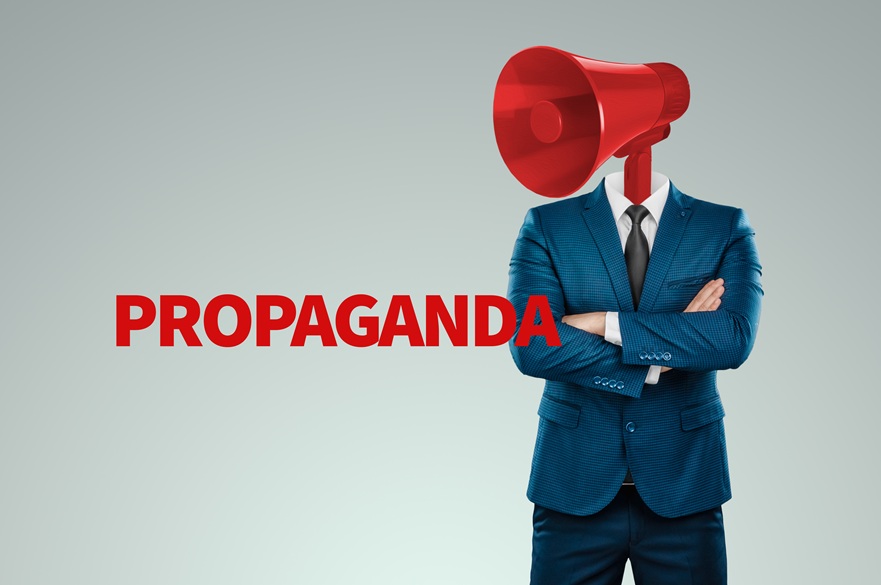
What you need to know:
- Harold Lasswell - one of the founding fathers of Communications Studies - defined propaganda in 1928 as the “management of collective attitudes by the manipulation of significant symbols.” This remains one of the preferred definitions by academics. It tells us that propaganda involves a deliberate set of actions, that it involves one-to-many rather than one-to-one communications and that its manipulation extends beyond texts and images and includes cultural symbols and the marginalisation of inconvenient counter-narratives.
- Propaganda is often considered synonymous with deceit or lying but that is only half of it. Propaganda can involve telling the truth -albeit a selective and self-interested framing of the truth. However, propaganda research is as much about trying to understand the communications that do achieve the oxygen of publicity as it is those that do not.
- Propaganda is used by governments, statutory bodies, corporations, non-profits, powerful individuals and even regular members of the public to promote their interests and to manipulate the information environment that surrounds them.
- Terms like ‘advertising’, ‘marketing’, ‘public relations/PR’ are all euphemisms for propaganda to make the intention of mass manipulation appear more acceptable to practitioners and publics alike.
- Propaganda is a global issue. Without improved communications literacy and understandings by publics of what is legal and ethical, people are more likely to have their conscience manipulated to the will of others.
- With the emergence of Gen AI technologies, propaganda – once a human-to-human activity with potentially trackable responsibility pathways – is likely to become more opaque and potentially more dangerous with reduced routes to human accountability.
What is propaganda?
The etymology of the word ‘propaganda’ is from the Latin and modern Italian verb propagare meaning ‘to spread’. It was first used by the Catholic Church in 1622 when Pope Gregory XV established the Sacra Congregatio de Propaganda Fide (Sacred Congregation for Spreading the Faith) as part of missionary efforts to prevent the decline of Catholicism as it was challenged by Protestantism and the Enlightenment.
The modern focus upon the term began during the 1920s when Communications Studies was established as an academic subject distinct from psychology, sociology and linguistics, and on account of emerging public debates about the societal impact of the ‘new media’ of radio broadcasting.
Lasswell was one of the founding academic fathers (they were all men) of Communications Studies. However, in those early years the term came to greatest prominence through Edward Bernays’ 1928 book Propaganda, which provided its readers with critical analysis, case studies and insight into some of the methods used in effective campaigns.
Propaganda is most effective when used subtly or when it operates beneath the target audience’s conscious awareness. It is on account of these subtleties that it is marginalised from full public consciousness and struggles to achieve the quality and quantity of critical attention that merits its influence over individual and collective decision-making. For example, propaganda is usually perceived as a part of warfare, when, in reality, it represents a much fuller part of the explanation for why these acts of mass violence continue to be accepted by publics in their name, why combatants enlist, why publics support armed conflict, and why most politicians and civilians cannot conceive of a world without war or have limited will to make it illegal. Propaganda is not a part of war – it is arguably the whole reason that war continues to exist.
Propaganda usually involves communications intended to provoke emotional attachment to a cause, belief, concept or individual. It discourages rational thoughts – although the propagandist may claim rational or ‘common sense’ logics. It regularly adopts or aligns with readily held ideological tenets and cultural symbols (flags, patriotism, the Royal Family, positive moments within collective memory - war victories, for example) to achieve its aims. This is where common understanding of propaganda usually ends.
Beyond this, much of the work of the propagandist involves influencing the social, economic and political circumstances that encourage the eminence of their cause above others. It is a process that results in the marginalising of inconvenient alternatives, encouraging the conditions of censorship and self-censorship, buying influence, using the spectacle of entertainment or controversy to attract attention, manipulating the rule of law and threats of legal consequences to compel compliance.
What is the key debate about propaganda?
Propaganda is often positioned as a ‘bad’ thing, but that is too simplistic a conclusion. Indeed, the digital age has meant that almost all of us are propagandists to some extent when we post filtered, edited or selective elements of our lives to social media. What people usually mean when they say that propaganda is ‘bad’ is that it is deceptive, conniving, self-interested or perhaps that there is a sense of poor sportsmanship in the use of manipulative communications strategies to encourage people to think or behave in ways that they otherwise would not. Some people also associated propaganda with crimes against humanity like genocide – shades of the Nazis and Dr Goebbels. All these points are valid. However, it must also be recognised that humans are a manipulative species who regularly use the tools and means at our disposal to control others and enhance our power. Therefore, propaganda ought to be seen as an inevitable and perhaps even natural part of complex human society. Nevertheless, it has the potential to be very dangerous and it should also be a subject that people have sophisticated critical understanding of to protect themselves from harm or from being encouraged to commit harmful acts towards others or the natural world at the behest of a propagandist.
Propaganda’s polemic can hereby be summarised through the work of two scholars. The political philosopher Leo Strauss argued that unity and obedience to civic imperatives was essential to preserve social order and orient collective behaviour. Taken from Plato he emphasised the appropriateness of a “noble” lie. Strauss claimed that stable societies depend on unifying myths, stories that may not be literally true, yet the meaning they carry offers simple explanations for complex situations and provides a sense of collective purpose and structure. Therein, it is the prerogative of the powerful to engage in tasks of social control, less society collapses into anarchy, chaos and gross individualism.
Alternatively, history tells us that the lie is very rarely noble as most actors who rise to the top have done so because of their will to power. To allow propaganda to thrive in a society is to accept the likelihood of tyranny. This was the position of Reinhold Niebuhr who argued that privileged groups regularly twist scenarios to their advantage or manufacture threats of imperilment to ensure the continuity of the hierarchy that they sit at the top of.
Insightful quotations about propaganda
“Since inequalities of privilege are greater than could possibly be defended rationally, the intelligence of privileged groups is usually applied to the task of inventing specious proofs for the theory that universal values spring from, and that general interests are served by, the special privileges which they hold.” (Reinhold Niebuhr, 1932: 72)
“[I]n almost every act of our daily lives, whether in the sphere of politics or business, in our social conduct or ethical thinking, we are dominated by the relatively small number of persons […] who understand the mental processes and social patterns of the masses. It is they who pull the wires which control the public mind.” (Edward Bernays, 1928: 37)
“Offered a choice between bitter truth and comfortable delusion, at least sometimes we will opt for truth. Not all the time – that would be too strong to claim. When we find reality hard enough to face, then the comfort afforded by the appropriate delusion may be irresistible. This is, of course, an epistemic problem here: a delusion has no power to comfort unless it is accepted as real, in which case how can we be said to prefer it as a delusion? After all, the problem is that from the inside delusion and reality may be indistinguishable. However, we do often have an inkling that our carefully safeguarded belief structure is fragile and collude in protecting it against damaging counterevidence, deception shades into self-deception.” (LW Sumner, 1996: 96)
“[A]ll the world’s masters, all the founders of religions or empires, the apostles of all beliefs, eminent politicians, and, in a more modest sphere, the mere chiefs of small groups of people have always been unconscious psychologists, possessed with an instinctive and often very sure knowledge of the character of crowds.” (Gustave Le Bon, 1895: 14)
An expert opinion on propaganda was also recently published by Dr Alexander.