Tourist hotspots could be creating new routes for parasite transmission
Researchers have carried out an international study examining how interactions between people, free-roaming dogs and wildlife at urban tourist destinations may create opportunities for parasite transmission.
By Dave Rogers | Published on 24 June 2026
Categories: Press office; Research; School of Animal, Rural and Environmental Sciences;
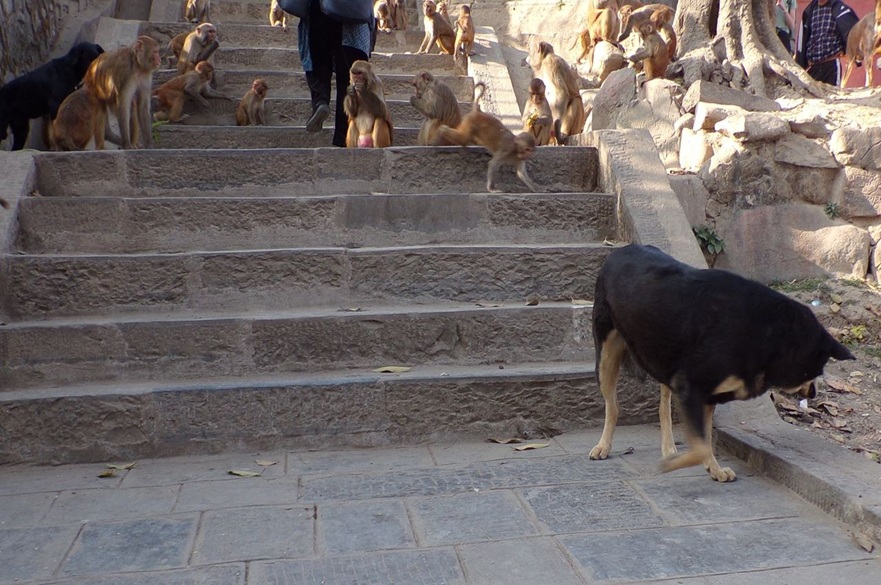
The study - a collaboration between the University of Lincoln, Tribhuvan University in Nepal, Nottingham Trent University and Keele University - focused on UNESCO-listed Swayambhunath Temple in Kathmandu, a popular tourist site where humans, dogs and macaques live and interact in close proximity.
Published in Parasitology, the research combined behavioural observations, parasitological analysis and visitor questionnaires to investigate how parasites may be transmitted between species in shared urban environments.
The researchers identified parasites across humans, dogs and macaques, including Entamoeba species with zoonotic potential. Macaques were found to have the greatest parasite diversity.
The findings suggest that everyday behaviours, including feeding wildlife and poor hygiene practices, may increase opportunities for parasite exposure. The study also found that infection risk may be influenced by social behaviour, stress and environmental contamination, rather than physical proximity alone.
Dr Laëtitia Maréchal, Associate Professor at the University of Lincoln and co-author of the study, said: "In busy urban tourist sites, people, pets, and wildlife mix far more closely than we realise. Simple actions like feeding monkeys or standing near free roaming animals can create unexpected opportunities for parasites to be transmitted between species.
"Our research shows how these everyday interactions in popular tourist areas can shape infection risks for both humans and animals living in the city."
The researchers say the findings highlight the importance of considering animal behaviour, human activity and environmental conditions together when managing health risks in urban areas where people and animals regularly interact.
Dr Stefano Kaburu, Senior Lecturer in Conservation Biology at Nottingham Trent University and co-author of the study, said: "With the growing expansion of urban areas, humans and domestic animals are increasingly coming into contact with wildlife. This creates conditions in which cities can become hotspots for parasite transmission across species.
“Our study showed that macaques and dogs act as important reservoirs and sentinels of parasite exposure, underlining their critical role in monitoring zoonotic disease risks. Findings also indicate that human activities, such as feeding wildlife and close contact with animals, can unintentionally increase infection risks, not only through exposure but by altering animal behaviour and stress."
The study, titled Parasite transmission risk at the urban human-dog-macaque interface, was led through a collaboration between Tribhuvan University, the University of Lincoln, Nottingham Trent University and Keele University.
Notes for Editors
Press enquiries please contact Dave Rogers, Public Relations Manager, on telephone +44 (0)115 848 8782, or via email.
About Nottingham Trent University, UK
Nottingham Trent University (NTU) has been named UK ‘University of the Year’ five times in six years, (Times Higher Education Awards 2017, The Guardian University Awards 2019, The Times and Sunday Times 2018 and 2023, Whatuni Student Choice Awards 2023) and is consistently one of the top performing modern universities in the UK.
Students have voted us 1st in the UK for course quality and top five in the UK for employability (Uni Compare 2027).
NTU is 4th in the UK for number of undergraduate students (HESA 2023-24) with over 36,000 students and more than 4,000 staff located across six campuses. It has an international student population of 6,000 and an NTU community representing over 160 countries.
NTU owns two Queen’s Anniversary Prizes for outstanding achievements in research (2015, 2021). The first recognises NTU’s research on the safety and security of global citizens. The second was awarded for research in science, engineering, arts and humanities to investigate and restore cultural objects, buildings and heritage. The Research Excellence Framework (2021) classed 83% of NTU’s research activity as either world-leading or internationally excellent.
NTU was awarded GOLD in the national 2023 Teaching Excellence Framework (TEF) assessment.
NTU is a top 10 for sport (British Universities and Colleges Sport league table 2025) and was named as Sports University of the Year (Daily Mail University Guide 2025). It has also been ranked as 25th in the UK by the Guardian University Guide 2026.
NTU is a holder of the University Mental Health Charter recognising the commitment an institution has shown towards continuous improvement in the area of mental health and wellbeing.
NTU is the most environmentally sustainable university in the UK and second in the world (UI Green Metric University World Rankings, 2024).
About the University of Lincoln, UK
Situated in the heart of a historic city, the University of Lincoln transforms lives and communities through teaching, research, and partnerships. We support students to thrive both academically and personally. Over a quarter of our subjects rank in the UK top 10 (Guardian University Guide 2025), and we hold a Silver award for Mental Health and Wellbeing (Whatuni Student Choice Awards 2025). In 2023, we received the Queen’s Anniversary Prize — the UK’s highest academic honour. Our strong ties with industry, including Siemens Energy, have earned national recognition. More than 75% of our research was rated internationally excellent or world-leading in REF 2021, underscoring our impact. We’re ranked in the global top 300 for progress on the UN Sustainable Development Goals (THE Impact Rankings), including 63rd for reducing inequalities. Lincoln also appears in the QS World Rankings (801–850 band), reflecting strengths in student experience and international collaboration. Almost £400 million has been invested in our modern, waterfront campus — a welcoming home to students from over 100 countries.
About Tribhuvan University, Nepal
Situated in the culturally rich and historic Kathmandu Valley, Tribhuvan University—Nepal’s oldest and largest institution of higher learning—transforms lives and drives national development through comprehensive teaching, vital research, and international partnerships. We support a highly diverse student body, empowering individuals from all backgrounds to thrive both academically and personally. As the premier national university, we educate the vast majority of Nepal's higher education students and consistently rank as the top academic institution in the country. Our specialized research centers, which focus on everything from applied sciences to economic development, have earned widespread regional acclaim. Our strong ties with government bodies, international organizations, and local industries play a pivotal role in shaping public policy and fostering societal resilience. We produce highly impactful research that addresses critical Himalayan, environmental, and socio-economic challenges, underscoring our regional and global significance. Recognized on the world stage, Tribhuvan University appears in the Times Higher Education (THE) World University Rankings, reflecting our growing international collaboration and commitment to educational advancement. Anchored by our sprawling, scenic central campus in Kirtipur and supported by an expansive nationwide network of constituent and affiliated colleges, TU is a welcoming academic home uniting students from all 77 districts of Nepal alongside international scholars from across the globe.
About Keele University, UK
We’re Keele and we’re different. Founded 75 years ago to meet the demands of a new kind of society, economy and world, our principles resonate now more than ever. We are a campus university with over 15,000 students, nestled in 600 acres of Staffordshire countryside and just an hour from Manchester and Birmingham. It’s a big campus but a small and cosmopolitan community, with space to think and plenty to do. Keele University was born from a pioneering vision, one of a different kind of university. Established in 1949 by Lord Lindsay - the former Vice-Chancellor of Oxford University - in a country still recovering from the Second World War, the University’s founding aim was to produce graduates who not only had the technical and specialist knowledge to move society forward, but who understood the social and political landscape that drove this need. Fast-forward 75 years and this original ethos remains at the core of the University’s mission, and our global network of over 100,000 alumni in 120 countries is creating positive impact across the world in a range of diverse careers.
Our research seeks to improve lives and address the most pressing challenges across our region, country, and world. Our academics are actively studying matters of global importance: from food security, climate change and smart energy, to neglected tropical diseases, global health and sustainable futures. It’s no wonder that 80% of our research is deemed world-leading or internationally excellent in the Research Excellence Framework (2021).