Pupils design and develop retro arcade games as part of ‘Girls Can Code’ event at NTU
Pupils from primary schools across Nottinghamshire took part in an inspiring new outreach initiative as Nottingham Trent University’s Department of Computer Science hosted its first-ever ‘Girls Can Code’ event in collaboration with the Equals Trust academy.
By Dave Rogers | Published on 23 June 2026
Categories: Press office; School of Science and Technology;
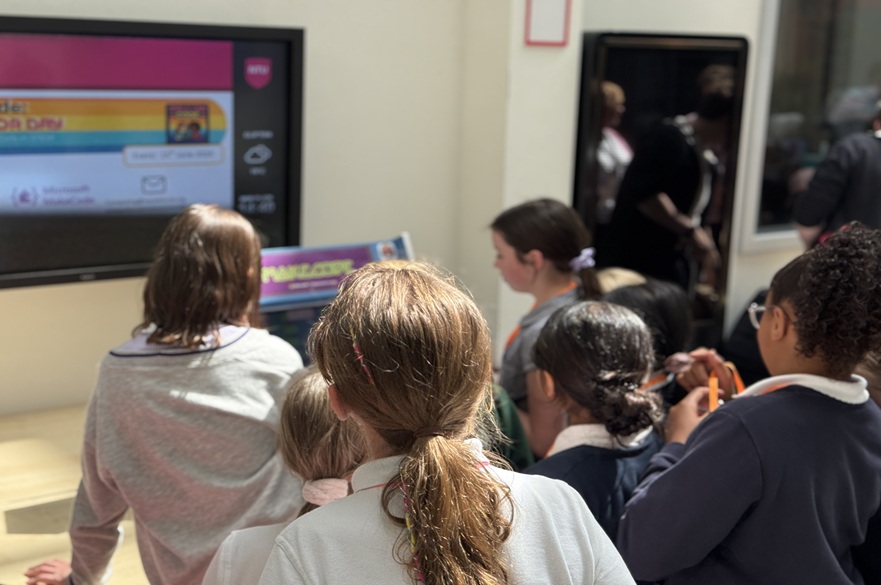
Bringing together more than 100 girls aged 9-10 from schools across the trust, the event aimed to build confidence in computer science, showcasing female career pathways into STEM and providing an authentic experience of software development in a university setting.
The pupils explored the Department of Computer Science’s cutting-edge facilities, including access to advanced computing laboratories, robotics and immersive virtual reality research development areas. These experiences aimed to give pupils an insight into the scale, creativity and innovation involved in modern computing, as well as a glimpse of what studying at university is like.
The event was made possible through funding from The Royal Society Partnership Grants, alongside the support of industry and university collaborators. Microsoft's MakeCode Arcade team provided sponsorship and support for the event, enabling students to learn coding through game development using the MakeCode Arcade platform.
Microsoft volunteers, together with NTU staff and students, played an important role in mentoring and inspiring the girls throughout the day, helping bring technology careers and digital skills to life.
At the heart of the event was a hands-on coding challenge where pupils designed and developed their own retro-style arcade games. Working in teams, the girls learned fundamental programming concepts while also developing creativity, resilience and problem-solving skills.
The activity was designed to go beyond simply writing code. The pupils became designers and researchers, exploring a key question at the center of the wider Royal Society project: ‘what makes a game engaging?’
By testing each other’s games, sharing feedback and refining their designs, the girls began to understand how user experience, challenge and creativity impact gameplay. This iterative approach introduced them to real-world development practices, where testing, evaluation and improvement are essential parts of the process.
The Girls Can Code initiative is designed to be more than a one-day experience. The university visit marked the beginning of a longer-term project that will continue back in participating schools over the coming months.
The children will build on their work by collecting feedback, analysing patterns in player responses and further developing their games. This ongoing approach encourages deeper thinking about how technology is designed and used, aiming to support understanding that coding is not just about making something work, but about creating meaningful and responsible digital experiences.
Dr Thomas Johnson, Senior Lecturer in the Department of Computer Science at Nottingham Trent University, said: “Throughout the day, the girls demonstrated enthusiasm, teamwork and determination as they engaged with new challenges and environments. They were supported not only in developing technical skills, but also in building confidence and seeing themselves as future innovators.
“The Girls Can Code event has played an important role in widening participation in computer science by providing early exposure to female role models, industry partners and real-world applications of technology.”
Andy Sawford, Deputy Headteacher at Heymann Primary and Nursery School, and Computing Lead for Equals Trust, said: “One of the most important parts of the day was the chance for the girls to meet, work with and learn from women in STEM and industry. That representation really matters. It helps pupils see that computing is something they can be part of.
“Events like Girls Can Code are so valuable because they give children a genuine experience of creating, testing and improving technology, while also helping them imagine where those skills could take them in the future.”
Notes for Editors
Press enquiries please contact Dave Rogers, Public Relations Manager, on telephone +44 (0)115 848 8782, or via email.
About Nottingham Trent University
Nottingham Trent University (NTU) has been named UK ‘University of the Year’ five times in six years, (Times Higher Education Awards 2017, The Guardian University Awards 2019, The Times and Sunday Times 2018 and 2023, Whatuni Student Choice Awards 2023) and is consistently one of the top performing modern universities in the UK.
Students have voted us first in the UK for course quality, top five in the UK for employability and third best University in the UK (Uni Compare 2027). We are ranked in the top 25 universities in the country (The Guardian University Guide 2026).
We have over 35,000 students and more than 4,000 staff located across five campuses. It has an international student population of over 5,000 and an NTU community representing over 160 countries.
NTU owns two Queen’s Anniversary Prizes for outstanding achievements in research (2015, 2021). The Research Excellence Framework (2021) classed 83% of NTU’s research activity as either world-leading or internationally excellent.
NTU was awarded GOLD in the national 2023 Teaching Excellence Framework (TEF) assessment.
NTU is a top 10 for sport (British Universities and Colleges Sport league table 2025) and was named as Sports University of the Year (Daily Mail University Guide 2025).
NTU is a holder of the University Mental Health Charter, recognising the commitment an institution has shown towards continuous improvement in the area of mental health and wellbeing.
NTU is the most environmentally sustainable university in the UK and third in the world (UI Green Metric University World Rankings, 2025).