Climate change-fuelled landslides push rarest great ape closer to extinction
About 7% of the entire population of the world’s rarest great ape are estimated to have been killed by landslides in a storm that was worsened by climate change, a new study has found.
By Dave Rogers | Published on 10 June 2026
Categories: Press office; Research; School of Animal, Rural and Environmental Sciences;
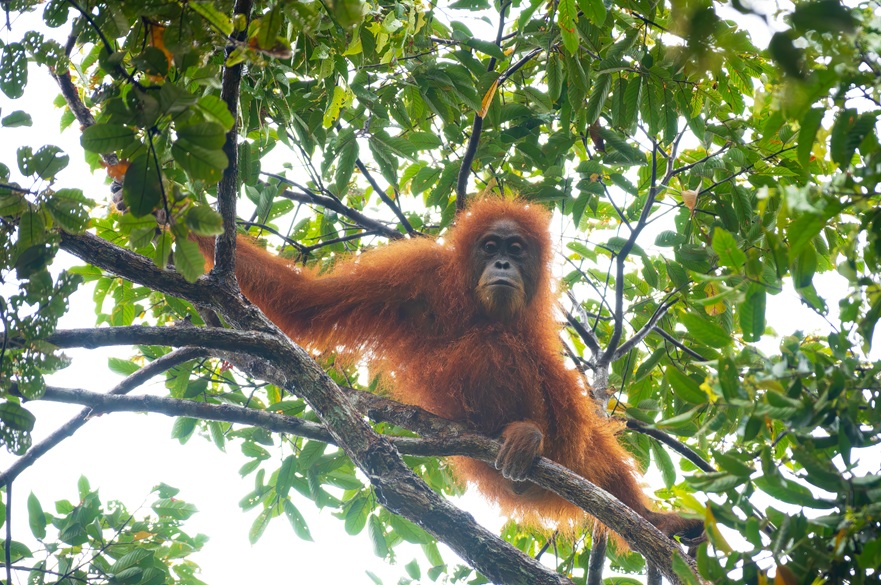
Published in Current Biology, scientists analysed the impact of Cyclone Senyar on Indonesia's critically endangered Tapanuli orangutans.
They found that the storm’s extreme rainfall in November 2025 resulted in landslides that delivered a severe demographic shock to a species already on the brink of extinction.
The scientists, including Nottingham Trent University's Professor Dave Petley, analysed satellite evidence of landslide scars in the West Block of the Batang Toru Ecosystem - home to the largest remaining population of the apes.
These were overlaid with estimates of orangutan density in the area. They concluded that an estimated 58 Tapanuli orangutans died as a result of the landslides - about 11% of the total living in this region, or 7% of the estimated overall population remaining in the wild.
Using climate attribution methods, the scientists also found that the rainfall intensity was increased by as much as 50% as a result of human-induced climate change, demonstrating how worsening weather extremes present a growing threat to endangered wildlife.
Key Findings:
● Severe Population Impact: Landslides resulting from downpours during Cyclone
Senyar are estimated to have caused the loss of about 11% of the critically-endangered Tapanuli orangutan population in the West Block region.
● Habitat Destruction: Approximately 8,300 hectares of forest, accounting for about
11.7% of the forest cover in the West Block of the Batang Toru region, were affected by landslides triggered by extreme rainfall.
● Climate-fuelled destruction: Attribution analysis shows that human-induced climate change increased the rainfall intensity by between 9 and 50%.
Professor Erik Meijaard, Chief Scientist at Borneo Futures said: “This level of loss is substantial for a species with such a small total population. When combined with ongoing pressures such as habitat degradation and human–wildlife conflict, it further increases the urgency of implementing and adequately resourcing a coordinated species action plan.”
Professor Jatna Supriatna, Department of Biology, Universitas Indonesia, said: "The loss of an estimated 58 Tapanuli orangutans to a single climate-induced landslide event is a devastating demographic shock to the world’s rarest great ape. To prevent the first modern extinction of a great ape species, Indonesia must permanently protect the Batang Toru ecosystem, but our international partners must also meet their global commitments by providing immediate biodiversity-recovery financing."
Professor Serge Wich, Primatologist at Liverpool John Moores University, said:
“It is tragic to lose so many apes in this way. In landscapes where populations are small and fragmented, this type of weather or climate event can have population-level consequences. It is extremely worrying for the future of this ape.”
Professor Dave Petley, Landslide Researcher at Nottingham Trent University, said: “These are high-velocity, shallow landslides triggered by intense rainfall. Because the debris flows are directly connected to the channel system, the failure is rapid and exceptionally destructive, leaving those in the path with little warning or chance of escape.”
Professor Friederike Otto, Professor of Climate Science at Imperial College London, said: “This study is a stark demonstration of how intertwined the crises of climate change and biodiversity loss are. By increasing the rainfall intensity of Cyclone Senyar by up to 50%, human-induced climate change turned a severe tropical storm into a catastrophic trigger for these tragic landslides.”
Notes for Editors
Press enquiries please contact Dave Rogers, Public Relations Manager, on telephone +44 (0)115 848 8782, or via email.
Nottingham Trent University (NTU) has been named UK ‘University of the Year’ five times in six years, (Times Higher Education Awards 2017, The Guardian University Awards 2019, The Times and Sunday Times 2018 and 2023, Whatuni Student Choice Awards 2023) and is consistently one of the top performing modern universities in the UK.
Students have voted us the best university in the UK and 1st in the UK for student employability (Uni Compare 2025).
NTU is 4th in the UK for number of undergraduate students (HESA 2023-24) with over 36,000 students and more than 4,000 staff located across six campuses. It has an international student population of 6,000 and an NTU community representing over 160 countries.
NTU owns two Queen’s Anniversary Prizes for outstanding achievements in research (2015, 2021). The first recognises NTU’s research on the safety and security of global citizens. The second was awarded for research in science, engineering, arts and humanities to investigate and restore cultural objects, buildings and heritage. The Research Excellence Framework (2021) classed 83% of NTU’s research activity as either world-leading or internationally excellent.
NTU was awarded GOLD in the national 2023 Teaching Excellence Framework (TEF) assessment.
NTU is a top 10 for sport (British Universities and Colleges Sport league table 2025) and was named as Sports University of the Year (Daily Mail University Guide 2025). It has also been ranked as 25th in the UK by the Guardian University Guide 2026.
NTU is a holder of the University Mental Health Charter recognising the commitment an institution has shown towards continuous improvement in the area of mental health and wellbeing.
NTU is the most environmentally sustainable university in the UK and second in the world (UI Green Metric University World Rankings, 2024).