Creating sustainable supply of declining tree species will support floodplain habitat restoration
A rare and rapidly-declining native tree species which can be found on floodplains has been planted at Nottingham Trent University’s Brackenhurst Campus in the hope that it can be used in future floodplain habitat restoration.
By Dave Rogers | Published on 3 March 2026
Categories: Press office; Environment and sustainability; Research; School of Animal, Rural and Environmental Sciences;
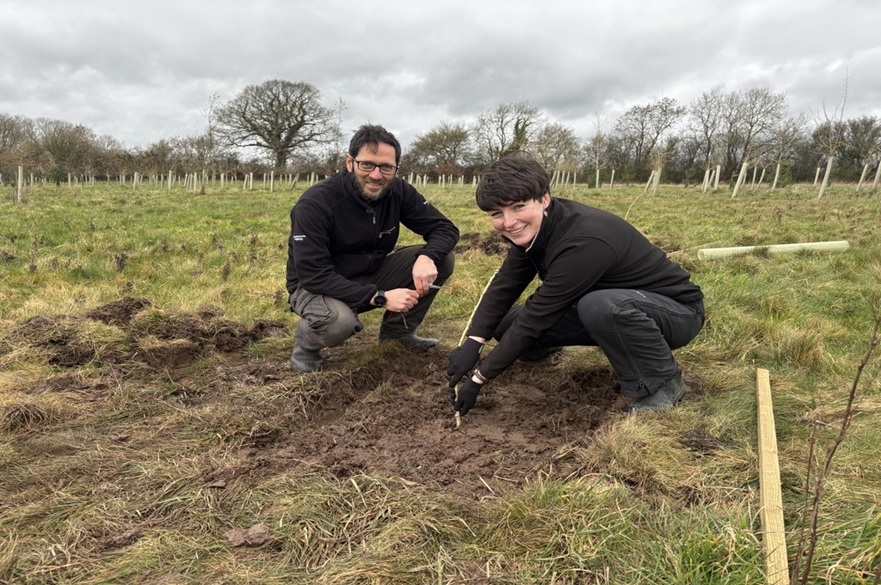
A number of native black poplar whips – young unbranched trees – were planted at the campus near Southwell as part of a project involving NTU, the Environment Agency, Nottinghamshire Wildlife Trust, Trent Rivers Trust, Nottinghamshire Biodiversity Action Group and the Sherwood Forest Trust.
Native black poplars thrive in wet floodplains and on riverbanks. They are flood tolerant and an ideal species for planting in close proximity to water and where flooding is more common.
A combination of changing farming practices, flood alleviation schemes and a decline in demand for wood from the tree, however, have led to their natural habitats disappearing across much of the UK.
Where habitat does remain the trees struggle to reproduce because many surviving trees are male as they have been historically preferred to the female trees which produce large quantities of white fluffy seed.
The genetic diversity of the tree is also complicated as hybridisation with other poplar trees is common.
There are believed to be about 7,000 native black poplar trees growing wild in Britain.
As well as being a floodplain tree, native black poplar have historically been used as boundary trees, possibly due to their large distinctive outlines and fast-growing nature, distinguishing between adjacent parish councils and landowners, usually within a hedgerow.
The Nottinghamshire project will involve creating a nursery of native black poplar at the Brackenhurst Campus – confirmed through DNA testing – with the aim of helping to bolster numbers of the tree across the county.
The campus whips will be grown up to establish larger coppice stools – the base of a tree which regrows multiple new shoots – from which a sustainable supply of new whips can be taken.
Brackenhurst is one of two sites for the project, with planting also planned for Vicar Water Country Park.
“Black poplar is one of our rarest trees. The historical removal of habitat in which it thrives has been a major cause of its rapid decline,” said Pete Haynes, Biodiversity Officer at the Environment Agency.
He said: “By creating nurseries of confirmed native black poplar we can confidently provide trees to projects to boost the occurrence of this tree with in the county.
“This is a long-term project, with the initial whips expected to be taken from coppice stools within the next five years. By that point hopefully will be able to provide a steady supply of native black poplar whips for floodplain habitat restoration and other planting projects.”
Locations for future planting would be considered on a site-by-site basis. They could be sites where the trees could naturally regenerate on their own – although these habitats are rare – or in areas where other trees struggle due to boggy conditions.
It is hoped that in the longer term the project will be able to link up with neighbouring counties as part of a Midlands-wide approach, sharing expertise and promoting wider planting of black poplar to increase its presence.
Dr Helen Hicks, senior lecturer in environmental science in Nottingham Trent University’s School of Animal, Rural and Environmental Sciences, said: “It’s great to be involved in this nature positive project.
“By establishing a nursery of native black poplars at our Brackenhurst Campus we are contributing to long-term landscape‑scale habitat restoration across our Trent Valley floodplains and helping local conservation bodies to deliver on the Local Nature Recovery Strategy.”
Notes for Editors
Press enquiries please contact Dave Rogers, Public Relations Manager, on telephone +44 (0)115 848 8782, or via email.
Nottingham Trent University (NTU) has been named UK ‘University of the Year’ five times in six years, (Times Higher Education Awards 2017, The Guardian University Awards 2019, The Times and Sunday Times 2018 and 2023, Whatuni Student Choice Awards 2023) and is consistently one of the top performing modern universities in the UK.
Students have voted us the best university in the UK and 1st in the UK for student employability (Uni Compare 2025).
NTU is 4th in the UK for number of undergraduate students (HESA 2023-24) with over 36,000 students and more than 4,000 staff located across six campuses. It has an international student population of 6,000 and an NTU community representing over 160 countries.
NTU owns two Queen’s Anniversary Prizes for outstanding achievements in research (2015, 2021). The first recognises NTU’s research on the safety and security of global citizens. The second was awarded for research in science, engineering, arts and humanities to investigate and restore cultural objects, buildings and heritage. The Research Excellence Framework (2021) classed 83% of NTU’s research activity as either world-leading or internationally excellent.
NTU was awarded GOLD in the national 2023 Teaching Excellence Framework (TEF) assessment.
NTU is a top 10 for sport (British Universities and Colleges Sport league table 2025) and was named as Sports University of the Year (Daily Mail University Guide 2025). It has also been ranked as 25th in the UK by the Guardian University Guide 2026.
NTU is a holder of the University Mental Health Charter recognising the commitment an institution has shown towards continuous improvement in the area of mental health and wellbeing.
NTU is the most environmentally sustainable university in the UK and second in the world (UI Green Metric University World Rankings, 2024).