When social media becomes a tool of diplomacy and warfare
Political leaders are increasingly using social media posts, memes and emotionally charged messaging to shape how conflicts are understood. Dr Tine Munk examines how this shift can weaken diplomatic clarity and increase the risk of misjudgement.
By Dr Tine Munk | Published on 5 March 2026
Categories: Press office; Research; School of Social Sciences;

War is unfolding between the US, Israel and Iran. But the battlefield is hybrid; it is not only physical but also digital. Official posts, memes and emotionally charged statements shape how the conflict is framed and how the public understands it. As political leaders use blame and spectacle to dominate the narrative space, offensive memetic warfare reshapes both the projection of power and the explanation of war.
This reflects a broader shift in international politics. Traditional diplomacy has long relied on negotiation, careful signalling and precise communication. Governments speak through formal channels, and statements are drafted deliberately because words carry consequences. Allies and adversaries alike must be able to interpret and understand the communication.
That model is increasingly being displaced by social media theatre. Official accounts now use posts, images and emotionally charged messaging to influence public perception before policy is formally articulated. Information warfare and memetic warfare are no longer marginal tools; they are becoming central instruments of power projection. This is not simply digital noise. It is the strategic use of offensive memetic warfare by political leaders and official offices.
How social media is changing diplomacy
This shift has become particularly visible since US President Trump began his second term in 2025. Official communication has moved more decisively onto social media platforms, where online posts often precede formal briefings and policy documents. The online audience now encounters strategic signals in real time.
Diplomacy relies on credibility. Government statements commit states to clear positions and define their stance in unfolding events. In moments of crisis, signals must be precise to prevent escalation. Clear communication helps safeguard international relations by reassuring allies and reducing the risk of misunderstandings that can have serious consequences.
Social media operates differently. It rewards speed, provocation and emotional intensity within the attention economy. When political leaders use this route for official communication, the emphasis shifts from explanation to impact. It conditions perception in advance, laying the groundwork for later action by normalising ideas that might otherwise have seemed exceptional or extreme.
Memes and stylised posts blur the line between humour, irony and intention, allowing bold geopolitical ideas to circulate without formal declaration. They test domestic and international reaction without committing to action, while spreading quickly and taking hold in the public mind long before corrections can follow.
Greenland: a rehearsal for digital diplomacy
In some early 2026 posts from President Trump and the White House, this dynamic is clearly illustrated. Greenland was depicted visually as though the US takeover of the country were already unfolding. Valentine-card graphics suggested executive reach. Arctic imagery featured penguins, even though penguins do not inhabit Greenland. A hospital ship was depicted as heading north, even though it was reportedly in dry dock and later redirected, with the Greenland mission postponed.
There has been no annexation of Greenland. Yet the imagery implied inevitability. The purpose was not to announce a concrete policy change. It was to introduce the idea of territorial ambition into public debate without triggering formal diplomatic consequences, and the administration achieved three strategic effects:
- It normalised expansionist imagery without committing to action
- It tested international reaction at low political cost
- It projected dominance while retaining deniability.
However, this kind of strategic uncertainty disrupts established diplomatic channels. When one NATO member appears, even symbolically, to threaten another, trust erodes. States begin to reassess their alliances. Long-standing ties can weaken, prompting some to seek new partnerships. Social media theatre bypasses negotiation and inserts spectacle directly into alliance politics.
From social media spectacle to real conflict
The implications become far more serious when this communicative style overlaps with active conflict/war. The ongoing US-Israeli war against Iran involves real strikes, retaliation and escalating regional tension. In such circumstances, clear communication is essential. Citizens need accurate information about what is happening and why. Allies require coherent signalling. Misinterpretation can increase the risk of escalation and confusion.
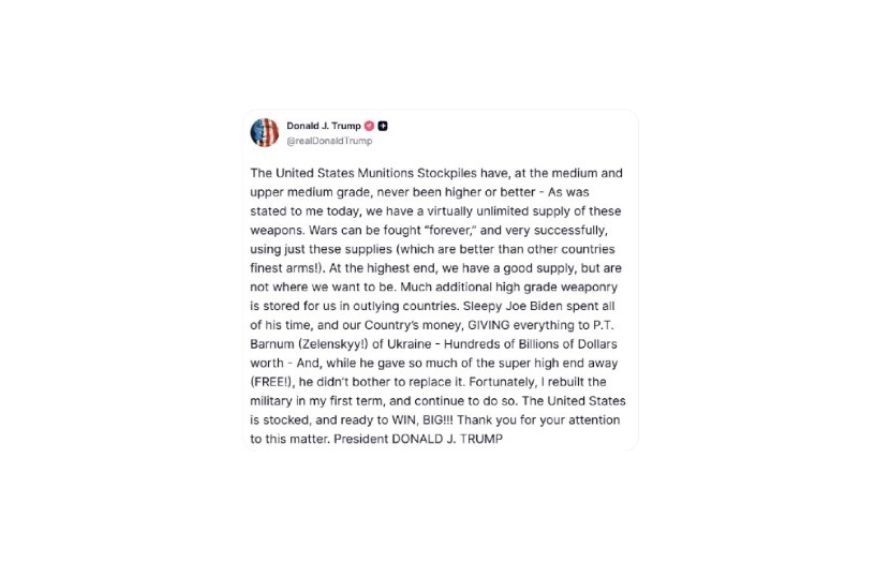
In a recent Truth Social post (3 March 2026), US President Trump claimed that US munitions stockpiles were ‘virtually unlimited’ and that wars could be fought ‘forever’. He criticised President Biden for weakening the US military capacity and for giving away high-grade weaponry. He referred to Ukrainian President Zelenskyy as ‘P.T. Barnum’, comparing him to a showman.
Political blame is not new; presidents often criticise predecessors and opponents. What stands out here is that, during active military engagement, accusation replaces explanation. Instead, communication is centred on inherited weakness and external fault. The US President directs current military decisions. But when responsibility is repeatedly pushed outward, escalation is framed as something inherited rather than as an active choice. Moreover, emotional intensity shapes perception before doctrine is fully articulated.
This becomes especially significant when the rhetoric targets allies. The US positions itself as a key partner to Ukraine in its war with Russia. Publicly portraying President Zelenskyy as manipulative or theatrical undermines that partnership. As with the earlier Greenland messaging, the communication creates strain in international relations rather than strengthening them.
The risks of governing through spectacle
In the developing US-Israeli war against Iran, the risks of governing through social media spectacle intensify. When communication relies on posts and emotionally charged messaging, visibility can outweigh accuracy. We now see that military developments are reduced to online blame narratives, while strategic details remain unclear. This digital style prioritises speed and provocation over careful explanation. In a volatile security environment, that lack of clarity weakens trust and increases the risk of misjudgement.
Online posts and memes are powerful tools. In war, however, they carry a heightened risk of deception and narrative manipulation compared to structured diplomatic communication. The shift we are witnessing is not merely stylistic. It reflects a move away from diplomacy as a stabilising practice and towards political communication as theatre, designed to capture an audience. The key question is whether governance built on performance can sustain stability in a conflict where precision and credibility matter more than attention.
Dr Tine Munk
Senior Lecturer in Criminology and Criminal Justice, School of Social Sciences