Expert blog: Seeing ourselves in the game - why women’s sports history matters
Dr Katie Taylor, Senior Lecturer in Sociology of Sport at Nottingham Trent University, discusses the importance of women's sports history - and why it needs to be understood and celebrated
By Dr Katie Taylor | Published on 12 March 2026
Categories: Press office; Research; School of Science and Technology;
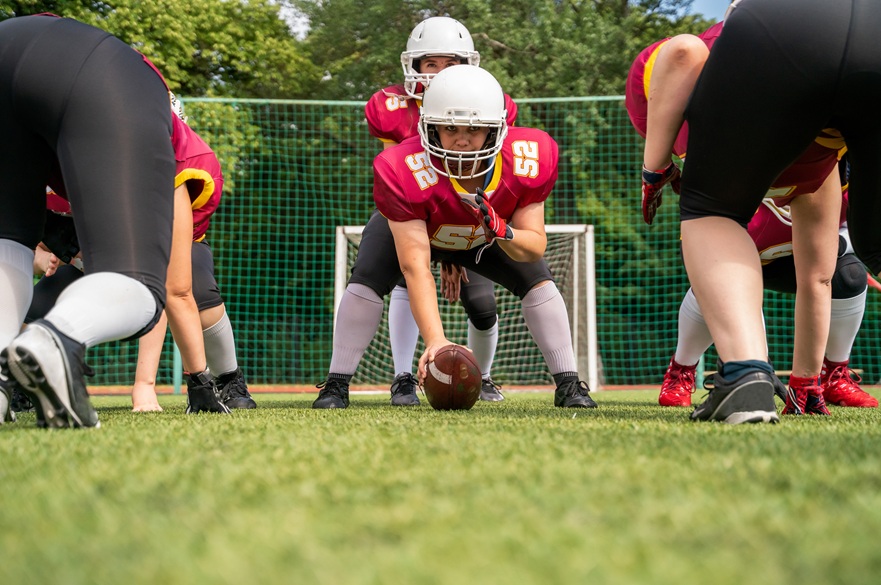
In 2011, on the shores of Lake Geneva, I attended a reception for the staff members of the competing teams at the EFAF European Flag Football Championships. While standing next to the British team’s head coach, I was mistaken for being his wife rather than the team’s manager.
The assumption was that women are not usually involved in American Football, even the non-contact version, especially at an international level.
Today, women’s appearance on the gridiron is more common; they have officiated and coached at the Super Bowl. Some have even won American football’s biggest prize.
However, as a woman in the sport, it is still easy to feel like you don’t belong.
Knowledge of women’s history is important in changing the opinions of those who make the kinds of assumptions that I experienced. It is also important for women and girls to be able to contextualise their place in the sport.
Much of my research has focused on uncovering women’s history in American football, whether as players or coaches. Uncovering these stories helps normalise their place on the gridiron. Women and girls can see that they are not anomalies in the sport; they are part of a rich and vibrant history. For others, they can see that women in the sport are not new or “unusual”; they have always been there.
American football is soon to be part of the world’s biggest sporting event, as the Summer Olympic Games in Los Angeles in 2028 will feature the non-contact version (flag football) as a medal event. But why this version, and why do football authorities such as the NFL focus on this version of the sport for women?
History has the answer! As eminent social and cultural historian Patricia Vertinsky notes, “By providing a sense both of their origins and the possibility of effecting change, women’s history provides an essential tool for analyzing the current difficulties of women.”
Years of neglecting the history of women’s participation in American football has naturalized gender differences and continue to promote the sport as a masculine space. Consequently, the NFL supports flag football for women and girls over the tackle version. In addition, their support echoes historical concerns that the tackle game is not suitable for the so-called “fairer sex”; fears largely based on outdated medical views and paternalistic attitudes.
However, women and girls have been playing the sport in its contact form for over 100 years, often to positive media coverage, and sometimes in front of paying crowds. They have shown time and again that they are capable of playing the sport in its most physical version. Uncovering hidden histories, therefore, helps us to understand the current difficulties that women face in the sport, but also how we can challenge these prevailing beliefs.
My own research, and that of other women’s sports historians, can reveal that women and girls’ sporting opportunities were not as restrictive as previous research has suggested. It can help to shatter stereotypes about what women and girls are capable of. In hypermasculine sports such as football, even informal participation by women is groundbreaking and can change the perceptions of those who believe that women don’t have a place in the sport.
The NFL’s lack of support for tackle football for girls and young women speaks volumes. It reinforces a belief that the tackle version is not appropriate for them.
Even today, girls and young women who compete alongside male teammates or act as officials face debate and critique for their choice of sport. The story of women playing football in the past has not been readily available to serve as inspiration. Hopefully, my research will encourage women to see that they have a place in American football, whether as players, coaches, officials, administrators, or other roles, by demonstrating that the sport belongs to them as much as it does to men.
While this piece draws on my own experiences and research in American football, the same arguments hold true for women in other sports, in male-dominated jobs, and in other areas of life.
If we do not understand women’s history, we can’t fully understand the problems they face today.
Without an understanding of the women who came before, it is easy to feel isolated, an anomaly, and like you don’t belong.
Women’s history is important and needs to be celebrated.