GRAPHIC WARNING: Beating and bleeding dummy hearts to train surgeons for emergency trauma injuries
By Chris Birkle | Published on 24 April 2026
Categories: Press office; Research; School of Art & Design;
GRAPHIC WARNING: This story contains images of realistic looking fake open heart surgery
Surgeons will now be able to practice emergency operations for knife and gunshot wounds to the heart thanks to lifelike model torsos created by Nottingham Trent University (NTU) which feature models that beat, breathe and bleed like real people.
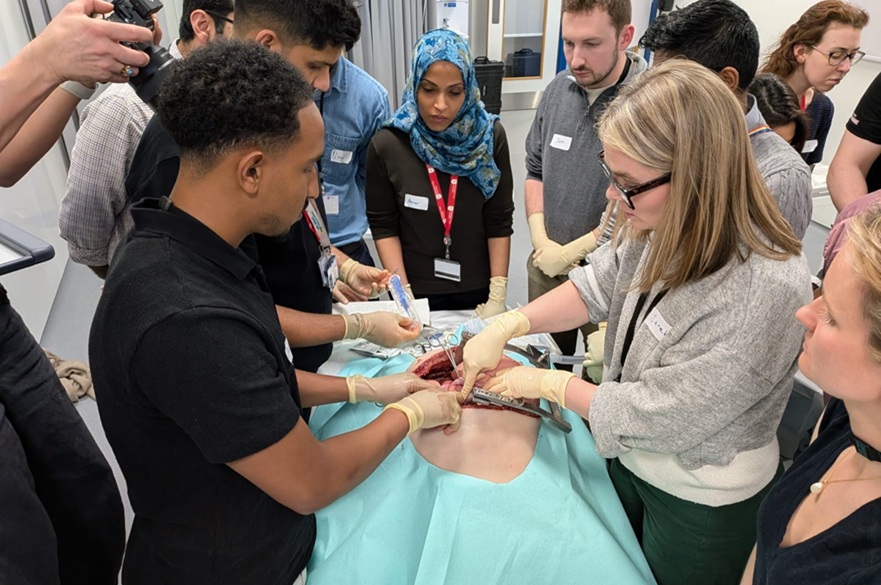
Led by Dr Richard Arm, of the Anatomical Replication and Manufacturing Department at NTU, realistic model torsos have been created for trainee surgeons at the Health Education East Midlands to practise locating and stopping catastrophic bleeds from the chest, to save people’s lives.
The aim is to simulate the experience of locating the injury swiftly and controlling the bleed, then suturing it before the patient runs out of blood.
The procedure involves opening the chest with surgical spreaders before making an incision through the pericardium, a thin but tough bag that surrounds the heart, before repairing the injured organ.
The highly realistic models – which are based on scan data from real patients – feature a pulsating flow of synthetic blood made from water-based glycerine fluid which is pumped through the artificial body, simulating arterial bleeding until the injury is repaired.
As the chest cavity fills with the synthetic blood, the trauma team practice locating the injury against the clock.
A video report on NTU's fake torsos which support surgeons training for emergency heart operations
Made from a unique combination of silicone rubber, gels and fibres, and featuring the tactile qualities of human hearts with varied tissue hardnesses, real surgical instruments can be used to suture the organs.
The units can then be resealed following a mock operation to allow for multiple uses, with new injuries added so different parts of the heart can be operated on.
The project is co‑led by Mr Adam Brooks OBE, Director of East Midlands Major Trauma Centre and Honorary Professor at NTU and the Medical Technologies Innovation Facility (MTIF) at NTU which delivered the first tranche of training with 16 trainee surgeons.
Research lead Dr Arm, of NTU’s Nottingham School of Art & Design, said: “The aim is to give trainee surgeons the opportunity to learn the technical aspects of emergency heart surgery in a safe environment, and to experience the time-pressure and tactile aspects of this live-saving operation.
“This technology can the simulate bleeding from a traumatic injury to a vital organ, providing the actual experience and limited visibility that surgeons must face on the operating table.”
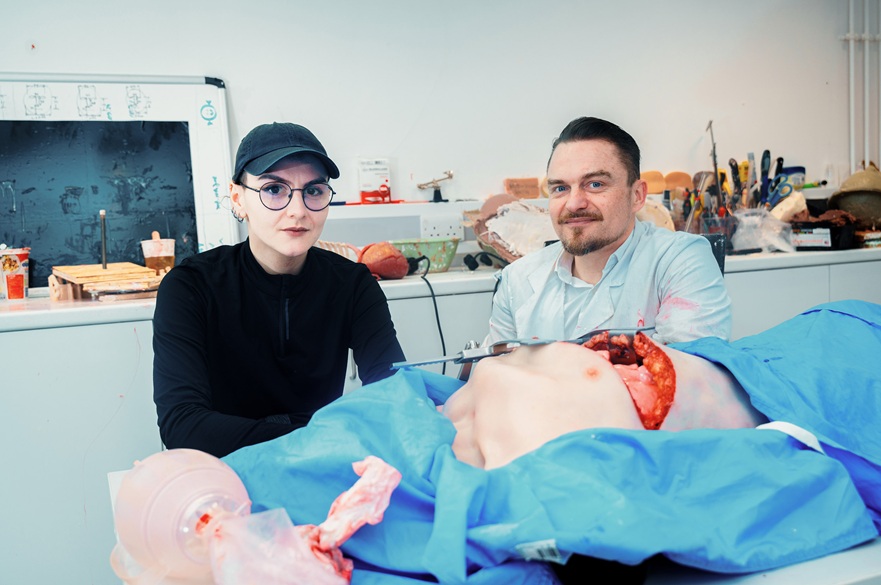
Dr Richard Arm (right) and Andreea Pislaru
To maximise access to the technology, the model is designed to be affordable, reusable and easily transportable to allow for increased training opportunities to allow as many surgeons as possible to gain experience in this simulated, safe environment.
Research Assistant Andreea Pislaru, of the Anatomical Replication and Manufacturing Department at NTU, said: “This technology will help maximise the chances of surgeons being able to save people’s lives by allowing them the space they need to practice this emergency operation and make them well prepared for real-life situations.”
The models were developed with support from consultant surgeons Mr Brooks, and Mr John-Joe Reilly, Consultant in Major Trauma and Emergency Surgery and Head of Emergency Surgery at Nottingham University Hospitals NHS Trust (NUH).
MTIF and NTU are working closely with the East Midlands Major Trauma Centre at NUH, and surgical and robotics manufacturers, to establish the MTIF Integrated Theatre Suite as a national surgical training and simulation centre of excellence.
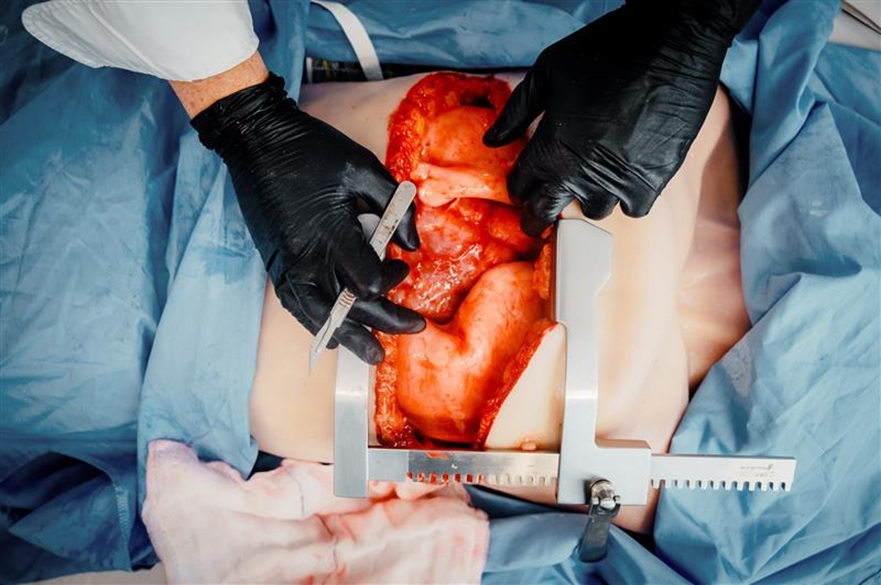
An image of open heart surgery on a fake torso
Mr Brooks said: “The new models that we have developed bring together expertise of the Major Trauma Centre, MTIF and ARM to deliver lifelike training for surgical trainees. This combined initiative will save lives.”
General surgical registrar Amanda Koh, who practiced surgery on the models, said: “The trauma course was excellent - well-structured, engaging, and highly educational. The faculty delivered high-quality teaching, focusing on real major trauma scenarios. The highlight was the realistic, high-fidelity 3D-printed thoracic and abdominal specimens used for simulation training.”
Notes for Editors
Press enquiries please contact Chris Birkle, Public Relations Manager, on telephone +44 (0)115 848 2310, or via email.
About Nottingham Trent University
Nottingham Trent University (NTU) has been named UK ‘University of the Year’ five times in six years, (Times Higher Education Awards 2017, The Guardian University Awards 2019, The Times and Sunday Times 2018 and 2023, Whatuni Student Choice Awards 2023) and is consistently one of the top performing modern universities in the UK.
Students have voted us the best university in the UK and 1st in the UK for student employability (Uni Compare 2025).
NTU is 4th in the UK for number of undergraduate students (HESA 2023-24) with over 36,000 students and more than 4,000 staff located across six campuses. It has an international student population of 6,000 and an NTU community representing over 160 countries.
NTU owns two Queen’s Anniversary Prizes for outstanding achievements in research (2015, 2021). The first recognises NTU’s research on the safety and security of global citizens. The second was awarded for research in science, engineering, arts and humanities to investigate and restore cultural objects, buildings and heritage. The Research Excellence Framework (2021) classed 83% of NTU’s research activity as either world-leading or internationally excellent.
NTU was awarded GOLD in the national 2023 Teaching Excellence Framework (TEF) assessment.
NTU is a top 10 for sport (British Universities and Colleges Sport league table 2025) and was named as Sports University of the Year (Daily Mail University Guide 2025). It has also been ranked as 25th in the UK by the Guardian University Guide 2026.
NTU is a holder of the University Mental Health Charter recognising the commitment an institution has shown towards continuous improvement in the area of mental health and wellbeing.
NTU is the most environmentally sustainable university in the UK and second in the world (UI Green Metric University World Rankings, 2024).