Vibrating pillows to warn deaf people of fire and burglar alarms at night
By Chris Birkle | Published on 21 April 2026
Categories: Press office; Research; School of Art & Design;
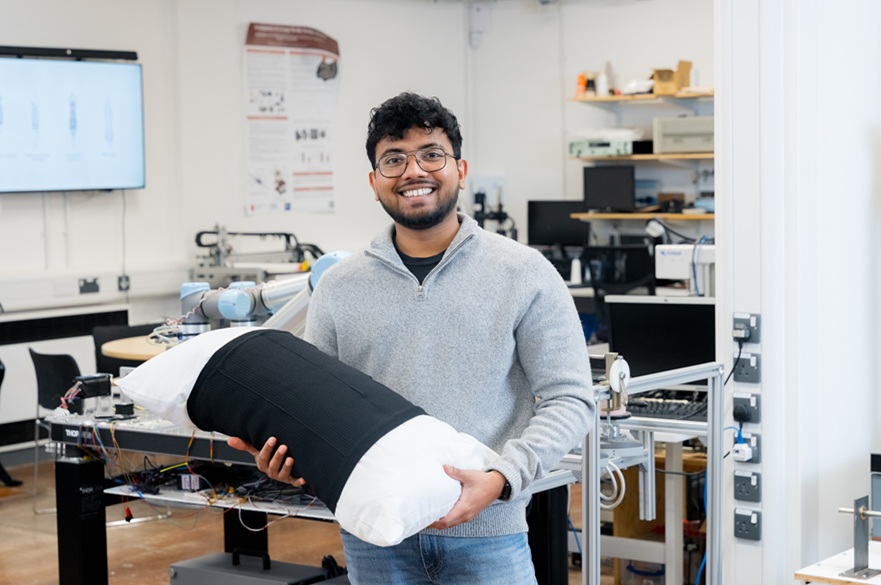
A smart pillow sleeve which vibrates to alert people who are deaf to fire and burglar alarms in the night has been created by scientists at Nottingham Trent University (NTU).
Developed with members of the Deaf community, the smart textiles technology replaces bulky gadgets that are kept under pillows which users say are uncomfortable.
The design is centred on a thin, flexible, electronic textile sleeve which features four tiny haptic actuators - measuring 3.4 mm by 12.7 mm - that are encapsulated and embedded within a yarn-like structure.
The sleeve is slipped over a standard size pillow and placed inside a normal pillow case, with the sensors at the bottom when positioned on the bed.
The electronics are connected to a smartphone, via a microcontroller, which could be wirelessly connected to household alarms and use different vibration pulses to indicate between fire alarms, burglar alarms and phone calls.
A video report on the smart pillow sleeve
“This project was born out of feedback from user groups we worked with in the Deaf community who told us that they can’t sleep well with bulky items under their pillows,” said PhD researcher Malindu Ehelagasthenna, who developed the sleeve as part of his doctoral studies at the Nottingham School of Art & Design.
“The electronics we have embedded in the yarns of the sleeve are so tiny that they cannot be felt by the users, but when an alarm sounds they can be made to vibrate intensely in order to wake even the most heavy sleepers.”
The yarn used in the sleeve has passed rigorous durability tests including multiple washing cycles to ensure real-world resilience.
The research team are now working to develop the prototype further and seek an industrial partner who would be interested in taking the product to market.
The study was presented at the Association for Computing Machinery CHI conference on Human Factors in Computing Systems at the Centre de Convencions Internacional de Barcelona. The work was co-authored by Malindu Ehelagasthenna, Lars Erik Holmquist, Carlos Oliveira, Arash M. Shahidi, Pasindu Lugoda and Theo Hughes-Riley.
Dr Theo Hughes-Riley, an associate professor in NTU’s Advanced Textiles Research Group (ATRG) who supervised the research, said: “This smart design represents a significant step toward inclusive emergency alert systems, allowing deaf and deafblind individuals to sleep more safely — and with greater peace of mind and comfort.
“It has been an entirely user-led development, stemming from feedback from the Deaf community, who told us exactly what kind of real world challenges they face which might be solved with electronic textiles.”
Notes for Editors
Press enquiries please contact Chris Birkle, Public Relations Manager, on telephone +44 (0)115 848 2310, or via email.
About Nottingham Trent University
Nottingham Trent University (NTU) has been named UK ‘University of the Year’ five times in six years, (Times Higher Education Awards 2017, The Guardian University Awards 2019, The Times and Sunday Times 2018 and 2023, Whatuni Student Choice Awards 2023) and is consistently one of the top performing modern universities in the UK.
Students have voted us the best university in the UK and 1st in the UK for student employability (Uni Compare 2025).
NTU is 4th in the UK for number of undergraduate students (HESA 2023-24) with over 36,000 students and more than 4,000 staff located across six campuses. It has an international student population of 6,000 and an NTU community representing over 160 countries.
NTU owns two Queen’s Anniversary Prizes for outstanding achievements in research (2015, 2021). The first recognises NTU’s research on the safety and security of global citizens. The second was awarded for research in science, engineering, arts and humanities to investigate and restore cultural objects, buildings and heritage. The Research Excellence Framework (2021) classed 83% of NTU’s research activity as either world-leading or internationally excellent.
NTU was awarded GOLD in the national 2023 Teaching Excellence Framework (TEF) assessment.
NTU is a top 10 for sport (British Universities and Colleges Sport league table 2025) and was named as Sports University of the Year (Daily Mail University Guide 2025). It has also been ranked as 25th in the UK by the Guardian University Guide 2026.
NTU is a holder of the University Mental Health Charter recognising the commitment an institution has shown towards continuous improvement in the area of mental health and wellbeing.
NTU is the most environmentally sustainable university in the UK and second in the world (UI Green Metric University World Rankings, 2024).