Mirror ball art raises awareness of how disabled people can feel on public transport
A fine art student has created an exhibition to communicate how disabled people can feel ‘like a mirror ball’ when using powerchairs on public transport.
By Chris Birkle | Published on 19 May 2026
Categories: Press office; School of Art & Design;
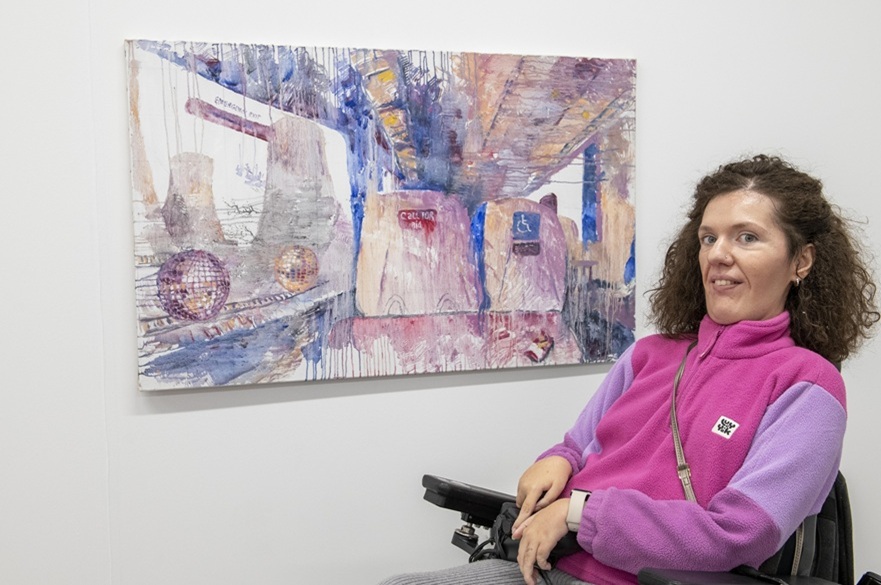
A fine art student has created an exhibition to communicate how disabled people can feel ‘like a mirror ball’ when using powerchairs on public transport.
Hanna Litvinova, 31, an artist who has spinal muscular atrophy, a genetic disease that impacts muscle strength throughout the body, is exhibiting a series of oil paintings as part of the 2026 Nottingham Trent University (NTU) art and design Graduate Festival.
Her works explore visibility, separation, and public space through disability as a cultural experience by featuring a mirror ball as a metaphor of how it can feel to use powerchairs on buses and trains.
“I’m obsessed with public transport because it gives me the opportunity to be more independent,” said Hanna, a powerchair user who was already an established artist in her native Ukraine before attending the Nottingham School of Art & Design.
A video interview with Hanna Litvinova
“At the same time it’s a very intimate moment, because you can’t avoid looking at other people. In a powerchair you’re positioned directly facing everyone, and you become very visible.”
Hanna – who works under the name Anna Li in her artistic practice – also uses her art to highlight the emotional impact of being physically separated from loved ones when on public transport, as her husband Maksim is also a powerchair user.
“We’re forced to take separate buses or sit in different carriages as there’s normally only room for one powerchair,” said Hanna, whose condition prevents her from walking or using her arms fully.
“Every time we travel we have this separated experience, whereas other people share that moment with their family. It’s always a little sad.”
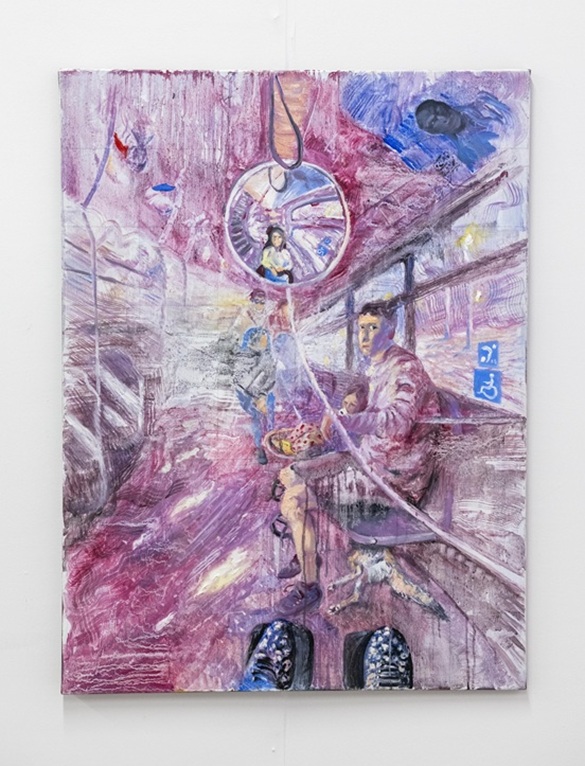
A close-up of one of Hanna's artworks
Hanna uses adaptive methods to create her artwork. She works while sat upright from her bed in Rise Park, Nottingham, and uses wide, flat fan brushes that are lightweight and easier to hold, often taping two brushes together to reach further across large canvases that can measure up to a metre in length.
The recurring image of a mirror ball sits at the centre of her paintings. Suspended, reflective and attention-grabbing, it represents how she experiences public attention as a disabled person.
“It’s dramatic and beautiful, but also very lonely,” she said. “It reflects light everywhere, but it doesn’t interact. It observes from a distance. That feels very close to the experience of being disabled – you attract a lot of attention in public, but there are boundaries. You can’t reach people easily or fully participate.”
Hanna uses oil paint diluted to a watercolour-like consistency, allowing the paint to flow more freely. “When the paint is very wet, it’s physically easier,” she said. “I can’t control most of the process, but that’s not about losing control. It’s about giving control to the materials.”
The resulting works are blurred and uncertain, with strokes flowing in different directions as she rotates the canvas to reach all areas. “There’s a huge freedom in that,” she said.
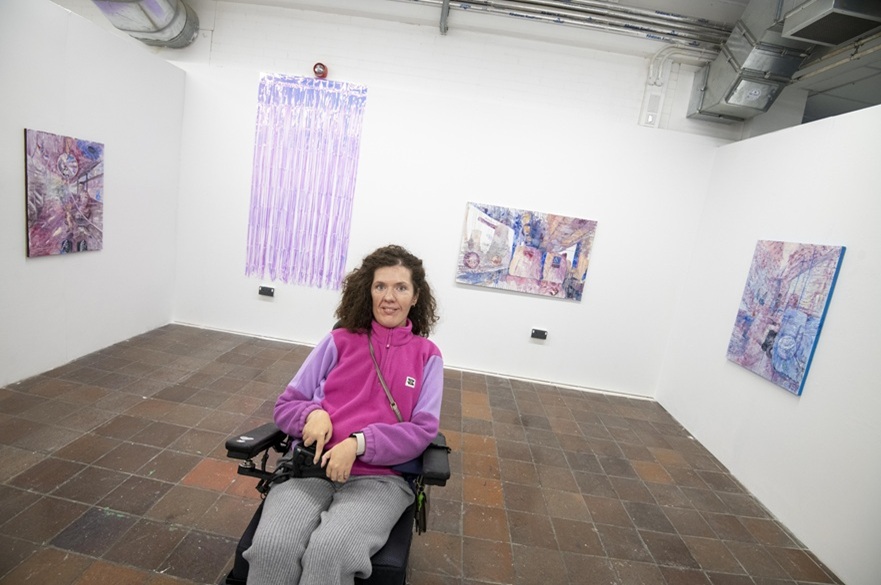
Hanna at her exhibition in the Bonington building
Hanna has been painting since the age of 10 and cannot remember a time when art wasn’t part of her life. Having previously studied art in Ukraine, she now develops her practice at Nottingham Trent University, where she engages more deeply with contemporary critical and conceptual approaches, particularly around the politics of representation. Influenced by abstract artist Amy Sillman, particularly her notion of ‘awkwardness’, Hanna’s work explores instability, fragmentation, and embodied experience.
“Art is a way to escape, but also a way to explain,” she said. “Most people don’t have a disability. I can’t always explain how my body feels in words, but I can show it through art – not to make people feel pity, but to make them interested.”
Hanna’s work is on public display as part of the ‘Common Ground’ exhibition at NTU’s Bonington building, City Campus, until 22 May.
Fine Art principal lecturer Dr Emily Strange said: “Hanna’s work is conceptually strong and emotionally resonant. Her use of a mirror ball communicates a powerful message to other people who would otherwise be unaware of how disabled people can feel when using public transport.”
Notes for Editors
Press enquiries please contact Chris Birkle, Public Relations Manager, on telephone +44 (0)115 848 2310, or via email.
Nottingham Trent University (NTU) has been named UK ‘University of the Year’ five times in six years, (Times Higher Education Awards 2017, The Guardian University Awards 2019, The Times and Sunday Times 2018 and 2023, Whatuni Student Choice Awards 2023) and is consistently one of the top performing modern universities in the UK.
Students have voted us the best university in the UK and 1st in the UK for student employability (Uni Compare 2025).
NTU is 4th in the UK for number of undergraduate students (HESA 2023-24) with over 36,000 students and more than 4,000 staff located across six campuses. It has an international student population of 6,000 and an NTU community representing over 160 countries.
NTU owns two Queen’s Anniversary Prizes for outstanding achievements in research (2015, 2021). The first recognises NTU’s research on the safety and security of global citizens. The second was awarded for research in science, engineering, arts and humanities to investigate and restore cultural objects, buildings and heritage. The Research Excellence Framework (2021) classed 83% of NTU’s research activity as either world-leading or internationally excellent.
NTU was awarded GOLD in the national 2023 Teaching Excellence Framework (TEF) assessment.
NTU is a top 10 for sport (British Universities and Colleges Sport league table 2025) and was named as Sports University of the Year (Daily Mail University Guide 2025). It has also been ranked as 25th in the UK by the Guardian University Guide 2026.
NTU is a holder of the University Mental Health Charter recognising the commitment an institution has shown towards continuous improvement in the area of mental health and wellbeing.
NTU is the most environmentally sustainable university in the UK and second in the world (UI Green Metric University World Rankings, 2024).