Smart drinks coaster to tackle ‘hidden epidemic’ of dehydration in hospitals
By Chris Birkle | Published on 1 June 2026
Categories: Press office; Research; School of Architecture, Design and the Built Environment;

Smart drinks coaster to tackle ‘hidden epidemic’ of dehydration in hospitals
A drinks coaster that monitors the weight of a patient’s cup to remind them to stay hydrated in hospital could help save the NHS up to £1 billion a year, according to an undergraduate designer.
An interview with Cameron Sandy
Product Design student Cameron Sandy created a prototype ‘smart coaster’ to tackle what has been called a ‘hidden epidemic’ of dehydration among hospital patients, particularly among the elderly and those with dementia.
The 22-year-old, who is studying at Nottingham Trent University (NTU), was inspired to create his working prototype by his mother who works as a nurse.
Her experiences made Cameron aware of the ongoing challenge of ensuring vulnerable patients drink enough fluids as part of their recovery.
Cameron says he also witnessed his grandfather develop dementia and struggle to keep himself hydrated properly, leading to health complications.
“My mum would come home exhausted, but she always wanted to do the best for her patients,” said Cameron, originally from Bahrain, who is now based in Sutton, south London.
“A lot of the time she was going around feeding people or giving them water, especially elderly patients who don’t always have family visiting.
“When people are in hospital, they’re out of their usual rhythm, they’re unwell, and something as simple as drinking water becomes harder.
“It was difficult to see my grandfather change as he developed dementia. Like others, he just didn’t drink and that was an issue I wanted to solve.”
Dehydration is a known contributing factor in a range of hospital complications, from infections to delayed recovery.
Cameron met with doctors, nurses and a former hospital chief executive officer who explained how the issue can be treated as a lower priority by hospital staff, despite its scale.
“One person described it as a ‘hidden epidemic’,” said Cameron, who is studying BSc Product Design at NTU. “Dehydration is usually recorded as a secondary condition, but it sits underneath so many other health issues.”
Dehydration can prolong hospital stays, reduce patient wellbeing and place additional strain on hospital staff.
According to reports, dehydration costs the NHS between £500 million and £1 billion a year.
Cameron’s smart hydration coaster is designed to sit under a patient’s cup and gently prompt them to drink.
A load cell sensor monitors the weight of the cup and if there’s no change in its weight within 60 minutes - indicating no drinking - an LED ring on the coaster lights up.
The aim is for it to prompt the patient to take a sip, but to avoid becoming an annoyance in any way to ensure the patient continues to use it.
The coaster is waterproof and designed without external ports or wires to minimise infection risks, and charges wirelessly via a docking station integrated into existing hospital infrastructure.
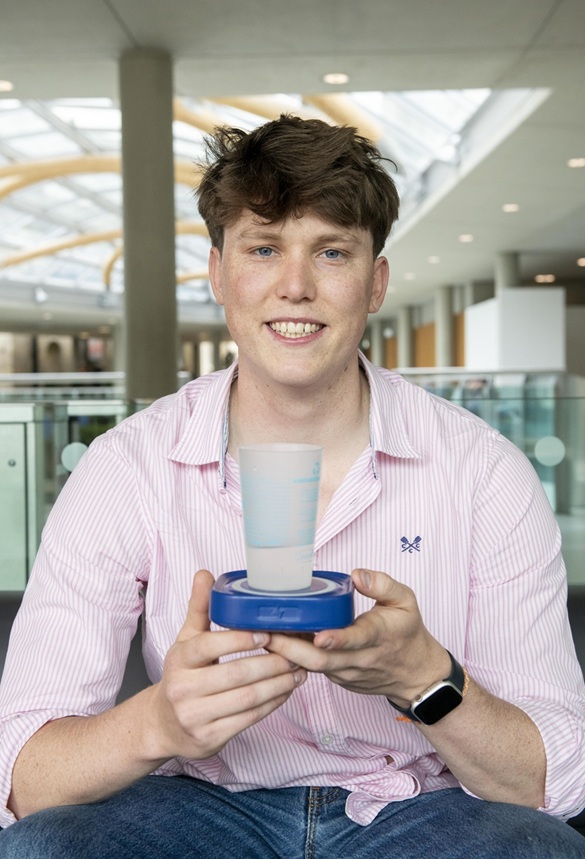
Cameron with his prototype
Coasters can be stacked directly onto water trolleys during transit, with charging docks located at nurses’ stations or in storage areas where the trolleys are kept between rounds.
The system operates during waking hours, typically between 7am and 10pm, to ensure patients are not disturbed overnight. A single charge can last up to two weeks, depending on use.
Additional visual indicators help staff manage the device: a red light signals faults, while a flashing LED indicates a low battery or if the cup has been removed and not replaced.
Designed using recycled polypropylene – which is sourced from materials such as bottle caps and food containers - the coaster is environmentally conscious and inexpensive.
The hydration coaster is designed to be affordable and scalable for hospital use, with an NHS unit cost of £34.99 and a retail price of £39.99.
“An overnight hospital bed is estimated to cost the NHS between £350 and £750 per patient,” said Cameron.
“If improved hydration helps reduce a patient’s stay by even a single day, the savings could cover the cost of up to 21 hydration coasters, demonstrating the potential for both improved patient care and significant financial benefits for the NHS.
“With around 140,000 NHS beds in England alone, even marginal improvements can have a huge impact. If patients are hydrated, they’re more likely to recover quicker and go home sooner — that’s where the real savings come in.
“But it’s not just about money. When people are hydrated, they’re happier, more alert, and more sociable. It improves their whole experience of care.”
Cameron’s prototype is on public display until 5 June for the 2026 art and design Student Showcase, which features the work of more than 1,300 graduating creative students.
Joseph Stewart, Senior Lecturer in Product Design at NTU, who oversaw the project, said: “Cameron has used the personal experiences of his mother and grandfather as inspiration to create a unique product that could improve the experience of hospital patients.
“He has identified a simple way to support people who are unnecessarily suffering the ill-effects of dehydration, which could also potentially save the NHS significant sums.
“If adopted widely, the smart hydration coaster could help address one of the NHS’s most persistent yet under-recognised challenges — ensuring that patients, quite simply, remember to stay hydrated.”
Notes for Editors
Press enquiries please contact Chris Birkle, Public Relations Manager, on telephone +44 (0)115 848 2310, or via email.
Nottingham Trent University (NTU) has been named UK ‘University of the Year’ five times in six years, (Times Higher Education Awards 2017, The Guardian University Awards 2019, The Times and Sunday Times 2018 and 2023, Whatuni Student Choice Awards 2023) and is consistently one of the top performing modern universities in the UK.
Students have voted us the best university in the UK and 1st in the UK for student employability (Uni Compare 2025).
NTU is 4th in the UK for number of undergraduate students (HESA 2023-24) with over 36,000 students and more than 4,000 staff located across six campuses. It has an international student population of 6,000 and an NTU community representing over 160 countries.
NTU owns two Queen’s Anniversary Prizes for outstanding achievements in research (2015, 2021). The first recognises NTU’s research on the safety and security of global citizens. The second was awarded for research in science, engineering, arts and humanities to investigate and restore cultural objects, buildings and heritage. The Research Excellence Framework (2021) classed 83% of NTU’s research activity as either world-leading or internationally excellent.
NTU was awarded GOLD in the national 2023 Teaching Excellence Framework (TEF) assessment.
NTU is a top 10 for sport (British Universities and Colleges Sport league table 2025) and was named as Sports University of the Year (Daily Mail University Guide 2025). It has also been ranked as 25th in the UK by the Guardian University Guide 2026.
NTU is a holder of the University Mental Health Charter recognising the commitment an institution has shown towards continuous improvement in the area of mental health and wellbeing.
NTU is the most environmentally sustainable university in the UK and second in the world (UI Green Metric University World Rankings, 2024).