What Count Binface tells us about political memes
The Clacton by-election has become about more than a satirical candidate. Dr Tine Munk examines how Count Binface's campaign demonstrates the power of memes to redirect political attention, challenge political narratives and encourage public participation.
By Dr Tine Munk | Published on 13 July 2026
Categories: Press office; Research; School of Social Sciences;
When a fictional candidate changes the story
Watching the Count Binface campaign unfold, I become less interested in the fictional candidate himself and increasingly interested in the communities creating and sharing his memes.
They are using defensive memetic warfare - the creating and sharing of humour, satire and participatory memes to redirect political attention and interrupt agenda setting, rather than to attack or insult opponents.
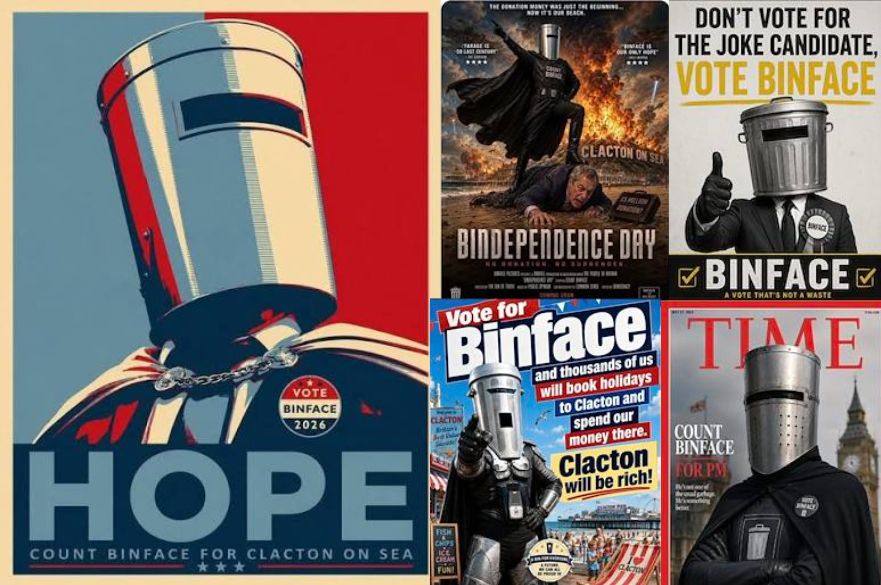
Every day brings another meme, another cultural reference and another remix. Batman appeared. The iconic Barack Obama HOPE poster returned.
Video game imagery became election campaign material. Count Binface dragged Nigel Farage into a rubbish bin, promised he could “take out the trash”, and within days became one of the most recognisable figures in the Clacton by-election, scheduled for 13 August 2026. Britain has a long tradition of satirical election candidates.
From Screaming Lord Sutch and the Official Monster Raving Loony Party to Lord Buckethead, fictional characters have used elections to expose the theatre of British politics. Count Binface initially appears to continue that tradition.
However, the Clacton by-election evolves into something quite different. The significance lies not in the prospect of electoral success, but in the campaign's ability to reshape the political conversation.
Thousands of people have transformed Count Binface into an alternative political narrative. Their engagement redirects attention from Farage’s political messaging to the people collectively shaping Count Binface’s campaign.
Rewriting the political spectacle
Since helping to found UKIP in 1993, Farage has become one of Britain's most recognisable political figures. His years as a Member of the European Parliament, leadership of UKIP, the Brexit Party and Reform UK, and election to Westminster have placed him firmly within the political establishment, despite continuing to present himself as its principal challenger.
Few politicians have mastered the politics of attention as successfully as Farage. Throughout his career, he has combined Euroscepticism, anti-establishment rhetoric and political spectacle to shape public debate and repeatedly return to the national stage.
The Clacton by-election follows a different script. Count Binface adopts many of the communication strategies that have sustained Farage's political career but turns them back on the politician himself. The attention surrounding the campaign exposes the tensions within Farage's anti-establishment identity. For perhaps the first time, that narrative is no longer his alone to control.
Over the past week, one of Britain's most experienced political communicators has found himself competing with a fictional character who refuses to play by the conventional rules of electoral politics.
National and international news organisations report on the fictional political character, while journalists focus on how his presence overshadows Reform UK's election strategy. Meanwhile, the constant social media presence extends the conversation well beyond the constituency itself.
The result is a remarkable reversal. Count Binface emerges as the outsider speaking for ordinary people, while Farage is increasingly portrayed as the establishment figure he has spent decades challenging.
Sustained through memes, symbolism and the attention they generate, the campaign increasingly dominates social media, news coverage and online conversations, redirecting the election towards a different political story.
The irony is striking. A politician who has spent more than three decades mastering political spectacle and shaping the national agenda now finds himself debating a bin.
The power of absurdity
The strength of Count Binface’s candidacy lies precisely in its absurdity. A fictional candidate wearing a silver bin on his head is never expected to become Prime Minister. Yet Count Binface quickly becomes one of the defining stories of the Clacton by-election.
Its absurdity disrupts the communication landscape surrounding the election and encourages people to pause and ask different questions; why does a fictional candidate become one of the key stories of the by-election? What does it say about British politics when a man wearing a silver bin attracts more attention than one of the country’s most experienced politicians? Why do the memes encourage people to stop and question the narratives unfolding around the election itself?
These questions reveal why electoral success is a poor measure of the by-election’s significance. The memes use humour, symbolism and familiar cultural references to expose political identities and invite audiences to question the narratives unfolding around the election.
From offensive memes to defensive memes
Political memes are often associated with information disorder, trolling and online hostility. Offensive memes frequently amplify conflict, reinforce political divisions and contribute to increasingly polarised forms of political communication.
Count Binface's candidacy points towards a different trajectory. The memes reshape the conversation surrounding the election. Humour, satire and familiar cultural references become tools for questioning political identities, exposing contradictions and encouraging public reflection.
Count Binface becomes more than a satirical candidate. The campaign uses humour, symbolism and theatrical gimmicks to transform political satire into a form of democratic communication.
The recurring HOPE meme illustrates this particularly well. Count Binface replaces Barack Obama in Shepard Fairey's iconic poster, retaining its visual associations with optimism, participation and democratic engagement while giving them an entirely different political context. The image demonstrates that memes can communicate optimism as effectively as criticism.
Defensive memes do not simply ridicule political opponents. They encourage citizens to question political narratives, participate in public debate and imagine alternative ways of engaging with politics. The campaign suggests that memes can challenge political communication while promoting a more participatory and constructive democratic culture.
More than a joke
The Clacton by-election reveals more than an unusual political contest. Count Binface uses humour to draw attention to broader questions about political accountability, public trust and the narratives surrounding the election.
Therefore, the campaign shifts attention away from political performance and towards the issues that might otherwise receive less scrutiny. Count Binface’s candidacy suggests that memetic communication is increasingly shaped by the stories citizens choose to create and share. In this context, Count Binface has already won the election.
Defensive memes have, so far, challenged established political narratives while inviting citizens to engage with politics in new ways.
Dr Tine Munk, Senior Lecturer in Criminology at NTU's School of Social Sciences and expert on cybercrime, digital warfare, and memetic warfare.