Study aims to strengthen water vole recovery across England
A new study is aiming to support the long-term recovery of endangered water voles in England.
By Dave Rogers | Published on 8 July 2026
Categories: Press office; Research; School of Animal, Rural and Environmental Sciences; School of Science and Technology;
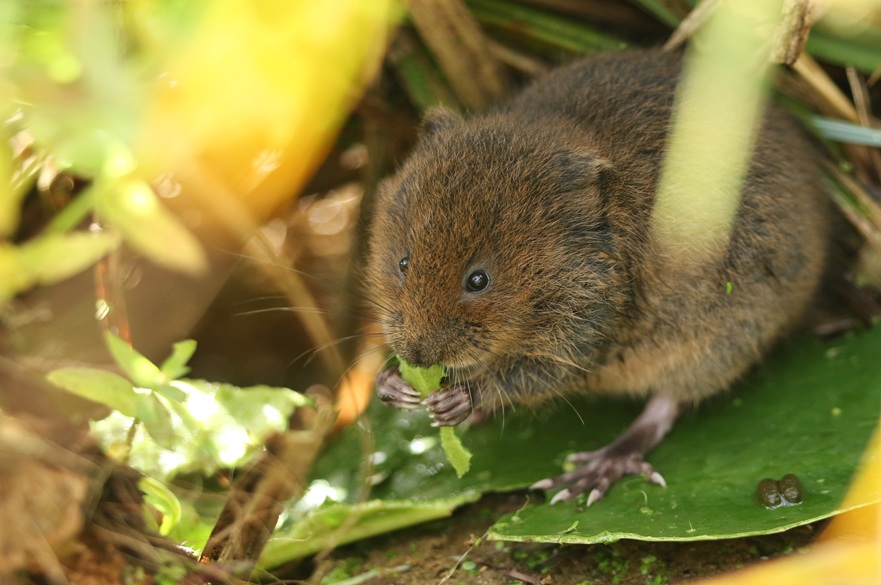
Water voles have seen one of the most rapid declines of any British wild mammal due to factors such as habitat loss and predation by invasive American mink.
As American mink are removed from rivers and wetlands, new opportunities are emerging to reintroduce water voles to parts of England where they have been lost.
The Nottingham Trent University and Natural England study will provide the genetic evidence needed to give water voles the best possible chance to thrive when they are reintroduced to the wild as part of future conservation efforts.
As part of the three-year study, the team will investigate how water vole genetics and future climate-driven changes to their habitats might influence population recovery.
The work is part of the ‘Wild Again: Restoring England’s Wildlife’ campaign, which has seen £60 million of government investment made available for projects as part of the Species Recovery Programme.
Breeding and reintroduction schemes are important for water vole recovery but there is a need to ensure their success in the wild isn’t hindered by genetic factors such as inbreeding.
Genetic diversity in water voles can be affected by habitat loss and changing water levels in rivers, which can isolate populations.
Using DNA analysis to study the genetic diversity and structure of existing populations – along with mapping techniques to understand how habitat suitability might change in the future – the researchers will identify populations which are thriving, as well as those where movement is restricted, leaving water voles more vulnerable to isolation.
This will help to reveal where conservation efforts could have the greatest impact and help to guide future water vole reintroductions.
Restoring native species and habitats can also help ecosystems cope with climate and environmental change, reducing the risk of ecosystem decline.
The project brings together experts in genetics, mammal and river ecology from NTU’s School of Animal, Rural and Environmental Sciences and School of Science and Technology, along with conservation practitioners from Natural England.
Researcher Dr Franziska Elsner-Gearing, an evolutionary biologist in Nottingham Trent University’s School of Animal, Rural and Environmental Sciences, said: “Genomic techniques can provide insight into how the few remnant populations of water voles used to be connected and how long they may have been isolated – giving us an idea of how at risk they may be of decline through inbreeding.
“As with any species, whether you are translocating water voles or rhinos, we want to ensure that surviving wild genetic diversity is not lost. Reconstructing past gene flow also lets us predict population connectivity under different climate change scenarios which are likely to affect Britain’s waterways. In doing so we can inform releases to bolster at risk populations and build a sustainable network of water vole populations to safeguard natural connectivity.”
Rachel Stubbington, Professor of River Ecology in Nottingham Trent University’s School of Science and Technology, said: “Rivers are dynamic systems, and understanding how changing water levels and connectivity influence the movement of animals is essential if we want conservation actions to succeed in the long term.
“This important work will help us predict where water vole populations are most vulnerable as river landscapes respond to environmental change.”
Dr Claire Howe, Principal Specialist, Species Recovery at Natural England, said: “Water vole recovery depends on more than simply releasing animals back into the wild. This research will provide the genetic evidence needed to coordinate reintroductions at a national scale, helping to create stronger, more connected and resilient populations for the future.
“I am excited to be working with Nottingham Trent University to address these important questions and to ensure future conservation translocations are guided by the best available evidence.”
Environment Secretary Emma Reynolds said: “Nearly one in six species in Britain are threatened with extinction and this Government is taking action to reverse that decline.
“Through the largest-ever investment in species recovery, we are backing projects across the country to protect threatened wildlife, restore habitats and secure the future of some of England's most iconic species.”
Notes for Editors
Press enquiries please contact Dave Rogers, Public Relations Manager, on telephone +44 (0)115 848 8782, or via email.
The Species Recovery Programme is funded by the government and delivered by Natural England. The programme funds species conservation projects including research into reasons for decline and methods of recovery, targeted habitat niche improvements, captive breeding and species reintroductions.
A full list of funded projects and species funded through Natural England’s Species Recovery Programme.
Nottingham Trent University (NTU) has been named UK ‘University of the Year’ five times in six years, (Times Higher Education Awards 2017, The Guardian University Awards 2019, The Times and Sunday Times 2018 and 2023, Whatuni Student Choice Awards 2023) and is consistently one of the top performing modern universities in the UK.
Students have voted us first in the UK for course quality, top five in the UK for employability and third best University in the UK (Uni Compare 2027). We are ranked in the top 25 universities in the country (The Guardian University Guide 2026).
We have over 35,000 students and more than 4,000 staff located across five campuses. It has an international student population of over 5,000 and an NTU community representing over 160 countries.
NTU owns two Queen’s Anniversary Prizes for outstanding achievements in research (2015, 2021). The Research Excellence Framework (2021) classed 83% of NTU’s research activity as either world-leading or internationally excellent.
NTU was awarded GOLD in the national 2023 Teaching Excellence Framework (TEF) assessment.
NTU is a top 10 for sport (British Universities and Colleges Sport league table 2025) and was named as Sports University of the Year (Daily Mail University Guide 2025).
NTU is a holder of the University Mental Health Charter, recognising the commitment an institution has shown towards continuous improvement in the area of mental health and wellbeing.
NTU is the most environmentally sustainable university in the UK and third in the world (UI Green Metric University World Rankings, 2025).