Our Strategic Partnership with National Trust
Nottingham Trent University (NTU) and the National Trust have formalised their long-standing relationship through a Strategic Partnership that supports the National Trust's People and Nature Thriving strategy.
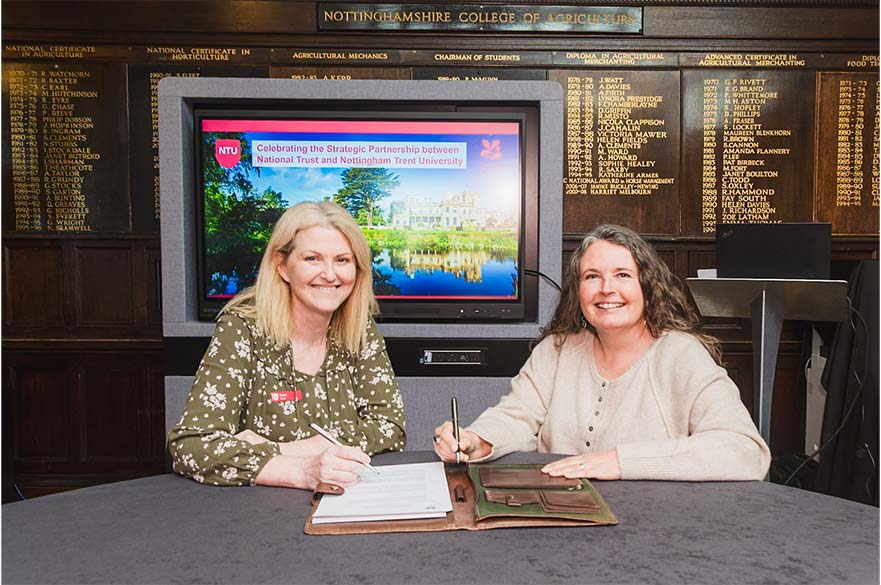
Nottingham Trent University and National Trust Celebrate their Strategic Partnership
Building on years of collaboration across research, education and community engagement, the partnership brings together NTU's academic expertise and civic mission with the National Trust's leadership in caring for nature, beauty and history.
Together, we share a commitment to restoring nature, ending unequal access to nature, beauty and history, and inspiring millions more people to care for and take action for the environment.
By combining expertise from both organisations, the partnership aims to:
- Support nature recovery and environmental sustainability
- Create opportunities for people to connect with nature and heritage
- Generate research that informs policy and practice
- Develop innovative solutions to social and environmental challenges
- Provide students with meaningful opportunities to apply their learning in real-world settings
This partnership is the National Trust's first Strategic Partnership with a university in the Midlands and East of England region.
Building on a strong foundation
NTU and the National Trust have worked together for many years across a wide range of disciplines and academic departments, involving students, researchers, and academic staff from across the university to create meaningful benefits for communities, heritage sites and the natural environment.
Examples of collaboration include:
- Peatland management
- Carbon footprinting and sustainability initiatives
- Visitor experience research
- Diversity, inclusion and community engagement
- Social prescribing and wellbeing
- Improving access to green and historic spaces
The Strategic Partnership provides a framework to strengthen and expand this work, creating new opportunities for research, student learning and real-world impact across the Midlands and East of England.
Supporting our students
Students helping shape the future of Hardwick Estate
One example of the partnership in action is NTU's collaboration with the National Trust on the Hardwick Whole Estate Plan.
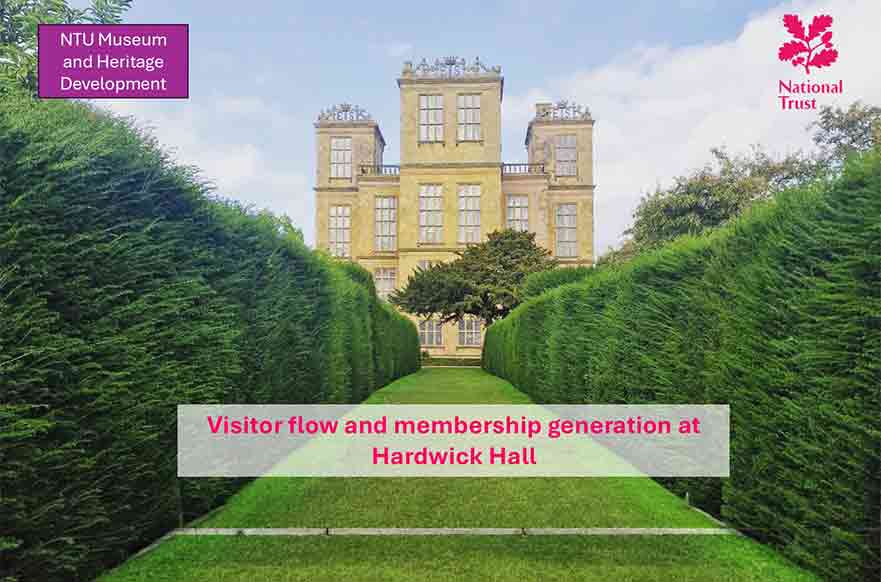
More than 130 students from disciplines including Psychology, English, Finance, Human Resources, History, Museum and Heritage Development and Sustainability, took part in this three-phase project, helping to identify priorities for the future development of the Hardwick Estate.
Working alongside National Trust colleagues, students explored how visitor experience, wayfinding and the use of key spaces across the estate could be enhanced in ways that are environmentally, socially and financially sustainable.
Through a combination of research, site visits, visitor surveys and observation, students developed evidence-based recommendations to support future decision-making at Hardwick Hall. Their work focused particularly on opportunities to improve visitor flow, unlock the potential of the Stable Yard and support membership growth.
As well as contributing to a live strategic project for one of the UK's leading heritage organisations, students gained valuable experience in research, project management, teamwork and stakeholder engagement, applying their learning to a real-world challenge with tangible impact.
The project was led by Emily Eastwood, Place and Proposition Development Manager at Hardwick Hall, National Trust, and Charlie Gregson, Senior Lecturer in Museum and Heritage Studies at NTU. Participants enjoyed the chance to work with National Trust and understand how such institutions initiate change.
Improving access to nature for everyone
Nature in Faiths
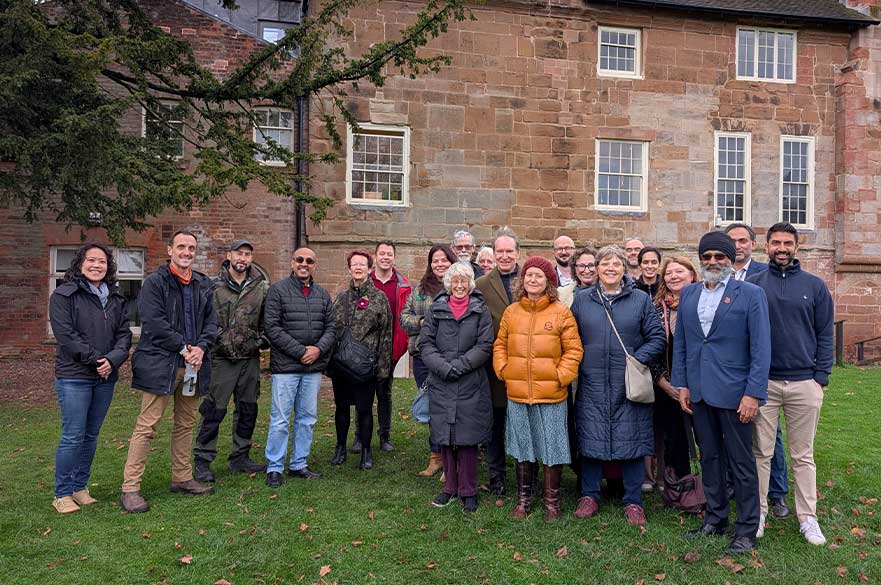
The Nature in Faiths project explores how faith communities can play a greater role in strengthening people's connection with nature and supporting environmental action.
Led by Anam Choudhury, Community and Participation Consultant at the National Trust, and Professor Duncan Guest at NTU, the collaboration brings together the National Trust's expertise in community engagement with NTU's research and evaluation capabilities.
The project is rooted in growing evidence that spirituality and faith can play an important role in shaping people's relationship with the natural world. A 61-country study published in Ambio found that higher levels of spirituality were strongly associated with stronger connections to nature. Britain ranked among the least nature-connected countries in the study, highlighting the need for new approaches to engaging people with the environment.
Faith groups, with their deep local roots, trusted leadership and long-standing traditions of stewardship, offer an important route to reaching communities that may not traditionally engage with conservation organisations. Through this partnership, NTU and the National Trust are co-designing community-led programmes that explore how faith communities can become active partners in nature recovery and environmental stewardship.
By combining practical community engagement with academic research and evaluation, the project aims to create approaches that can be adopted more widely, helping to ensure that nature and heritage are relevant, accessible and meaningful to diverse communities.
The collaboration also provides opportunities for NTU students and researchers to contribute to an emerging area of research and practice with the potential to influence how conservation organisations engage communities in the future.
Research and innovation supporting conservation
Protecting the Silver-studded Blue butterfly
NTU researchers and National Trust colleagues are working together to support the conservation of the Silver-studded Blue butterfly, a threatened species that has lost around 80% of its UK range over the last century and has not been recorded in Nottinghamshire since 1885.
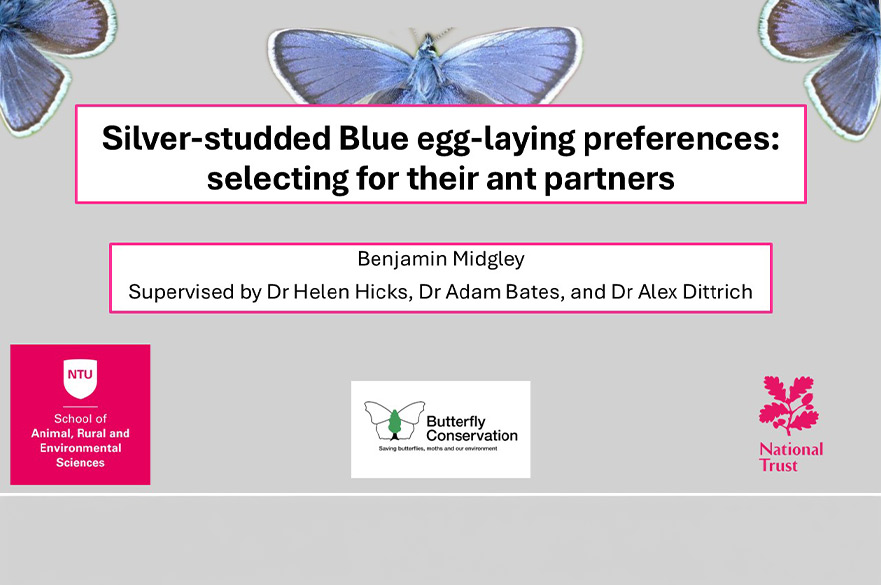
The project is being carried out by PhD researcher Ben Midgley, supervised by Dr Helen Hicks, Dr Adam Bates and Dr Alex Dittrich at NTU, in collaboration with Amy Trewick, Assistant Land Use and Nature Delivery Partner at the National Trust.
The research focuses on understanding the habitat conditions that are most important for the butterfly's survival and reproduction. In particular, the team is investigating the complex relationship between the butterfly, heathland habitats and the ant species that help protect its larvae from predators.
Fieldwork at Prees Heath in Shropshire and Clumber Park in Nottinghamshire has helped identify the habitat characteristics most strongly associated with successful egg-laying. Early findings suggest that the butterfly favours areas of early succession heathland with diverse flowering plants and established ant colonies.
The research is already helping to inform habitat management decisions at Clumber Park, including approaches to heathland restoration and maintenance. The findings will also support future conservation planning and potential species reintroduction efforts.
This project demonstrates how collaboration between researchers and conservation practitioners can generate new scientific knowledge while delivering practical benefits for biodiversity recovery and habitat management.
What our partners say
Dawn Scott, Executive Dean, School of Animal Rural & Environmental Sciences (ARES) at Nottingham Trent University, said:
We are delighted to celebrate this announcement with Nottingham Trent University. We have already achieved a much greater impact through working together, and this next chapter enables us to continue this partnership, supporting our ambitious new strategy for both people and nature to thrive.
Collaborating with students and academics alike enables the National Trust to better restore habitats for nature, take action to mitigate climate change, and improve access to nature and history for the benefit of everyone.
Emma Hawthorne, Assistant Director for the National Trust in the Midlands and East of England.
About National Trust
The National Trust is an independent conservation charity founded in 1895 to preserve historic and natural places in England, Wales and Northern Ireland and open them up for everyone to enjoy. More than 130 years later, that mission remains at the heart of everything the National Trust does.
Over the next decade, their cause will be delivered through their People & Nature Thriving strategy. The National Trust have three ambitious goals: to restore nature - not just on National Trust land, but everywhere; to end unequal access to nature, beauty and history; and to inspire millions more people to care and take action.
With 5.3 million members, 40,000 volunteers, and a wide network of supporters, partners and communities, the National Trust represents a cause that is bigger than any one organisation: caring for nature and heritage everywhere, for everyone, for ever.