
Scientists identify ‘sweet spot’ for blowing perfect soap bubbles
Curious scientists have identified the ‘sweet spot’ for blowing the biggest and best soap bubbles.
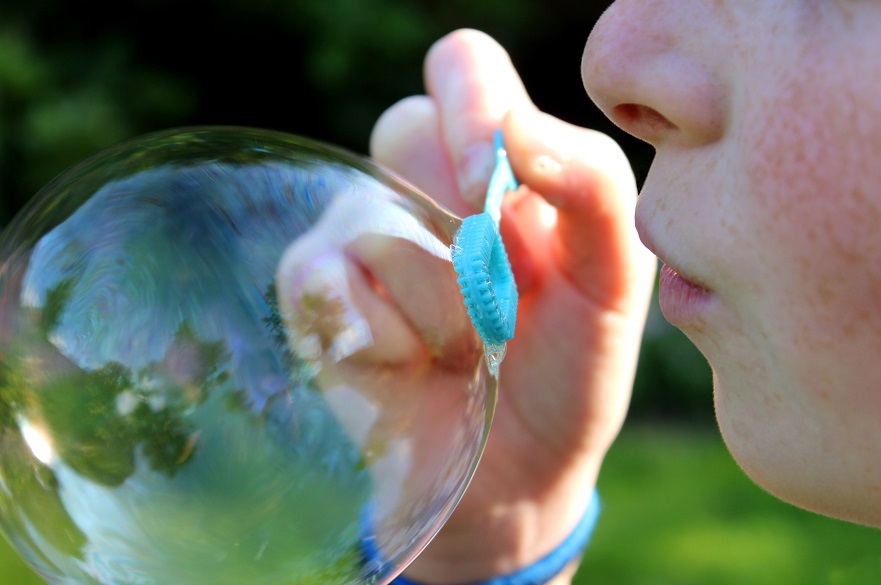
The Nottingham Trent University scientists wanted to investigate the party trick after one of the team noticed that their child didn’t get any bubbles when blowing either too slowly or too fast.
Working with a team of local school pupils, the scientists observed the biggest bubbles – as much as ten times the size of the wand – by blowing downwards and at the lowest air speeds.
As part of the fun study, they found that there is a perfect threshold velocity for getting the optimum bubble, an air speed of about 7.5 metres per second.
Blow just a little too gently and the soap film will only deform a little as there won’t be enough force to overcome the surface tension; blow too hard and a long sausage-shaped bubble will form, which then breaks into small bubbles.
The team warns against the temptation of blowing too fast as the bubble begins to inflate or shaking the wand to give it some extra encouragement – consistency and patience is key.
Get it just right and the weight of the expanded bubble along with the wind speed from the air is enough to make it detach at the optimum size, the researchers say.
Blowing downward is recommended as they say the gravity then pulls the liquid into the film to make it thicker and more robust.
“Street artists blow bubbles over a meter in length, but that’s usually because the size is determined by the size of the hoop or wand they use,” said Dr Dave Fairhurst, a physicist in Nottingham Trent University’s School of Science and Technology.
He said: “We recorded about 1,500 bubbles in total, finding that we were able to create bubbles up to ten times the size of the wand, much bigger by comparison, with our very biggest bubbles forming when we are only just into the sweet spot.
“In our study the biggest bubbles were actually blown by keeping the air speed constant. They quickly get smaller as you blow faster. At even higher speeds there is a transition between ‘dripping mode’, when the bubbles are slow inflated at lower velocities and detach from the wand when they are too big, and ‘jetting mode’, when a long sausage is formed which breaks up into little bubbles.
“We believe that even larger bubbles may even be possible by varying the air speed slightly and this is something we’d like to look at more in the future. A higher initial speed will overcome Laplace pressure needed to begin the bubble, then more gently to inflate the bubble without detaching, and finally increasing to detach.”
The team, which also included scientists from Paris-Saclay University in France and was supported by the Nuffield Foundation, reports its findings in the Royal Society of Chemistry journal Soft Matter.
Dr Anniina Salonen, Associate Professor at Université Paris Saclay, said: “This work gave a first taste of an international collaboration to the young students, as they shared the experimental data between French and English groups.”