How to make a success of Votes at 16
Votes at 16 might become a reality across the UK. But that alone won’t ensure an increase in the participation of young people in democratic politics. James Sloam, Matt Henn and Ana Nunes offer a diagnosis of why young people haven’t been voting as much as their elders, and put forward proposals for how to change that.
By James Sloam, Matt Henn and Ana Nunes | Published on 10 April 2026
Categories: Press office; Research; School of Social Sciences;
In February, the UK Government introduced its Representation of the People Bill, which includes the historic lowering of the voting age to 16 in general elections. The self-proclaimed goals of the policy, included in the Labour Party manifesto, is to grant rights to 16- and 17-year-olds to increase trust and participation in democratic institutions. Policy-makers and academics alike acknowledge that lowering the voting age can only be part of the answer to strengthening youth democratic engagement. Alongside Votes at 16, the Bill will introduce automatic voter registration. It also sits aside efforts to improve youth voice – embedded in the new National Youth Strategy – and the planned reinvigoration of citizenship education in the National Curriculum of England.
Our new book, Youthquakes and Aftershocks: Youth Political Participation in the UK, Europe and the United States, sets out the key challenges of increasing youth engagement and participation in politics. We argue for the need to focus attention on the issues that young people care about in their everyday lives, as well as on low-participation groups through things like citizenship education. Finally, we emphasize the need for political parties to improve on weak offerings to the young and poor communication strategies. Instead they need to engage young people across the electoral cycle rather than only at election time.
Why did so few young people turn out in 2024?
Youth turnout in UK general elections has been low in comparison to other established European democracies. Yet there is evidence to show that these same young people in the UK are just as interested in politics as their peers in high turnout countries such as Germany or Sweden. The democratic deficit amongst young people in UK stems from disaffection with the political system and the choices on offer, and the failure of public policy to deliver for successive youth cohorts since austerity politics in 2010: from university tuition fee rises to Brexit to huge cuts in youth services.
In our previous book, we focussed on the 2017 and 2019 electoral youthquakes. Labour under the leadership of veteran left-winger Jeremy Corbyn made a conscious effort to appeal to (and mobilise) young voters both through its policies and its styles of communication rooted in their everyday concerns. As a result, these elections saw relatively high youth turnout – up to well over 50 per cent – alongside mass youth support for the Labour Party, who garnered over 60 per cent of the vote amongst 18-24-year-olds.
Fast-forward to 2024, we found that young people were initially very supportive of the Labour Party and enthusiastic about voting. However, the campaign focus of the main parties on immigration and who would better manage the economy (without raising taxes) alienated a cohort of young people shaped by the Covid pandemic, the cost-of-living crisis, and concerns about mental health, housing, Gaza and climate change. The support of 18-24-year-olds for Labour plummeted from around 60 per cent to 40 per cent by election day, culminating in a boosting of the Green vote as well as abstention of many youth from the polls.
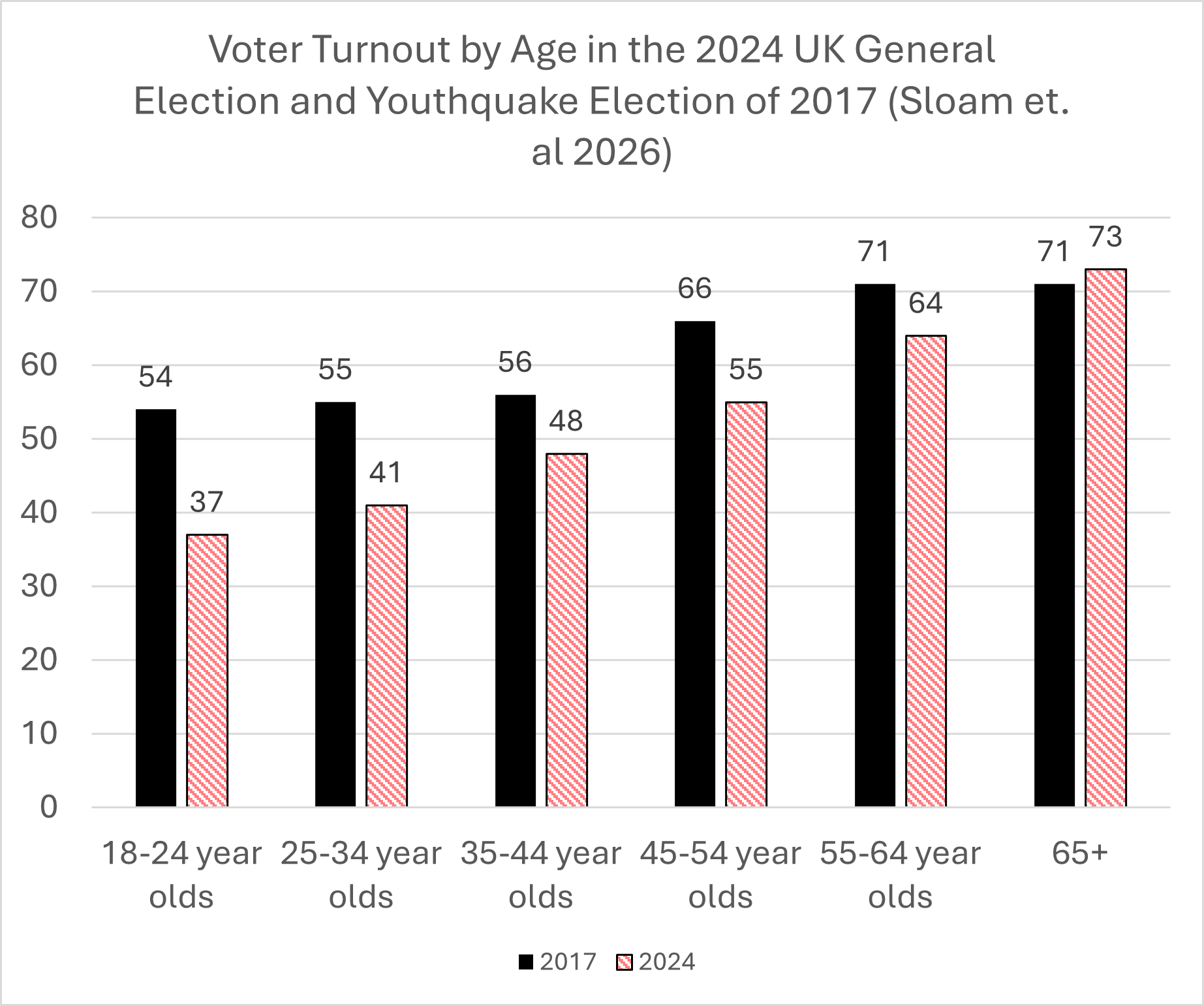
The Figure below shows the stark results in terms of youth turnout. The proportion of 18-24-year-olds voting in 2024 fell by more than a third (17 percentage points) from 2017, with a much smaller decline amongst older cohorts. We suggest that the parties’ focus on issues prioritised by older generations contributed to this generational divergence – in particular immigration. The progressive values of today’s young people – who we previously described as “left cosmopolitans“, prioritising social justice and public investment as well as social liberal causes – were given little prominence by the parties.
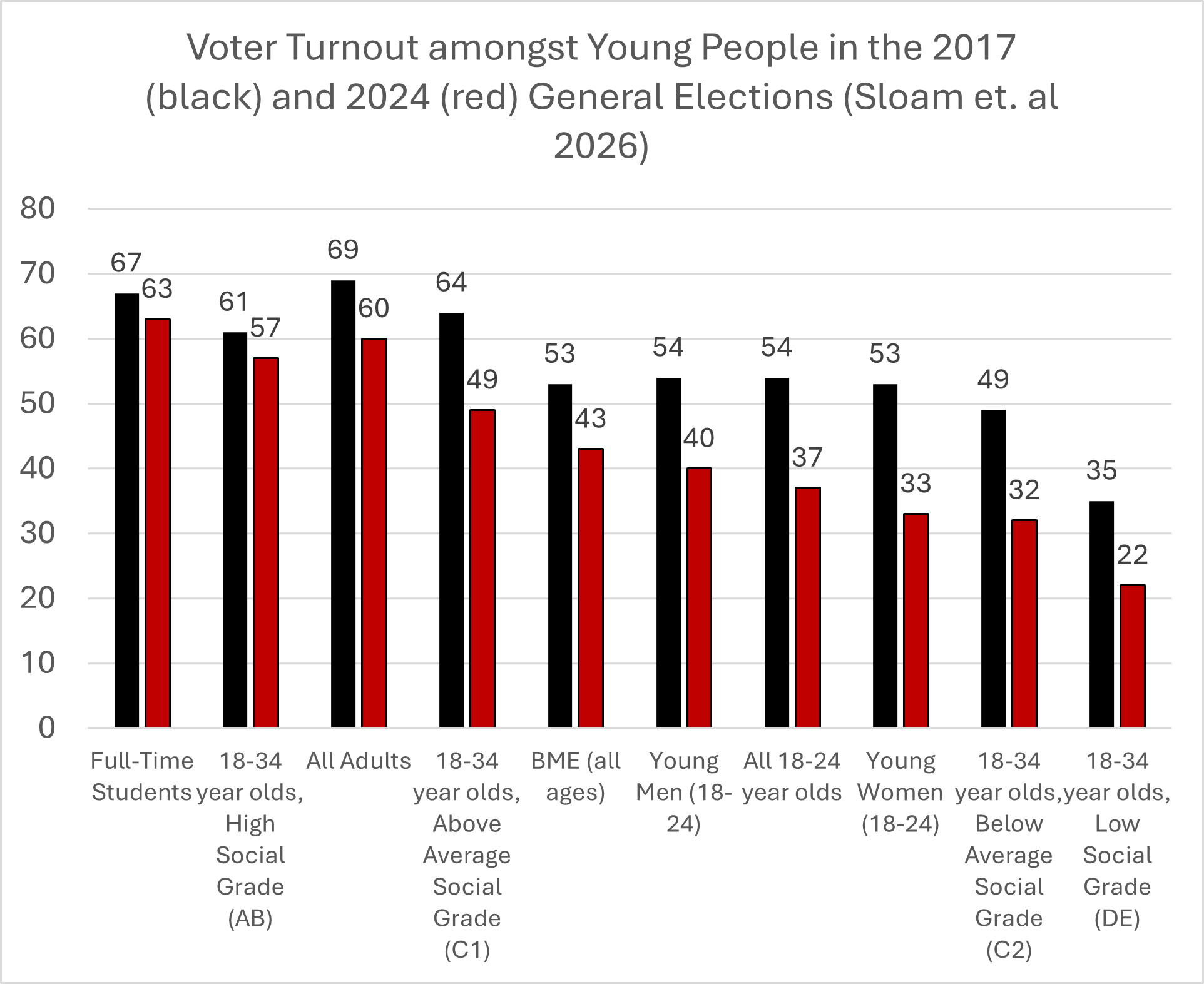
We also draw attention to intra-generational inequalities in youth participation. It is well known that those from higher socio-economic groups are more likely to vote. However, the inequalities of participation amongst young voters increased substantially in 2024. The Figure below shows that turnout amongst full-time students and young people (aged 18 to 34) from the highest (AB) social groups declined relatively modestly, whilst participation among less well-off (C2 and DE) young people plummeted. Clearly, if the Government wishes to improve youth participation in elections alongside Votes at 16, it needs to focus on these latter groups.
We attribute the failure of political parties to bring out the youth vote to two key factors. First, the lack of a youth offer. In our analysis of the various party manifestos, we found that youth‑relevant policies were sparse, fragmented, and rarely framed around young people’s lived experiences. The 2017 Labour manifesto had represented a major shift by offering a bold, youth‑centred, anti‑austerity agenda that helped spark the “Youthquake”, showing that youth participation rises when parties address young people’s priorities. In 2024, the Liberal Democrats and Greens put forward the strongest youth policy packages, with the Lib Dems proposing a Minister for Young People and renewed Erasmus+ access, while the Greens offered free transport for under‑18s, scrapped tuition fees, and supported votes at 16 – a commitment shared by both parties
Second, a failure in communication. Parties’ social media efforts to engage with youth were widely viewed as “cringe” by young people we spoke to: embarrassing and cynical efforts to get their votes at election time. Even young party members were put off by communication styles that were top‑down, negative, and disconnected from young people’s political identities.
The Green Party was a notable exception, appealing directly to young people through social justice, environmentalism, and its stance on Gaza, as well as by actively listening to and mobilising (rather than merely addressing) younger voters.
Making votes at 16 work
If Votes at 16 is to succeed, 16 and 17-year-olds need a reason to vote. The existing research suggests that this requires a focus on both internal and external efficacy: increasing a young person’s belief in their capacity – knowledge and democratic skills – to participate, and a belief that their participation will make a difference.
Regarding internal efficacy, it is critical for the Government to prioritize the teaching of citizenship in schools. Our research for the Association for Citizenship Teaching and for this book demonstrates that the GSCE in Citizenship Studies has a statistically significant impact in boosting young people’s political interest, confidence and participation, particularly among those from less advantaged backgrounds. The 2025 Curriculum and Assessment Review made citizenship teaching statutory in primary schools in England and promised a stronger model in secondary schools. It is essential that the expansion and consolidation of citizenship education comes hand-in-hand with an increase in teacher training – there are currently only 30 teachers specializing in citizenship across the country – and that schools are incentivised to teach the democratic politics elements of citizenship through robust inspection by Ofsted.
To strengthen external efficacy, political parties should co-produce with young people a clear youth offer on priority issues such as mental health, housing, and the environment with national and local relevance for young people’s everyday lives. Trust in the system must be built between elections – drawing on the ambition of the National Youth Strategy, there is need for a quantum leap forward in the quantity and quality of interactions between local policy-makers and young people in their communities.
Commentators were shocked recently by the Green Party polling at over 20 per cent in the general population and over 50 per cent amongst 18-24-year-olds after their success in the February 2026 Gorton and Denton by-election. The Greens under Zack Polanski have a clear youth strategy; other parties must now rise to the challenge – for their own benefit and to make a success of Votes at 16.
This article first appeared on the London School of Economics British Politics blog.
James Sloam is professor of politics at Royal Holloway University, where he was co-director of the Centre for European Politics from 2007 to 2017. He is a founding convenor of the UK Political Studies Association (PSA) specialist group on young people’s politics.
Dr Matt Henn is Emeritus Professor of Social Research at the Department of Social and Political Sciences (SPS) at Nottingham Trent University. In 2024 he was elected as a Fellow of the Academy of Social Sciences for his contributions to the field of young people and democracy.
Dr Ana Isabel Nunes is a Lecturer in Social and Political Sciences (SPS) at Nottingham Trent University, specialising in youth civic and political engagement, and art for social change.